Our Location
Free Trade Tower, Xiyong street.
Chongqing, China

Free Trade Tower, Xiyong street.
Chongqing, China
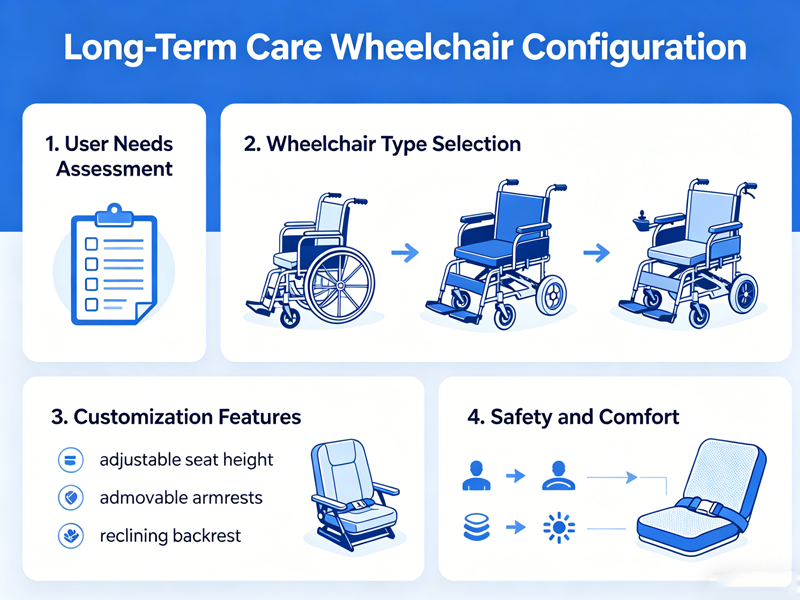
When people hear the word wheelchair, they often imagine a standard chair with wheels and footrests. In long-term care settings, however, wheelchair configuration is far more complex—and far more important. A properly configured wheelchair is not just mobility equipment. It becomes a daily living system that supports posture, protects skin health, improves comfort, reduces caregiver strain, and helps users remain active and engaged.
For residents in nursing homes, assisted living communities, rehabilitation centers, or home-based long-term care, spending several hours a day in a wheelchair is common. In many cases, it may be the primary seating system for years. That makes proper wheelchair configuration essential.
Yet many wheelchairs are still selected based on availability or basic dimensions alone. The result can be pressure injuries, pain, falls, poor posture, limited mobility, and avoidable medical complications.
Unlike temporary mobility use after surgery or injury, long-term care users often depend on a wheelchair every day for mobility, dining, social interaction, and transportation. Because of this prolonged use, even small fitting errors can create major problems over time.
A poorly configured wheelchair may lead to:
By contrast, a correctly configured wheelchair can significantly improve quality of life. Users often experience better sitting tolerance, easier movement, stronger participation in activities, and reduced fatigue.
Long-term care facilities that prioritize wheelchair seating also tend to see fewer preventable incidents and improved resident satisfaction.
Seat dimensions influence almost every aspect of comfort and posture.
Seat Width
A seat that is too narrow causes hip pressure and discomfort. A seat that is too wide reduces trunk stability and encourages leaning.
The ideal width usually allows a small amount of clearance on each side while maintaining support.
Seat Depth
Seat depth should support most of the thigh without pressing into the back of the knees. If too short, weight distribution decreases and sitting becomes unstable. If too long, circulation issues and sliding may occur.
Correct seat sizing improves posture, pressure distribution, and long-term tolerance.
In long-term care, cushions should never be treated as accessories. They are essential clinical components.
Different cushion materials serve different needs:
Foam Cushions
Best for low-risk users needing basic comfort and positioning support.
Gel Cushions
Useful for pressure distribution and comfort, especially for moderate-risk users.
Air Cushions
Often recommended for users at high risk of skin breakdown who need advanced pressure management.
Hybrid Cushions
Combine multiple materials for balanced support and stability.
The right cushion depends on skin integrity, sitting duration, posture control, and transfer ability. A high-end cushion is not always the best choice if the user cannot maintain balance on it safely.
Standard sling backs are common in basic wheelchairs, but they rarely provide ideal long-term posture support.
Long-term care users often benefit from upgraded back systems that improve trunk alignment and comfort.
Benefits of proper back support include:
Back height, contour, and firmness should match the user’s posture needs and mobility goals.
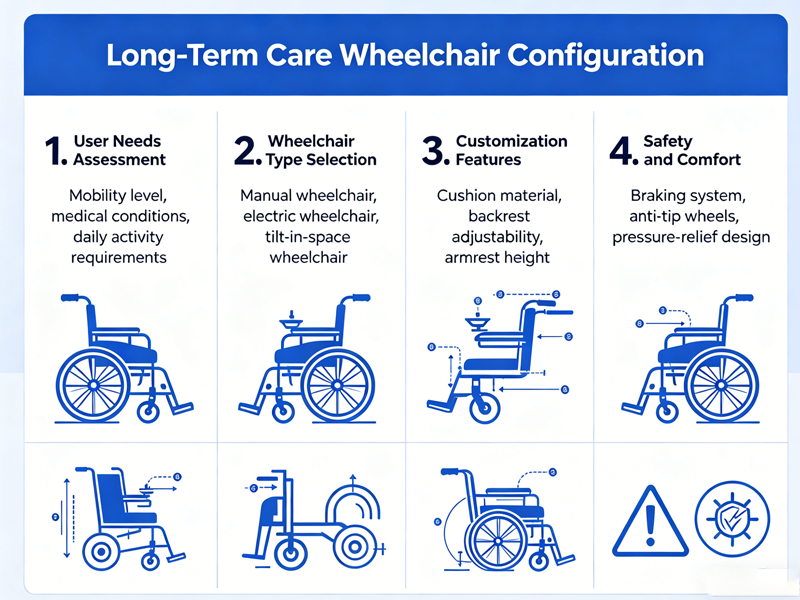
For users who cannot independently shift weight or maintain upright posture for long periods, tilt and recline functions can be transformative.
Tilt-in-Space
The entire seating system changes angle while maintaining hip and knee positioning. This is ideal for:
Recline
The backrest opens relative to the seat angle. This may assist with:
Not every long-term care resident needs these features, but for the right user, they can dramatically improve comfort and skin protection.
Lower extremity positioning is often overlooked, yet it strongly affects comfort and circulation.
Important considerations include:
When feet are unsupported or positioned incorrectly, pelvic posture often collapses. Good lower body alignment helps stabilize the entire body.
For users who self-propel, rear wheel placement is critical.
If wheels are too far back:
If wheels are too far forward:
For long-term users with enough arm strength, optimized wheel access can increase independence significantly.
Pressure injuries remain one of the most serious preventable issues in long-term care.
Wheelchair configuration should be part of every prevention strategy. Key elements include:
No cushion alone can solve pressure risk. Configuration must work alongside clinical care routines.
Not all wheelchair users can manage complex controls.
For individuals living with dementia or cognitive decline, simpler configurations may improve safety:
Sometimes less technology creates better outcomes than advanced systems the user cannot safely use.
A wheelchair that works for the resident but creates daily strain for caregivers may fail in practice.
Good long-term care wheelchair setup should support:
Facilities that involve nursing assistants and caregivers in seating feedback often make better long-term equipment decisions.
Even experienced care teams sometimes overlook key issues.
Using Standard Chairs for Complex Needs
One-size-fits-all equipment often causes avoidable discomfort.
Ignoring Postural Changes Over Time
Residents may lose strength, gain weight, develop contractures, or need new supports.
Delaying Cushion Replacement
Worn cushions lose protective value.
Incorrect Footrest Height
This can create pelvic tilt, pain, and leg swelling.
No Reassessment After Hospitalization
Health status often changes after acute illness.
Long-term care wheelchair needs are never static.
A wheelchair should be reviewed when:
Even without issues, annual seating reassessment is a smart standard.
Modern wheelchair systems are evolving rapidly.
Current innovations include:
As aging populations grow globally, demand for better long-term seating solutions will continue to rise.
The best outcomes usually come from collaboration between:
A professional assessment prevents costly mistakes and helps secure the most appropriate equipment.
Long-term care wheelchair configuration is not simply about selecting a chair. It is about designing daily support for mobility, dignity, safety, and health.
When a wheelchair fits correctly, the difference is immediate. Users sit longer without pain, move more confidently, engage more socially, and require fewer corrective interventions.
For care providers and families, the lesson is clear: never underestimate the power of proper seating.
A wheelchair may look like equipment—but for many people in long-term care, it is home base for daily life.
1. How often should a long-term care wheelchair be replaced?
There is no universal timeline. Many chairs last several years, but replacement depends on wear, medical changes, posture needs, and safety condition. Annual reassessment is recommended.
2. What is the best cushion for elderly wheelchair users?
There is no single best cushion. The right option depends on skin risk, balance, sitting time, comfort preference, and transfer ability. Professional fitting is ideal.
3. Is tilt-in-space necessary for all long-term care residents?
No. It is most beneficial for users who cannot independently shift weight, have poor trunk control, or need pressure relief and positioning support.