Our Location
Free Trade Tower, Xiyong street.
Chongqing, China

Free Trade Tower, Xiyong street.
Chongqing, China
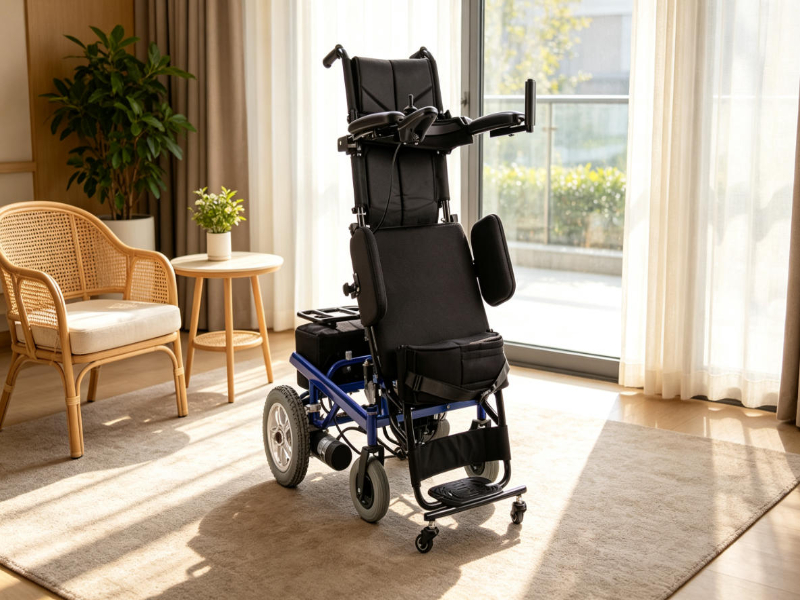
For someone who has spent years relying on a conventional wheelchair, the ability to change position independently can mean much more than simply gaining another seating option. Being able to move from sitting to standing can make it easier to communicate at eye level, reach a work surface, participate in household activities, interact with other people and change posture throughout the day. That is where a Foldable Standing Wheelchair with Adjustable Standing Function for Elderly and Disabled Users can offer a different approach to everyday mobility.
A modern standing wheelchair is no longer simply a wheelchair with an additional lifting mechanism. It is a mobility platform designed around changing positions, controlled movement, stability and practical independence. For elderly users and people with disabilities, these functions can make a meaningful difference in environments where remaining seated all day is not always convenient.
At the same time, choosing a standing wheelchair requires more thought than choosing a standard electric wheelchair. The frame, standing mechanism, control system, braking method, seating dimensions, battery configuration, weight capacity and intended environment all need to work together. A product that looks impressive in a catalogue may not necessarily be the right solution for every user.
A wheelchair is often thought of primarily as a means of transportation. For many users, however, mobility involves much more than getting from one room to another. The ability to change body position can affect how a person interacts with their surroundings, how they complete everyday tasks and how much assistance they require from family members or caregivers.
A standing function allows the wheelchair to transition the user from a seated position toward an upright position through a powered or mechanical system. Instead of asking the user to transfer to another chair, stand with assistance and then return to the wheelchair, the mobility device itself becomes part of the positioning process.
This can be particularly useful in everyday situations. Imagine being at a kitchen counter, speaking with someone who is standing, reaching for an item on a higher shelf or participating in a conversation around a table. Remaining seated can sometimes create practical limitations. A standing wheelchair is designed to reduce some of those limitations by giving the user another positioning option.
For elderly users, the value can also come from flexibility. A person may want to remain seated while travelling, elevate or recline when resting, and use the standing function when appropriate. Instead of relying on one fixed posture, a multi-position wheelchair can adapt to different moments throughout the day.
However, standing capability should not be viewed as an automatic substitute for independent standing ability. Users should be assessed according to their individual mobility, balance, posture, transfer and medical needs, and the standing mechanism should always be operated according to the manufacturer’s instructions and appropriate professional guidance.
The phrase Foldable Standing Wheelchair with Adjustable Standing Function for Elderly and Disabled Users combines several requirements that are important but not always easy to achieve together.
A wheelchair designed to stand must have sufficient structural stability because the centre of gravity changes as the seat and user’s body move upward. A folding wheelchair, meanwhile, must balance portability with structural strength. The control system needs to be simple enough for everyday operation while providing predictable movement.
This is why buyers should look beyond a single specification.
1. Standing mechanism
The standing mechanism is arguably the defining feature. A useful system should allow controlled movement rather than abrupt transitions. Depending on the model, users may be able to move between sitting, elevated, reclining and standing positions.
The objective is not simply to reach a standing height. The mechanism should support the user throughout the transition and work together with the seat, backrest, armrests, foot support and other positioning components.
2. Stability and braking
Once a wheelchair moves into a standing position, stability becomes particularly important. A reliable braking system can help keep the chair stationary when the user stops.
The YSE308 standing wheelchair, for example, combines its standing system with an electromagnetic brake. According to the manufacturer’s specifications, the model uses an intelligent electronic braking system and is designed to maintain stability on slopes of up to 12°.
For users considering a Foldable Standing Wheelchair with Adjustable Standing Function for Elderly and Disabled Users, braking should therefore be treated as a primary safety feature rather than a minor specification.
3. Control simplicity
Standing wheelchairs can contain more functions than conventional power wheelchairs. If the controls are complicated, the additional functionality may become frustrating rather than useful.
An intuitive remote control or joystick can make a significant difference. The YSE308 uses a multifunction remote control, with individual controls for sitting, elevating, reclining and standing. It also offers an optional toggle switch intended to make operation easier for users with limited wrist mobility.
The YSE303 takes a different approach, using a one-hand joystick controller for driving and motorized positioning. Its adjustable armrests can also be raised to make transfers easier.
4. Seat and backrest dimensions
A standing mechanism cannot compensate for poor seating geometry. Seat width, seat depth, backrest height and cushion design all influence comfort during daily use.
The YSE308, for example, has a 43 cm seat width and 46 cm seat depth, with a 54 cm backrest. Its seat height is adjustable from 56 to 69 cm.
The YSE303 has a 45 cm seat width and 43 cm seat depth.
These dimensions illustrate why buyers should compare actual measurements rather than relying only on descriptions such as “comfortable” or “ergonomic.”
Different users need different combinations of portability, standing capability, driving performance and positioning functions. Iyasocare offers several standing wheelchair designs, including models that focus on multi-position operation and motorized standing mobility.
YSE308 Standing Wheelchair with Electromagnetic Brake
The Iyasocare YSE308 Standing Wheelchair with Electromagnetic Brake is designed as a multi-position mobility chair for users who want more than a simple sit-to-stand function.
Its major advantage is the range of positioning options. The manufacturer describes four primary modes: sitting, elevating, reclining and standing. These functions are operated through a multifunction remote, allowing users to select different positions according to the situation.
The YSE308 uses a steel frame and an electromagnetic brake system. It is specified for a maximum user load of 120 kg, with 14-inch rear wheels and 8-inch front wheels. Dual 320W worm-gear motors provide propulsion, while the 24V 55Ah battery is specified for a driving range of up to 45 km. Maximum speed is listed at 6 km/h, with a gradeability of up to 12°.
The model is also designed around longer periods of use. Its seat measures 43 cm wide by 46 cm deep, and the adjustable seat height ranges from 56 to 69 cm. The standing height is listed as 190 cm, which can provide a more natural eye-level position when communicating with people who are standing.
Another practical feature is the inclusion of liftable armrests and knee pads. For users who need assistance with transfers or require additional lower-body support during positioning, these components can make the overall chair more functional.
For elderly users or disabled adults who want a Foldable Standing Wheelchair with Adjustable Standing Function for Elderly and Disabled Users with multiple positioning modes, the YSE308 is particularly interesting because its design combines standing, reclining and elevating functions rather than treating standing as an isolated feature.
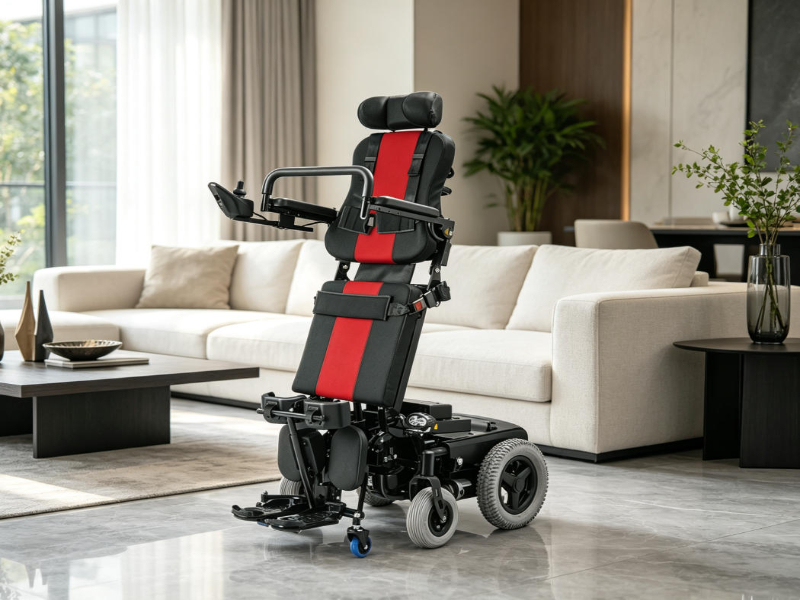
The Iyasocare YSE303 Electric Stand-Up Wheelchair takes a more compact approach to motorized standing mobility.
The manufacturer describes the YSE303 as a motorized standing wheelchair capable of transitioning between sitting, standing and walking functions. It features a 360-degree turning capability, which can be particularly useful in homes, corridors, offices and other spaces where conventional turning manoeuvres may be difficult.
Its driving system uses dual 200W motors and a 24V 40Ah lead-acid battery. The stated driving range is approximately 30–40 km, with a maximum speed of 8 km/h. The chair uses an electronic parking brake and a steel frame with a stated maximum load of 100 kg.
The YSE303 also offers adjustable armrests that can be raised for easier transfers. The seat width is 45 cm and the seat depth is 43 cm, while the standing height is listed as 190 cm. The compact product dimensions are given as 100 × 56 × 85 cm, which can be advantageous for users who need to consider storage and manoeuvrability.
For users who place a high priority on turning performance and relatively compact dimensions, the YSE303 can be a practical candidate. Its 360-degree turning capability may be especially useful in indoor environments where space is limited.
The important point is that the YSE303 and YSE308 are not simply interchangeable products. Their specifications and functional priorities are different, so the choice should be based on the user’s environment, physical requirements and desired operating range.
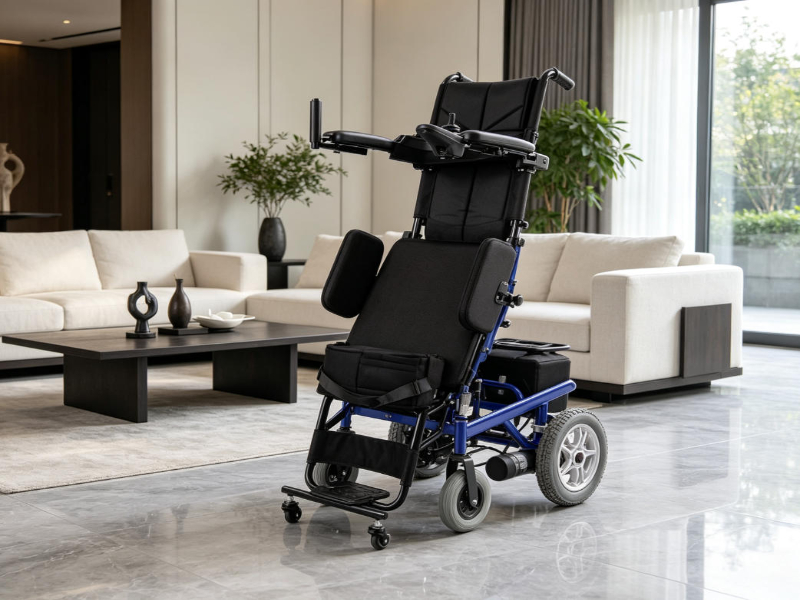
The word “foldable” is attractive because portability matters to many wheelchair users. A wheelchair that can be folded or stored more efficiently may make transportation, storage and home use easier.
However, standing wheelchairs require a more careful approach to foldability.
A traditional lightweight manual wheelchair may fold primarily around the frame. A powered standing wheelchair contains motors, batteries, positioning mechanisms, wiring, controls and structural components that may affect how the chair can be transported. Therefore, buyers should not assume that every standing wheelchair folds in the same way as a conventional travel wheelchair.
For a Foldable Standing Wheelchair with Adjustable Standing Function for Elderly and Disabled Users, ask several practical questions before purchase: What is the folded or packing size? How much does the chair weigh? Can the battery be removed? Can it fit into the intended vehicle? Does folding require one person or two? Is the standing mechanism designed to be locked safely during transportation?
These questions are often more useful than simply asking whether a product is “foldable.”
For dealers and distributors, packaging dimensions should also be considered because they influence warehouse storage, shipping costs and last-mile delivery. The YSE303, for example, lists a package size of 115 × 65 × 60 cm, while the YSE308 lists a packing size of 118 × 71 × 86 cm.
A standing wheelchair becomes most valuable when its functions match the user’s actual routine.
At home, standing capability may help users participate in cooking, household activities or conversations at different heights. The ability to recline or return to a seated position can also make it easier to change posture throughout the day.
In workplaces or public environments, standing can improve face-to-face interaction. Eye-level communication may feel more natural than remaining seated when speaking with colleagues, customers or family members who are standing.
Outdoor mobility introduces another set of considerations. Surface quality, slopes, battery capacity, wheel size and motor performance become more important. A chair that performs well on a flat indoor floor may not provide the same experience on uneven outdoor surfaces.
This is why the specifications of the Foldable Standing Wheelchair with Adjustable Standing Function for Elderly and Disabled Users should always be considered in context.
The YSE308, with its 14-inch rear wheels, dual 320W motors and stated 12-degree gradeability, is positioned for a combination of indoor and outdoor use. The YSE303, meanwhile, emphasises compact manoeuvrability and a 360-degree turning capability.
Neither specification alone determines whether a wheelchair is suitable for a particular user. Door widths, floor surfaces, ramps, local terrain and transportation arrangements all matter.
The best wheelchair is not necessarily the model with the longest range, largest motor or greatest number of functions. It is the model that solves the user’s actual mobility challenges without introducing unnecessary complexity.
For an elderly person who spends most of the day at home, manoeuvrability, ease of control, transfer accessibility and seating comfort may be more important than maximum outdoor range.
For someone who regularly travels outdoors, battery capacity, motor performance, wheel dimensions and gradeability may deserve greater attention.
For users who need frequent changes between sitting, reclining, elevating and standing, a multi-position model such as the YSE308 may offer a more comprehensive positioning solution.
For someone who prioritises compact manoeuvrability and a simpler motorized standing concept, the YSE303 may be worth considering.
Caregivers should also be involved in the decision. Even when a user can operate the wheelchair independently, caregivers may need to transport, charge, store or maintain it. A product that works well for the user but is difficult for the caregiver to handle may not be the most practical long-term choice.
The development of standing wheelchairs reflects a broader change in mobility equipment. Modern wheelchair design is increasingly focused not only on transportation but also on positioning, independence, accessibility and participation.
A conventional wheelchair keeps the user in one primary position. A standing wheelchair introduces movement between positions. This seemingly simple change can affect how users interact with furniture, people, workspaces and their environment.
The combination of electric motors, electronic braking, adjustable positioning and user-friendly controls makes these systems increasingly practical for everyday use.
At the same time, technology should never replace careful product selection. A standing wheelchair needs to fit the user’s body, environment and routine. The standing function should be used only when appropriate, and users should follow professional advice where individual medical or postural considerations apply.
For manufacturers and mobility equipment suppliers, this category also represents an opportunity to offer more specialised solutions to rehabilitation centres, elderly care providers, distributors and families looking for advanced mobility products.
Iyasocare’s range includes standing wheelchairs alongside electric wheelchairs, manual wheelchairs, stair-climbing wheelchairs and other rehabilitation mobility products, allowing buyers to compare different approaches to mobility within one product portfolio.
Explore Iyasocare Mobility Solutions.
Before purchasing a Foldable Standing Wheelchair with Adjustable Standing Function for Elderly and Disabled Users, it is useful to work through a simple checklist rather than making a decision based on appearance alone.
User fit: Check seat width, seat depth, seat height, backrest dimensions and maximum user weight.
Standing requirements: Determine how often the standing function will be used and whether the user needs additional positioning functions such as reclining or elevation.
Control system: Make sure the joystick, remote or switches are manageable for the user’s hand strength, coordination and range of motion.
Safety: Check the braking system, frame construction, wheel configuration and stability characteristics.
Battery and range: Consider the user’s normal daily travel distance rather than choosing a battery simply because it has a larger capacity.
Environment: Measure doorways, corridors, ramps, lifts and storage areas before ordering.
Transportation: Confirm dimensions and weight requirements for the vehicle or transportation method used by the family or care facility.
Maintenance: Ask about batteries, motors, controllers, tyres, brakes and replacement parts before committing to a long-term purchase.
This approach helps turn a complicated purchase into a practical mobility assessment.
A Foldable Standing Wheelchair with Adjustable Standing Function for Elderly and Disabled Users can offer considerably more flexibility than a conventional wheelchair when standing and position changes are important parts of everyday life.
The value is not simply in being able to stand. It is in having more options: sitting when travelling, changing posture when needed, reclining while resting and standing when the environment or activity calls for it. When these functions are combined with suitable controls, reliable braking and appropriate seating support, a standing wheelchair can become a genuinely useful part of daily mobility.
The YSE308 stands out for its multi-position design, electromagnetic braking system, dual 320W motors, 24V 55Ah battery and combination of sitting, elevating, reclining and standing functions. Its stated 120 kg load capacity and 45 km driving range make it a model worth examining for users seeking a more comprehensive standing mobility platform.
The YSE303 offers another direction, with a 360-degree turning capability, adjustable armrests, one-hand joystick control, dual 200W motors and a stated 30–40 km driving range. Its more compact dimensions may make it attractive for users who place greater emphasis on manoeuvrability and everyday indoor use.
Ultimately, the right choice depends on the person rather than the product catalogue. A wheelchair should match the user’s body dimensions, mobility ability, environment, daily routine and transportation needs. When those factors are considered carefully, standing technology can become more than an impressive feature—it can become a practical tool for greater independence.
1. What is a Foldable Standing Wheelchair with Adjustable Standing Function for Elderly and Disabled Users?
A Foldable Standing Wheelchair with Adjustable Standing Function for Elderly and Disabled Users is a powered mobility chair designed to allow the user to move between seated and standing positions through an integrated positioning mechanism. Depending on the model, it may also include reclining or elevated positions. These functions can help users participate more comfortably in daily activities and interact with their surroundings from different heights. However, suitability should be assessed according to the user’s individual mobility and positioning requirements.
2. Is a standing wheelchair suitable for elderly users?
It can be suitable for some elderly users, particularly those who need powered mobility but also want the option to change position during daily activities. Important considerations include body size, balance, posture, transfer ability, control strength, maximum supported weight and the user’s ability to operate the controls. A healthcare or rehabilitation professional should be consulted when there are specific medical, postural or standing-related concerns.
3. What is the difference between the YSE308 and YSE303 standing wheelchairs?
The YSE308 is a multi-position standing wheelchair offering sitting, elevating, reclining and standing functions. It uses dual 320W worm-gear motors, a 24V 55Ah battery, an electromagnetic brake and has a stated load capacity of 120 kg and driving range of up to 45 km.
The YSE303 focuses on motorized standing mobility with sitting, standing and walking functions, 360-degree turning, adjustable armrests and one-hand joystick operation. It uses dual 200W motors and a 24V 40Ah lead-acid battery, with a stated range of 30–40 km and maximum speed of 8 km/h.