Our Location
Free Trade Tower, Xiyong street.
Chongqing, China

Free Trade Tower, Xiyong street.
Chongqing, China
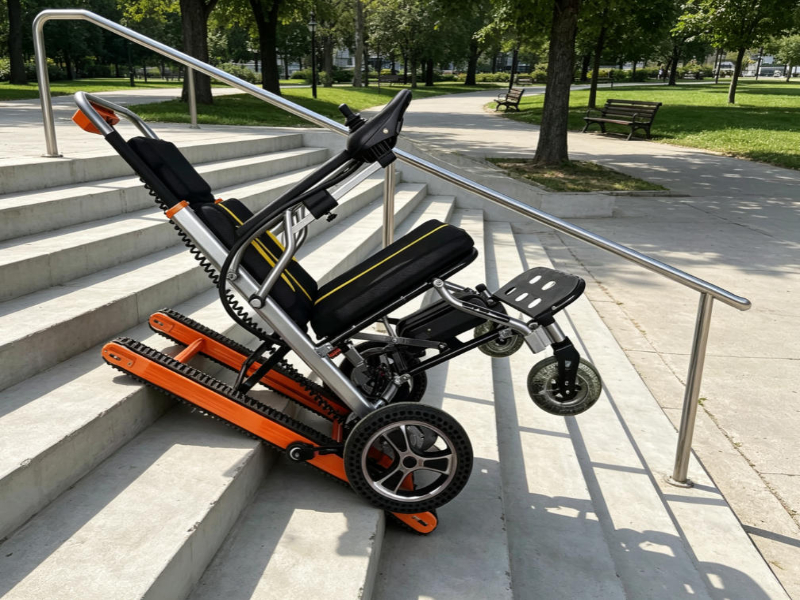
For wheelchair users, a staircase can turn an otherwise accessible building into a complete barrier. A conventional wheelchair may move smoothly across a hospital corridor, apartment floor or pavement, but a flight of stairs presents a very different mechanical challenge. This is where stair climbing wheelchair track systems come into the picture.
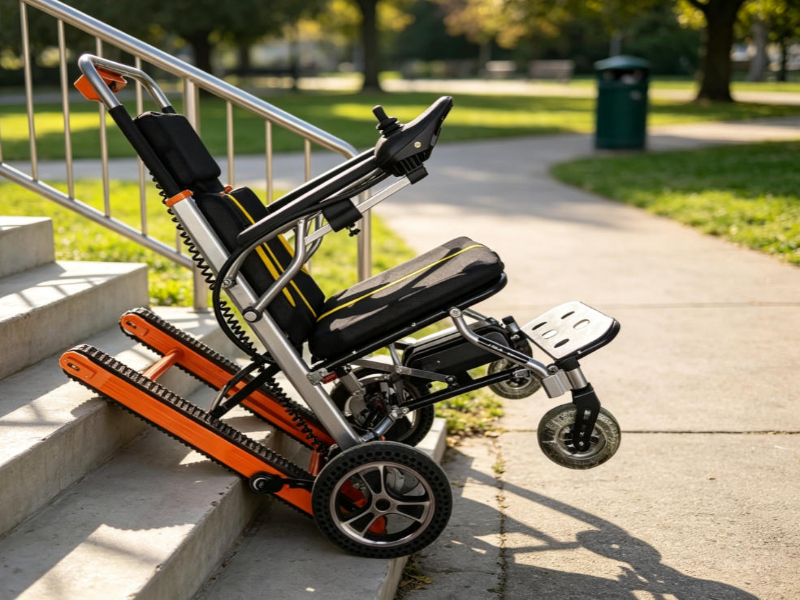
Instead of relying only on traditional wheels, a tracked stair climbing wheelchair uses a continuous crawler-style track to maintain contact with the steps while the chair moves upward or downward. Electric motors provide the required driving force, while the track system, control mechanism and safety features work together to keep the wheelchair moving in a controlled manner.
Understanding how stair climbing wheelchair track systems work is important for wheelchair users, caregivers, rehabilitation centres, hospitals and mobility equipment distributors. It explains why these wheelchairs look different from ordinary power chairs, why staircase measurements matter so much, and why motor power alone does not determine whether a stair-climbing wheelchair is suitable.
Modern models can also combine stair climbing with conventional flat-ground driving. The result is not simply a machine designed to climb stairs, but a specialised mobility solution that can be used across different parts of a user’s daily journey.
The basic principle is easier to understand when you think about the difference between a wheel and a track.
A conventional wheelchair uses individual wheels to support the chair and move it across the ground. When those wheels encounter a staircase, the front edge of the next step becomes a physical obstacle. The wheelchair cannot simply roll forward because the wheels are designed for relatively continuous surfaces rather than repeated vertical edges.
A tracked stair climbing wheelchair approaches the problem differently.
The wheelchair incorporates one or more continuous tracks, often referred to as crawler tracks. Instead of placing all of the load on individual wheel contact points, the track creates a longer contact surface against the staircase. As the motor turns the track, the tread engages with the steps and gradually moves the wheelchair from one step to the next.
The track does not simply “pull” the wheelchair upward. The complete system has to control the relationship between the chair, the user’s centre of gravity, the staircase and the track. This is why a modern stair climbing wheelchair combines mechanical components with electronic controls and safety mechanisms.
In practical terms, the process can be understood in several stages.
First, the wheelchair approaches the staircase. The operator positions the chair correctly at the bottom of the stairs and activates the appropriate climbing mode.
Next, the climbing mechanism engages. Depending on the model, the track system is positioned so that it can make stable contact with the steps.
The electric motor then drives the track. Rather than relying on ordinary rolling movement, the crawler mechanism progresses step by step.
During the climb, the system controls speed and traction. This is particularly important because a staircase creates a much steeper operating angle than normal flat-ground travel.
At the top or bottom of the staircase, the wheelchair transitions back to conventional movement. Dual-use models can then continue travelling on ordinary floors, corridors or outdoor surfaces.
The exact mechanism differs between manufacturers and models, so users should always follow the instructions for the specific wheelchair rather than assuming that all tracked systems operate identically.
A stair climbing wheelchair track system is not one component. It is a combination of several systems that have to work together.
1. Electric Motors
The motors provide the mechanical force needed to move the wheelchair and user.
Stair climbing places greater demands on the drivetrain than flat-ground travel because the wheelchair must overcome the incline and maintain controlled movement. This means that the motor system needs sufficient torque rather than simply a high top speed.
For this reason, comparing stair-climbing wheelchairs by maximum speed alone can be misleading. A wheelchair designed for stairs may intentionally operate at a relatively controlled speed because stability and predictable movement are more important than travelling quickly.
The YSE207, for example, lists a stair-climbing speed of approximately 15 steps per minute, while its published specifications also include a 20Ah lithium battery and a stated climbing capacity of up to 500 steps.
The YSE208 similarly lists a controlled climbing speed of 15 stair steps per minute and a climbing capacity of up to 500 steps.
These figures illustrate an important point: stair-climbing technology is generally about controlled progression, not speed.
2. Continuous Crawler Tracks
The tracks are the most recognisable part of the system.
A crawler track consists of a continuous loop that moves around internal drive and support components. When powered, the track creates a moving contact surface that can engage with the edges and surfaces of the stairs.
This design is fundamentally different from a normal wheelchair wheel because several parts of the track can remain in contact with the staircase during movement.
That longer contact area can help the wheelchair maintain traction and distribute forces across multiple points. It also allows the wheelchair to move progressively from one step to another instead of trying to roll directly over each vertical riser.
However, the presence of tracks does not mean that every staircase is automatically suitable. Track geometry, chair dimensions, staircase slope, step dimensions and available landing space all affect performance.
This is why manufacturers specify staircase requirements for individual models.
3. Control System
The control system determines how the wheelchair responds to operator input.
A modern stair-climbing wheelchair may have separate driving and climbing controls, a universal controller, a joystick, a remote control or other dedicated interfaces.
The purpose is not simply to make the wheelchair easier to drive. The control system needs to manage a very different type of movement once the wheelchair is on stairs.
The YSE208 uses a universal controller designed to simplify switching between flat-ground driving and stair-climbing operation. The manufacturer specifically positions the model as a dual-use electric wheelchair for both ordinary surfaces and stairs.
The YSE207 also uses a universal controller together with a climbing controller, allowing the wheelchair to operate as a flat-ground electric wheelchair as well as a stair-climbing system.
For caregivers, this dual-mode approach can be particularly useful because it avoids the need to use one mobility device for flat ground and a completely different system for stairs.
4. Stair Locks and Braking Systems
Braking becomes especially important when a wheelchair is operating on an incline.
A conventional brake system that works adequately on a flat surface is not necessarily sufficient for stair climbing. A stair-climbing wheelchair therefore needs mechanisms that help prevent uncontrolled movement during climbing and descending.
The YSE207 includes a climbing-lock system described as providing slow-down and reverse-lock functions. It also incorporates a backup camera to improve visibility during operation.
These features are important because stair climbing is not simply about generating enough power. The wheelchair must also be able to stop, slow down and maintain a controlled position when necessary.
It is worth emphasising that safety systems reduce risk but do not eliminate it. Users and caregivers still need appropriate training and must operate the wheelchair within the manufacturer’s specified limits.
The actual climbing sequence is where the engineering becomes most interesting.
Imagine the wheelchair positioned at the bottom of a staircase.
The operator first aligns the chair with the stairs. The position of the chair matters because an incorrect approach can affect how the tracks engage with the steps.
Once the climbing system is activated, the wheelchair changes from normal rolling movement to tracked climbing. The motor begins turning the crawler mechanism, and the track starts engaging with the staircase.
As the track moves, the wheelchair advances upward one step at a time.
The important principle is that the track maintains contact with the staircase while the chair progresses. Instead of lifting the entire wheelchair vertically, the system converts motor rotation into controlled forward and upward movement.
At the same time, the wheelchair’s structure and control system need to keep the user’s seating position stable.
This is why seat design matters even on a stair-climbing machine.
A wheelchair user should remain properly positioned during the entire movement. Seat width, depth, backrest support, foot placement and restraint systems all contribute to the overall operating experience.
Once the wheelchair reaches the top landing, the track system has to transition back to flat-ground movement. The landing therefore needs to provide enough space for the wheelchair to complete the transition safely.
This is one of the reasons staircase measurements should always be checked before purchasing a stair-climbing wheelchair.
One of the most common mistakes buyers make is asking:
“Can this wheelchair climb stairs?”
That question is too general.
The better question is:
“Can this specific wheelchair climb my specific staircase?”
Staircases vary considerably between homes, hospitals, apartments and commercial buildings. Some are narrow. Some have unusually deep or shallow steps. Others have limited landing space, sharp turns or handrails that reduce usable width.
The YSE208 provides a useful example of how specific these requirements can be. The manufacturer lists a required stair width of more than 700 mm, a corner landing width and depth of more than 1100 mm, and a stair slope below 45 degrees. It also specifies 12-inch rear wheels and 8-inch front wheels for its flat-ground configuration.
This means a buyer should measure more than the overall staircase width.
Before choosing a tracked wheelchair, check:
| Staircase factor | Why it matters |
|---|---|
| Stair width | Determines whether the wheelchair can physically fit |
| Step depth | Influences track engagement |
| Step height | Affects climbing geometry |
| Stair angle | Determines whether the model is within its operating limits |
| Landing size | Provides space for turning and transition |
| Handrails | Can reduce usable width |
| Doorways | May restrict access before or after the stairs |
| Surface condition | Can affect traction and stability |
| Top and bottom clearance | Determines whether the chair can align correctly |
For distributors and mobility equipment dealers, this is also an important part of customer qualification. Asking for staircase measurements before recommending a model can prevent unsuitable purchases and unnecessary returns.
The YSE208 Electric Stair-Climbing Wheelchair is designed around a practical idea: one wheelchair should be able to handle both flat-ground travel and stairs.
This dual-use approach is useful because stairs are rarely the only part of a user’s journey. A person may need to travel from a bedroom to a hallway, climb a staircase, cross a lobby and then continue outdoors. Switching between different mobility devices at every transition can make the journey more complicated.
The YSE208 uses a steel frame and has a stated maximum load of 120 kg. Its seat measures approximately 43 cm wide, 45 cm deep and 44 cm high. The chair has a foldable design, with a listed folding size of 110 × 65 × 35 cm, making storage and transportation easier than with some larger fixed mobility systems.
Its 13Ah lithium battery provides a published driving range of up to 15 km, while the stair-climbing system is specified for up to 500 steps. The manufacturer lists a climbing speed of approximately 15 steps per minute.
The YSE208 is also designed around specific staircase requirements. It is specified for stair slopes below 45 degrees, stair widths greater than 700 mm and corner landing dimensions greater than 1100 mm in both width and depth.
For users who live in apartments, houses or care facilities where elevators are unavailable, these specifications make the YSE208 particularly relevant.
Its strongest advantage is not necessarily the highest motor output. Instead, it is the combination of flat-ground driving, tracked stair climbing, foldability, height adjustment and practical dimensions.
This makes it a useful model to consider for residential mobility and institutional environments where storage and everyday usability matter.
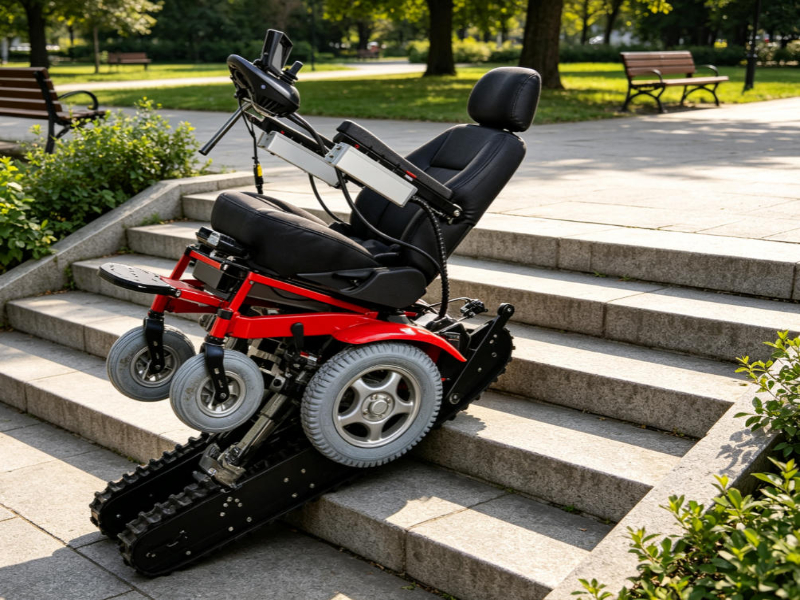
The YSE207 Single Operator Electric Automatic Stair Climbing Wheelchair takes a different approach, with a stronger focus on controlled stair operation and manoeuvrability.
The model uses a crawler climbing system together with a universal controller and climbing controller. IYASOCARE’s published information describes it as a dual-use wheelchair capable of operating on flat ground and climbing stairs.
One of its notable features is the universal front wheel, which provides 360-degree steering in place. This can be useful when the wheelchair needs to manoeuvre in confined spaces such as corridors, elevator areas and indoor rooms.
The YSE207 has a steel frame, a 50 cm seat width and 50 cm seat depth, with a stated maximum load of 150 kg. It uses a 20Ah lithium battery and has a published driving range of up to 15 km. Its stair-climbing speed is approximately 15 steps per minute, with a listed capacity of up to 500 steps.
The manufacturer specifies a stair width above 850 mm, stair depth above 1500 mm and a slope below 45 degrees for the model. These requirements again demonstrate why staircase measurements need to be matched to the exact wheelchair rather than using general assumptions about tracked systems.
The YSE207 also includes a climbing lock with slow-down and reverse-lock functions and a backup camera. The camera can be particularly useful because the operator needs clear visibility when manoeuvring around a staircase.
For distributors, rehabilitation providers and families looking for a larger-capacity stair-climbing solution, the YSE207 is an interesting option.
Its 150 kg stated load capacity, 20Ah lithium battery, crawler climbing system and single-operator design give it a distinct position within the stair-climbing wheelchair category.
| Feature | YSE208 | YSE207 |
|---|---|---|
| Stair climbing | Yes | Yes |
| Flat-ground driving | Yes | Yes |
| Battery | 13Ah lithium | 20Ah lithium |
| Listed range | Up to 15 km | Up to 15 km |
| Listed climbing capacity | Up to 500 steps | Up to 500 steps |
| Climbing speed | 15 steps/min | 15 steps/min |
| Maximum load | 120 kg | 150 kg |
| Stair slope | <45° | <45° |
| Required stair width | >700 mm | >850 mm |
| Frame | Steel | Steel |
| Foldable | Yes | Folding dimensions specified |
| Main advantage | Portable dual-use design | Higher stated load + manoeuvrability |
The comparison does not produce a universal winner.
The YSE208 is particularly attractive when foldability, storage and compatibility with relatively narrower staircases are priorities. Its stated requirement of more than 700 mm stair width can be relevant in residential environments where staircase space is limited.
The YSE207 is more suitable when the buyer needs a higher stated load capacity and values its universal front wheel, crawler system, climbing lock and backup camera. However, its published staircase requirements are more demanding, including a stair width above 850 mm and stair depth above 1500 mm.
In other words, the better wheelchair is the one that matches the staircase and user—not simply the model with the larger battery or higher load capacity.
The key advantage of a track system is contact.
A conventional wheel touches the ground at a relatively small area. On a flat floor, that is highly efficient. The wheel rolls easily and requires relatively little energy to maintain movement.
A staircase changes the problem.
Every step contains a horizontal surface and a vertical riser. A standard wheel must overcome these repeated changes in elevation. A tracked system instead uses a continuous moving surface that can maintain contact with several parts of the staircase during the climbing sequence.
This can improve traction and help distribute the mechanical load.
However, tracks also introduce additional weight, mechanical complexity and maintenance requirements. They are not automatically superior in every environment.
A traditional electric wheelchair may be more efficient and easier to transport for someone who never encounters stairs. A tracked wheelchair becomes more valuable when stairs are a regular and unavoidable part of the user’s route.
This distinction is important for buyers because stair-climbing technology should solve a real mobility problem rather than simply add complexity to a product.
A stair-climbing wheelchair has to carry both the user and its own mechanical system.
That means weight becomes an important consideration.
Tracks, motors, batteries, structural reinforcement and climbing mechanisms can make stair-climbing wheelchairs heavier than ordinary folding electric wheelchairs.
The YSE208 is listed at 45 kg net and 48 kg gross in its product specifications, while the YSE207 is listed at 130 kg net with battery.
This is a substantial difference and highlights the importance of understanding the exact product configuration.
If the wheelchair must frequently be transported in a vehicle, storage requirements should be considered before purchase. If it will remain primarily in a building, portability may be less important than climbing performance and user comfort.
Battery capacity also matters because stair climbing consumes energy differently from flat-ground driving. Published range figures should therefore be treated as reference specifications rather than guaranteed real-world distances.
Actual performance can vary with user weight, staircase conditions, battery condition, temperature, driving habits and frequency of stair climbing.
One of the strongest reasons people consider stair-climbing wheelchairs is independence. But independence should never mean ignoring safety procedures.
A tracked wheelchair can reduce the need for manually lifting a wheelchair or transferring the user between devices, but it does not make every staircase safe.
The user or caregiver needs to understand the correct operating procedure.
Before climbing, the staircase should be inspected. Loose objects, wet surfaces, damaged steps and other hazards should be considered. The wheelchair should be aligned correctly, and the user should remain properly positioned.
The chair should only be used on staircases that meet the manufacturer’s specifications.
During operation, users should follow the recommended speed and control procedures rather than attempting to accelerate the chair beyond its intended climbing performance.
The same principle applies during descent. Going down stairs is not simply the reverse of climbing. The braking and control system must manage the wheelchair’s movement while gravity is acting in the direction of travel.
For this reason, buyers should pay close attention to features such as climbing locks, reverse locks, braking systems, control interfaces and visibility aids.
The YSE207’s climbing lock and backup camera are good examples of features designed around the practical challenges of stair operation.
Stair-climbing wheelchairs can be relevant to several groups.
For elderly users, stairs can become increasingly difficult when strength, balance or endurance declines. A stair-climbing wheelchair may provide an alternative way to move between floors when an elevator is unavailable.
For people with disabilities, tracked stair mobility can help address environments where ramps or elevators cannot provide a practical solution.
For caregivers, a powered stair-climbing system may reduce the need to manually lift or carry a conventional wheelchair, although correct operation and training remain essential.
For hospitals and rehabilitation centres, stair-climbing wheelchairs can provide mobility options in older buildings or areas where architectural accessibility is limited.
For mobility equipment distributors, these products create a specialised category that sits between conventional electric wheelchairs and fixed accessibility infrastructure.
The key is to match the technology with the actual use case.
A user living in a single-storey accessible home may have little reason to invest in stair-climbing technology. Someone living on the second floor of a building without an elevator has a very different mobility problem.
Start with the staircase, not the catalogue.
Measure the width, step depth, step height, slope and landing area. Check whether there are turns, handrails, doors or other obstacles around the staircase.
Then look at the user.
Check weight, body dimensions, seating requirements, physical ability and whether the wheelchair will be operated independently or with caregiver assistance.
Next, consider the rest of the journey.
Will the chair also be used on flat floors? Does it need to fit inside a vehicle? Will it be stored at home? Does it need to travel outdoors? How many times per day will the stairs be climbed?
Only after answering these questions should you compare motors, batteries and track systems.
For a portable residential solution, the YSE208 may be worth considering because of its foldable structure, dual-use operation and stated compatibility with stair widths above 700 mm.
For users who need a larger stated load capacity and value manoeuvrability and additional stair-operation features, the YSE207 provides another option, with a 150 kg stated load capacity, crawler climbing system, climbing lock and backup camera.
Understanding how stair climbing wheelchair track systems work makes it easier to see why these products are so different from ordinary electric wheelchairs.
The technology combines electric motors, crawler tracks, control systems, braking mechanisms and structural support to transform a staircase from a simple obstacle into a surface that can potentially be navigated under the correct conditions.
But the track itself is only one part of the solution.
A successful stair-climbing wheelchair needs the right combination of traction, controlled speed, mechanical strength, braking, user positioning, battery performance and staircase compatibility. The surrounding environment matters just as much as the wheelchair.
The IYASOCARE YSE208 demonstrates how a foldable, dual-use electric wheelchair can combine flat-ground driving with tracked stair climbing. Its published specifications include a 120 kg load capacity, 13Ah lithium battery, up to 15 km driving range and up to 500 stair steps, subject to the stated operating conditions.
The YSE207 takes a different approach, combining crawler stair climbing with a universal controller, 360-degree front-wheel steering, climbing lock, backup camera, 20Ah lithium battery and a 150 kg stated load capacity.
Neither should be selected simply because it has more features.
The right question is whether the wheelchair fits the user’s body, the user’s lifestyle and—most importantly—the actual staircase.
For anyone considering this technology, measure first, compare second, and operate according to the manufacturer’s instructions. That is the most practical way to turn advanced stair-climbing technology into a genuinely useful mobility solution.
1. How does a stair climbing wheelchair track system work?
A stair-climbing wheelchair track system uses powered crawler tracks instead of relying only on conventional wheels. Electric motors drive the continuous tracks, which maintain contact with the staircase and move the wheelchair progressively from one step to the next. Control and braking systems help regulate movement during climbing and descending. The exact mechanism varies by model, so the manufacturer’s operating instructions and staircase requirements should always be followed.
2. Can a tracked stair climbing wheelchair be used on normal floors?
Many modern models are designed for dual use. For example, the IYASOCARE YSE208 combines conventional electric driving on flat ground with electric tracked stair climbing, while the YSE207 is also designed for both flat-ground and stair operation. This allows one mobility device to be used across different parts of a user’s journey instead of requiring a separate wheelchair for stairs.
3. What should I check before buying a stair climbing wheelchair?
The most important step is to measure the actual staircase. Check stair width, step depth, step height, slope, landing dimensions, handrails and surrounding clearance. Then compare those measurements with the manufacturer’s specifications. You should also consider the user’s weight and body dimensions, battery range, wheelchair weight, transportation requirements, braking system, control method and whether the chair will be operated independently or with caregiver assistance.