Our Location
Free Trade Tower, Xiyong street.
Chongqing, China

Free Trade Tower, Xiyong street.
Chongqing, China
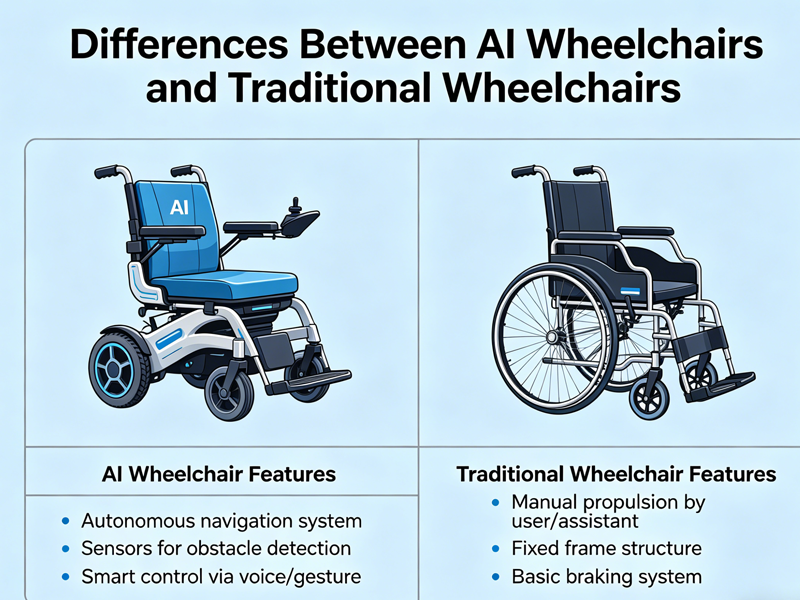
Mobility devices are often discussed in purely technical terms, but for the people who rely on them, the differences are deeply practical. Choosing between an AI-powered wheelchair and a traditional wheelchair is not just about features—it’s about daily experience, independence, safety, and long-term usability.
While both types serve the same core purpose, the gap between them is more substantial than it first appears. To understand that gap clearly, it helps to look at how each performs across real-world dimensions rather than abstract descriptions.
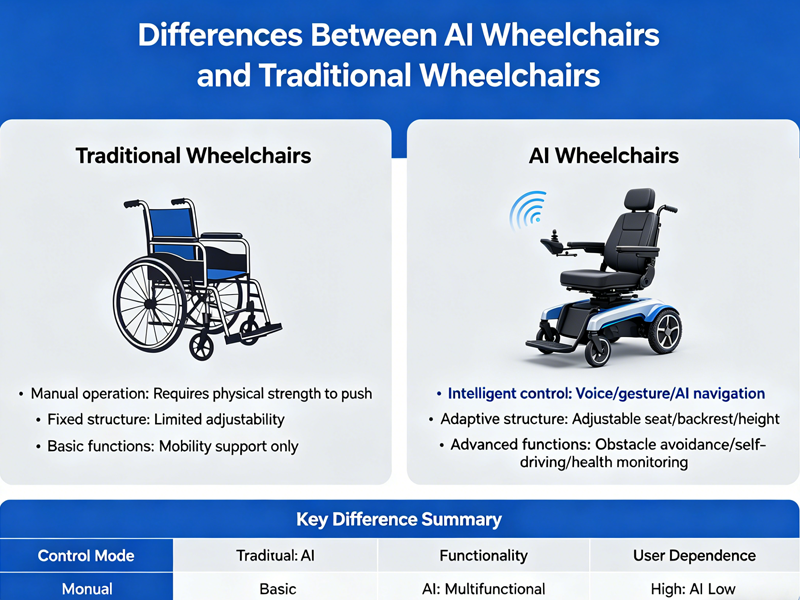
Instead of discussing each type in isolation, let’s directly compare how AI wheelchairs and traditional wheelchairs differ across key aspects of daily use.
| Dimension | Traditional Wheelchairs | AI Wheelchairs |
|---|---|---|
| Control Method | Fully manual or joystick-based; requires continuous user input | Assisted or semi-autonomous; interprets user intent |
| Navigation | User reacts to environment | System anticipates and adapts in real time |
| Accessibility Level | Limited for users with severe disabilities | Designed for a wider range of physical conditions |
| Safety | Passive (brakes, stability) | Active (collision avoidance, auto-stop) |
| Learning Ability | No adaptation | Learns user habits and preferences |
| Maintenance | Simple, mechanical | Complex, software + hardware integration |
| Cost | Generally affordable | High initial investment |
| Independence | Moderate | Significantly enhanced |
This comparison highlights a key truth: traditional wheelchairs depend on the user’s ability, while AI wheelchairs compensate for limitations.
The most immediate difference shows up the moment someone tries to use each type.
With a traditional wheelchair, control is direct and constant. Whether pushing the wheels manually or operating a joystick, the user must actively manage every movement. Even small adjustments—turning slightly, slowing down, avoiding obstacles—require effort and precision.
AI wheelchairs reduce this burden.
Instead of demanding exact control, they interpret signals. A slight movement, a voice command, or even eye direction can be enough. The system then translates that intention into smooth, controlled motion.
The real difference:
Over long periods, this distinction significantly affects fatigue and usability.
Traditional wheelchairs rely entirely on the user’s awareness. If an obstacle appears, the user must detect it, decide how to respond, and act quickly.
In contrast, AI wheelchairs actively monitor their surroundings.
They use sensors to continuously scan the environment, enabling them to:
Key difference:
Traditional wheelchairs respond after something happens.
AI wheelchairs respond before it becomes a problem.
This shift from reactive to proactive navigation is one of the most meaningful advancements.
Not all mobility devices are equally usable for everyone.
Traditional wheelchairs—especially manual ones—require physical strength, coordination, or at least reliable hand control. Even powered versions assume that the user can operate a joystick.
AI wheelchairs remove many of these limitations.
They can support alternative control methods such as:
The real impact:
People who previously needed constant assistance may gain independent mobility.
This is not just a technical improvement—it changes who can participate in daily life without relying on others.
Traditional wheelchairs are designed to be stable and durable, but they don’t actively prevent accidents.
If a user makes a mistake—like misjudging a slope or approaching stairs too quickly—the chair won’t intervene.
AI wheelchairs, however, are built to prevent errors from turning into accidents.
They can:
Difference in mindset:
Traditional = “Be careful.”
AI-powered = “We’ll help keep you safe.”
This added layer of protection is especially valuable for users with limited reaction time or vision.
A traditional wheelchair behaves the same way every day. There is no memory, no adjustment, no personalization beyond physical settings.
AI wheelchairs, however, evolve over time.
They can learn:
What this means in practice:
The longer you use an AI wheelchair, the better it understands you.
This creates a more intuitive experience, reducing the need for constant adjustments and making daily movement feel more natural.
Traditional wheelchairs are mechanically straightforward. Repairs are typically quick, and parts are widely available. This makes them reliable in a wide range of environments, including areas with limited technical support.
AI wheelchairs introduce a new level of complexity.
They require:
Trade-off:
Traditional = easier to maintain
AI-powered = more capable, but more demanding
For some users, especially in remote or resource-limited regions, this difference can be decisive.
Cost is often the most practical factor in decision-making.
Traditional wheelchairs are available across a wide price range and are often covered by insurance or public health systems.
AI wheelchairs are significantly more expensive due to their advanced technology.
However, the value proposition is different.
Traditional wheelchairs:
Affordable, widely accessible, reliable
AI wheelchairs:
Higher cost, but potentially life-changing in terms of independence
The decision often comes down to whether the additional capabilities justify the investment for a specific user.
Perhaps the most important difference is how each type affects independence.
Traditional wheelchairs restore mobility, but users may still depend on caregivers in complex environments—crowded areas, narrow spaces, or unfamiliar locations.
AI wheelchairs reduce that dependence.
They allow users to:
Core difference:
Traditional wheelchairs enable movement.
AI wheelchairs enable autonomy.
This is the wrong question.
The better question is: Which one fits the user’s needs?
In many cases, both will continue to coexist, serving different segments of users.
The difference between AI wheelchairs and traditional wheelchairs is not just technological—it’s experiential.
Traditional wheelchairs place responsibility entirely on the user.
AI wheelchairs share that responsibility, offering support, intelligence, and adaptability.
For some users, that difference is minor.
For others, it can redefine daily life.
1. What is the biggest practical difference between AI and traditional wheelchairs?
The biggest difference is assistance. Traditional wheelchairs require full user control, while AI wheelchairs assist with navigation, safety, and decision-making, reducing effort and increasing independence.
2. Are AI wheelchairs only for people with severe disabilities?
No. While they are especially beneficial for users with severe mobility limitations, they can also help anyone who wants reduced physical strain and smarter navigation in complex environments.
3. Is it worth upgrading from a traditional wheelchair to an AI wheelchair?
It depends on the user’s needs. If independence, safety, and ease of use are major concerns—and budget allows—an AI wheelchair can offer significant improvements. Otherwise, traditional wheelchairs remain a practical and effective solution.