Our Location
Free Trade Tower, Xiyong street.
Chongqing, China

Free Trade Tower, Xiyong street.
Chongqing, China
Mobility technology has evolved far beyond simple transportation. Today’s electric wheelchairs are expected to deliver comfort, safety, independence, and reliable performance across a wide range of indoor and outdoor environments. As user expectations continue to rise, one engineering feature has become increasingly important: the suspension system.
A well-designed electric wheelchair suspension system directly influences ride quality, obstacle handling, traction, battery efficiency, and long-term durability. Whether navigating uneven sidewalks, cobblestone streets, ramps, grass, or interior thresholds, suspension determines how smoothly the wheelchair responds to the real world. For users who spend many hours seated each day, reducing vibration and repeated impact is not a luxury—it is essential for health and quality of life.
Unlike standard wheelchairs, powered wheelchairs often travel longer distances, carry heavier integrated systems, and are used by people with diverse medical conditions. Many users experience sensitivity to shock, poor trunk stability, chronic pain, circulation issues, or spinal complications. Because of this, road vibration and sudden impacts can cause fatigue, discomfort, or even medical risk.
Suspension performs several critical tasks simultaneously:
Without effective suspension, even a powerful wheelchair may feel unstable or harsh. A technically advanced drive system cannot compensate for poor ride dynamics.
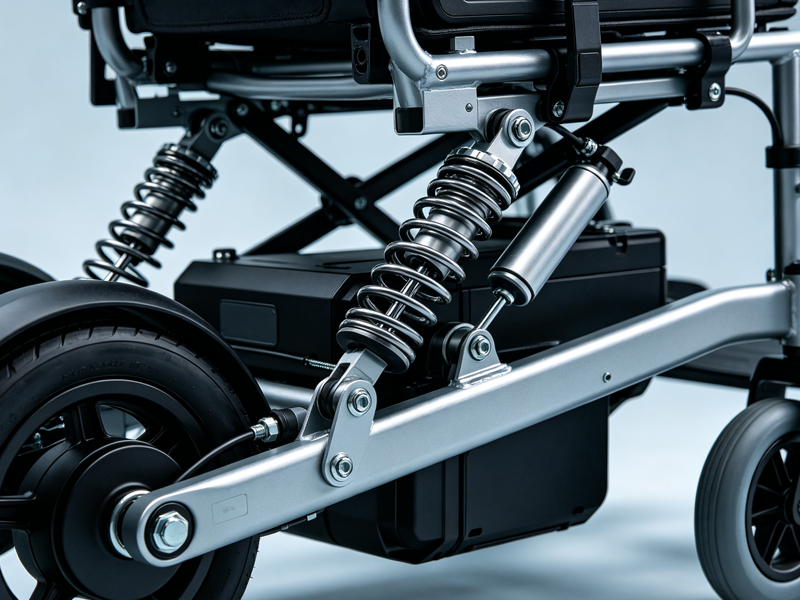
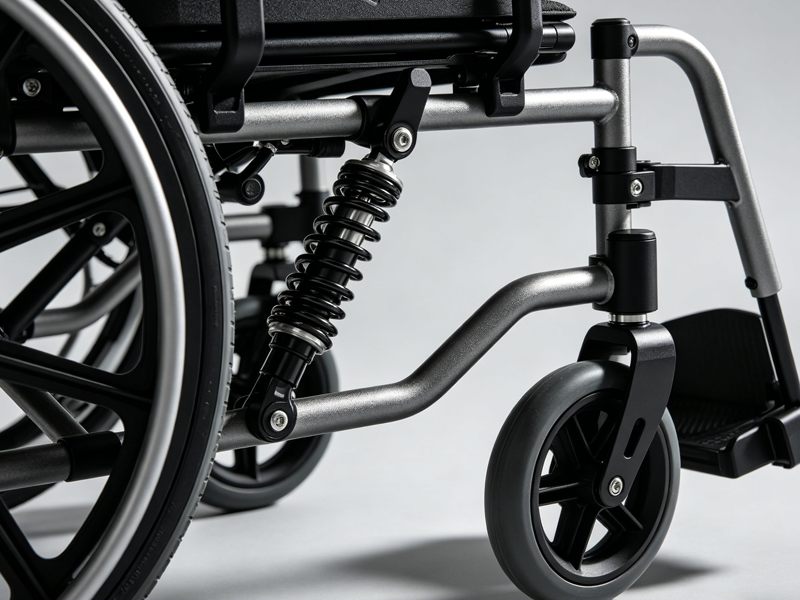
At its foundation, an electric wheelchair suspension system controls the movement between the wheels and the chassis. When wheels encounter uneven terrain, the suspension compresses and rebounds in a controlled way, rather than transmitting full impact directly to the frame.
This system generally includes three core elements:
Elastic Components
Springs store impact energy temporarily. Common options include coil springs, rubber elastomers, torsion bars, and air elements. The spring rate determines how much force is required to compress the system.
Damping Components
Shock absorbers or dampers convert movement energy into heat, slowing oscillation after impact. Without damping, the wheelchair may continue bouncing after hitting a bump.
Linkage or Mounting Geometry
Arms, pivots, and frame joints guide wheel movement through a defined path. Geometry affects wheel alignment, travel range, stability, and packaging efficiency.
Balancing these three elements is the heart of suspension optimization.
Different wheelchair classes require different suspension architectures. There is no universal solution because indoor maneuverability, outdoor capability, transport size, and cost all influence design choices.
Independent Front and Rear Suspension
Each wheel or axle moves with partial independence. This improves terrain adaptability and reduces cross-frame disturbance when one wheel encounters an obstacle.
Advantages include smoother ride quality, improved contact patch control, and better user comfort on uneven surfaces. This design is often preferred in premium mobility chairs.
Swing Arm Suspension
A wheel is mounted to a pivoting arm with spring-damper support. Swing arms are compact and relatively simple, making them common in mid-range designs.
They provide predictable movement and are effective for curb transitions or outdoor pathways.
Elastomer Suspension
Instead of traditional springs, elastomer blocks deform under load. These systems are lightweight, low maintenance, and quiet, though they may offer less adjustability.
Full Active or Semi-Active Suspension
Advanced systems use sensors and electronically controlled dampers or actuators. These are still emerging in mobility devices due to cost and energy demands, but they represent the future of adaptive ride control.
A wheelchair suspension system must meet different standards than automotive suspension. The user is seated close to the ground, weight distribution changes frequently, and package space is limited. Optimization therefore requires a specialized design mindset.
Comfort Without Excessive Softness
An overly soft suspension may feel smooth at low speed but unstable during turns, ramps, or emergency stops. Excessive body roll can create anxiety and reduce safety.
The best systems isolate vibration while preserving directional confidence.
Compact Mechanical Packaging
Electric wheelchairs contain motors, batteries, controllers, seating systems, footrests, and folding structures. Engineers must fit suspension travel into a highly constrained footprint.
Low Maintenance Reliability
Users need dependable equipment, not frequent servicing. Bearings, bushings, seals, and dampers must survive moisture, dust, repeated loading, and transportation handling.
Weight Efficiency
Heavier systems reduce battery range and make transport more difficult. Designers must minimize mass without sacrificing structural strength.
Accessibility and Cost Control
High-performance engineering has little value if it makes products unaffordable. Smart optimization often focuses on achieving 80% of premium performance with simpler manufacturing methods.
Traditional mechanical design often focuses on force, stress, and motion. In wheelchair engineering, human factors are equally important.
A suspension that appears efficient in simulation may still feel uncomfortable to users if vibration frequencies align with sensitive body zones. Repetitive vertical movement can increase fatigue, especially for users with spinal injuries or posture limitations.
Optimization should therefore consider:
User feedback is often the difference between a technically acceptable product and an exceptional one.
Designing a suspension system is only the first step. Fine-tuning determines real-world success.
Spring Rate Selection
Higher spring rates support heavier loads and reduce bottoming out. Lower rates improve comfort but may compress too easily.
Since wheelchair users vary greatly in body weight and equipment load, adjustable or modular spring options are valuable.
Damping Ratio
Insufficient damping causes bounce. Excessive damping creates a harsh, slow-reacting feel. The correct damping range depends on speed, wheel size, and expected terrain.
Suspension Travel
Travel is the distance the wheel can move vertically. More travel improves obstacle absorption, but packaging constraints often limit available motion.
Center of Gravity Management
Battery placement, seat height, tilt systems, and user posture all affect center of gravity. Suspension must remain stable under these changing conditions.
Tire Interaction
Pneumatic tires already provide some compliance. Engineers must tune suspension and tire softness together rather than independently.
Materials strongly affect ride quality, weight, and lifespan.
Aluminum Alloys
Widely used for frames and arms due to their strength-to-weight ratio and corrosion resistance.
High-Strength Steel
Useful for critical load-bearing brackets and pivots where fatigue resistance is required.
Composite Materials
Carbon fiber or reinforced polymers reduce weight but increase cost. They are increasingly relevant in premium designs.
Elastomer Compounds
Material hardness and environmental resistance determine long-term performance in compact suspension units.
The best products often combine materials strategically rather than relying on a single material type.
Modern wheelchair suspension development increasingly uses digital engineering tools before physical prototyping.
Finite Element Analysis (FEA)
Used to identify stress concentration, frame fatigue zones, and structural deflection under repeated loads.
Multibody Dynamics Simulation
Models how wheels, arms, springs, and the chassis move together during bumps, turning, braking, and slope travel.
Vibration Analysis
Helps predict frequencies transmitted to the seat and identifies resonance issues.
Real-World Validation
Simulation saves time, but field testing remains essential. Engineers should test across:
Laboratory perfection does not guarantee urban usability.
Many people do not associate suspension with battery life, but optimized ride dynamics can improve efficiency.
When wheels maintain better contact with the ground, traction improves and wasted wheel slip decreases. Controlled chassis movement also reduces energy losses from repeated jolting and unstable acceleration corrections.
Lighter suspension systems further help by lowering rolling demand. For daily users, even modest range gains can be meaningful.
Suspension must support not only comfort but also safety. Poorly tuned systems can create instability under real conditions.
Important safety scenarios include:
The suspension should keep wheels engaged, minimize tipping tendencies, and preserve steering predictability.
Redundant mechanical stops, anti-bottoming features, and secure fasteners are equally important in production design.
As electronics become more compact and affordable, electric wheelchair suspension systems are entering a smarter era.
Emerging technologies include:
For example, an urban mode may prioritize efficiency and responsiveness, while an outdoor mode softens impact behavior for rough terrain.
These innovations can transform the wheelchair from a mobility tool into an intelligent mobility platform.
Companies developing next-generation wheelchairs should focus on an integrated strategy rather than isolated parts.
A strong roadmap includes:
This approach shortens development cycles while improving product-market fit.
The design and optimization of an electric wheelchair suspension system is a multidisciplinary challenge that combines mechanical engineering, ergonomics, materials science, electronics, and real-world user insight. Suspension is no longer a secondary feature—it is central to comfort, safety, confidence, and long-term product value.
A successful system does more than absorb bumps. It protects the user, preserves control, extends component life, and enables smoother daily mobility across unpredictable environments. As smart technologies and lightweight materials continue to advance, suspension systems will become one of the defining differentiators in the future of electric wheelchair design.
For manufacturers, engineers, and healthcare mobility innovators, investing in better suspension is not simply about performance. It is about delivering dignity, independence, and a higher quality of movement for the people who rely on it every day.