Our Location
Free Trade Tower, Xiyong street.
Chongqing, China

Free Trade Tower, Xiyong street.
Chongqing, China

For millions of wheelchair users worldwide, a manual wheelchair represents more than mobility—it represents independence, flexibility, and control over daily life. Unlike powered wheelchairs, manual chairs allow users to stay physically engaged, maintain upper-body strength, and navigate a wide variety of environments with precision. Yet anyone who relies on a manual wheelchair for extended periods understands the physical reality that comes with it: every push demands energy, and over time, that effort can place considerable strain on the shoulders, elbows, wrists, and hands.
As mobility technology continues to evolve, one innovation has gained significant attention among rehabilitation specialists, occupational therapists, and active wheelchair users alike: power assist systems for manual wheelchairs. These systems bridge the gap between traditional self-propelled mobility and full electric assistance, offering users extra support without taking away the natural experience of controlling their chair.
A power assist system is designed to enhance—not replace—manual propulsion. When the user pushes the hand rims, sensors built into the system detect the amount of force being applied. In response, compact motors provide additional propulsion, effectively amplifying each push.
The wheelchair still moves because the user initiates the movement. Steering remains fully manual. Braking feels the same. Turning corners, adjusting direction, and navigating tight spaces all continue to rely on the user’s own control. The difference is that every push becomes more efficient, requiring less effort to travel the same distance.
This creates a unique mobility experience. Users retain the physical engagement and independence associated with a manual wheelchair while significantly reducing repetitive strain. Instead of pushing harder or more often, they move farther with less energy expenditure.
This technology is often recommended by rehabilitation professionals for individuals experiencing shoulder fatigue, reduced endurance, early repetitive stress injuries, or progressive conditions that affect strength over time. In many cases, it allows users to extend their independence for years before considering a full power wheelchair.
Long-term manual wheelchair use can place tremendous demands on the upper body. Unlike walking, where body weight is distributed across larger muscle groups, wheelchair propulsion repeatedly loads smaller joints and muscles.
The shoulders, in particular, are vulnerable. Studies in wheelchair biomechanics consistently show that repetitive pushing can contribute to overuse injuries, including tendon inflammation, rotator cuff strain, joint degeneration, and chronic pain.
Daily activities that seem routine—commuting to work, navigating a campus, shopping, moving through airports, or simply crossing uneven sidewalks—can require hundreds or even thousands of push cycles.
When fatigue builds, users may notice:
Power assist systems were developed to address exactly these challenges.
At first glance, a power assist wheelchair may look almost identical to a standard manual chair. The technology is often integrated discreetly into the wheels or frame, preserving the familiar design users already trust.
However, inside that simple appearance is an advanced combination of sensors, motors, batteries, and control software.
Modern power assist systems rely on precision sensors to detect movement.
These sensors continuously monitor:
When a user applies force to the push rim, the system instantly calculates how much assistance is needed.
A light push results in gentle support.
A stronger push produces more acceleration.
Because assistance is proportional, movement feels natural rather than robotic.
Users typically adapt quickly because the chair still behaves like a manual wheelchair—only smoother and more responsive.
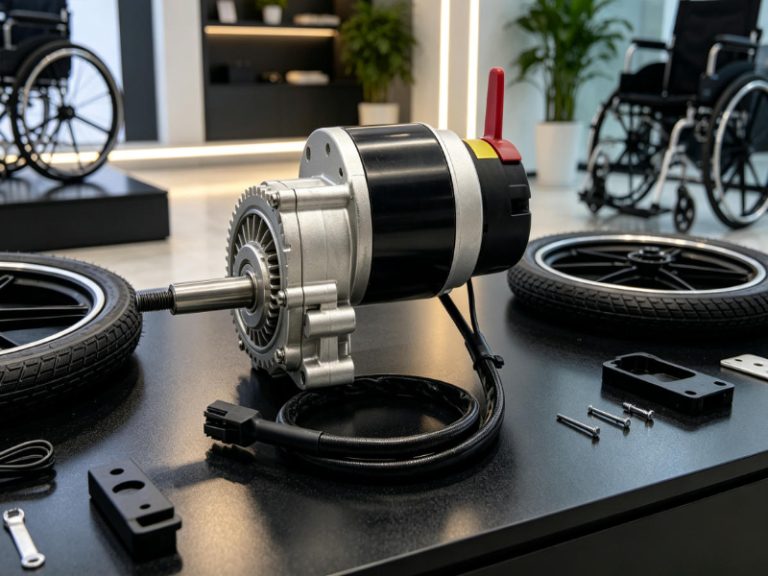
Once the sensors detect user input, compact motors activate.
These motors are commonly integrated into:
Instead of moving independently, the motors simply extend the momentum created by the user.
For example, a single push that might normally move the chair 2–3 meters may now carry the user significantly farther.
This reduces the number of pushes required throughout the day.

Most power assist systems use rechargeable lithium-ion battery packs.
These batteries are typically mounted in the wheel hubs or under the seat to maintain balance and stability.
Depending on terrain, user weight, and assistance settings, a full charge can often support a full day of use.
Charging usually takes place overnight, fitting naturally into everyday routines.
Battery indicators or digital displays help users monitor remaining power and avoid unexpected interruptions.
Not all power assist systems are designed the same way. Choosing the right configuration depends on lifestyle, transportation habits, daily environment, and physical ability.
Integrated Smart Wheel Systems
One of the most popular solutions involves replacing standard rear wheels with intelligent motorized wheels.
These systems combine:
all within the wheel itself.
The result is a highly integrated design that preserves the chair’s original handling characteristics.
Users often prefer smart wheel systems for:
Because the propulsion remains closely connected to the push rims, the learning curve is often minimal.
Rear or Front Mounted Drive Units
Another option uses detachable powered drive units.
These systems attach directly to the wheelchair frame and provide propulsion through a powered traction wheel.
They are particularly effective for:
A major advantage is flexibility. Users can remove the drive unit when transporting the chair in a vehicle or when manual propulsion is preferred.
The true value of power assist becomes most obvious in everyday situations.
Climbing Ramps and Hills
Inclines are among the most physically demanding challenges for manual wheelchair users.
Without assistance, climbing requires sustained force and careful control to avoid rollback.
Power assist dramatically reduces that physical demand by providing extra torque exactly when needed.
Instead of struggling through the incline, users maintain smoother, safer momentum.
Uneven Outdoor Surfaces
Cracked sidewalks, brick pathways, gravel, rough pavement, and small elevation changes can quickly drain energy.
Power assist compensates for rolling resistance, helping maintain consistent movement across challenging surfaces.
This allows users to travel farther outdoors with less fatigue.
Indoor Precision
One concern many first-time users have is whether power assist will make indoor maneuvering harder.
In practice, properly calibrated systems remain highly responsive at low speeds.
Users can still:
without sacrificing control.
The advantages of power assist go far beyond simply making movement easier.
For many users, it represents long-term joint preservation.
By reducing repetitive loading, power assist may help lower the risk of:
This becomes especially important for younger wheelchair users who may rely on manual mobility for decades.
Occupational therapists often emphasize that preserving shoulder health early can significantly improve long-term independence.
In this sense, power assist is not just a mobility upgrade—it can be a preventative health investment.
Despite its benefits, power assist technology is not perfect for everyone.
There are practical factors to evaluate.
Added Weight
Power assist components add weight to the wheelchair.
For users who frequently load their chair into a car independently, this can affect transportation routines.
Battery Maintenance
Although charging is straightforward, batteries require consistent management.
Users must remember to recharge and occasionally replace battery packs over time.
Cost and Insurance
Power assist systems can represent a significant investment.
Insurance coverage varies widely between countries, providers, and clinical situations.
Some users may require professional documentation from a therapist or physician to qualify for reimbursement.
Choosing between power assist and a fully powered wheelchair depends largely on physical ability and lifestyle goals.
| Feature | Power Assist | Full Power Wheelchair |
|---|---|---|
| User propulsion | Required | Not required |
| Physical activity | High | Lower |
| Transportation | Easier | More difficult |
| Chair weight | Moderate | Heavy |
| Independence in loading | Often possible | Less common |
| Manual steering feel | Preserved | Replaced |
Power assist often appeals to users who still have functional upper body strength but want to reduce wear and fatigue.
Full power chairs are often more appropriate when manual propulsion becomes unsafe or physically unrealistic.
Power assist systems have fundamentally changed what manual wheelchair mobility can look like. They allow users to stay active, protect their joints, and maintain independence without fully transitioning to powered mobility.
For many people, that balance is exactly what makes power assist so valuable.
It is not about replacing strength.
It is about using technology intelligently to preserve it.
1. Does power assist make a wheelchair fully automatic?
No. Power assist only activates when the user pushes. The chair does not move on its own, and the user remains fully responsible for steering, braking, and controlling movement.
2. Can power assist be installed on any manual wheelchair?
Many systems are compatible with common wheelchair frames, but compatibility depends on frame geometry, axle configuration, and weight distribution. A professional wheelchair fitting is strongly recommended before purchase.
3. Is power assist better than switching to an electric wheelchair?
It depends on the user’s physical ability and goals. If a person still wants to stay active and can safely self-propel, power assist often offers the best balance of exercise, independence, and joint protection. If manual propulsion is no longer practical, a full power wheelchair may be the better solution.