Our Location
Free Trade Tower, Xiyong street.
Chongqing, China

Free Trade Tower, Xiyong street.
Chongqing, China
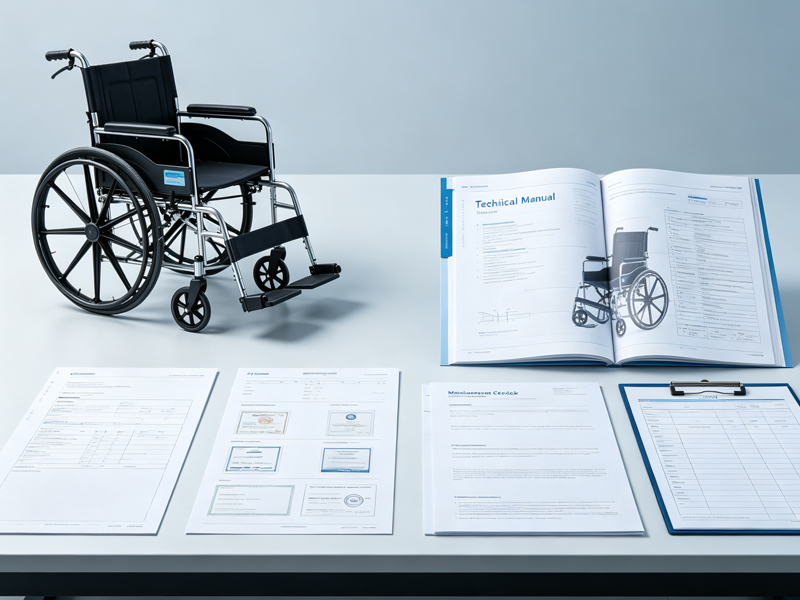
For distributors, medical equipment companies, hospitals, rehabilitation centers, care facilities, and private-label brands, the technical documents that come with a wheelchair can be just as important as the wheelchair itself. A product may look well designed, perform properly, and even have an attractive price, but without the right documentation, it can become difficult to import, register, sell, service, or support in the target market.
This is especially important when purchasing wheelchairs in bulk or working directly with an overseas wheelchair manufacturer. Different countries and markets can have different requirements for product safety, labeling, testing, electrical systems, materials, transportation, and after-sales service. A professional wheelchair supplier should therefore be able to provide a clear technical documentation package rather than simply sending a product catalog and quotation.
So, what technical documents should a wheelchair supplier provide?
The answer depends on the type of wheelchair and the destination market, but a reliable supplier should normally be prepared to provide product specifications, user manuals, drawings, test reports, certificates, material information, packaging details, maintenance instructions, and other documents needed for commercial and regulatory purposes.
One common mistake among wheelchair buyers is to treat documentation as paperwork that can be requested later.
In reality, technical documents are part of the product supply process.
Imagine that a distributor receives several hundred wheelchairs and discovers that the product dimensions in the quotation do not match the actual packaging dimensions. The distributor now has a problem with warehouse planning, shipping calculations, and possibly customs documentation.
Or consider an electric wheelchair that arrives without a detailed battery specification, charging instruction, wiring information, or maintenance guide. Even if the wheelchair works perfectly, the distributor may have difficulty answering customer questions or arranging after-sales service.
Good documentation reduces these problems.
For a wheelchair supplier, technical documents help demonstrate that the product has been properly designed, tested, manufactured, and prepared for the intended market. For the buyer, they provide a reference point for purchasing, quality control, installation, customer support, and future orders.
A professional supplier should also understand that different documents serve different purposes. A brochure is designed for marketing. A technical specification sheet is designed for product verification. A test report provides evidence of testing. A user manual explains operation. A certificate may demonstrate conformity with a specific regulatory requirement.
These documents should not be treated as interchangeable.
The first document every wheelchair supplier should be able to provide is a detailed technical specification sheet.
This document should contain objective product information rather than general marketing descriptions.
For a manual wheelchair, specifications may include:
For a powered wheelchair, the specification sheet should normally go further. It may include:
The key point is consistency.
The dimensions and specifications shown on the technical sheet should correspond with the actual production model. If the supplier offers several configurations, the differences should be clearly identified.
For buyers, this document is particularly useful when comparing suppliers. Instead of comparing vague statements such as “high quality” or “strong frame,” buyers can compare measurable specifications.
A product photograph is useful, but it does not replace an engineering drawing or dimension diagram.
A professional wheelchair supplier should be able to provide a dimension drawing showing the major measurements of the wheelchair.
This can be particularly important for distributors and institutional buyers because wheelchair dimensions affect transportation, storage, accessibility planning, packaging, and compatibility with other equipment.
A useful drawing may show:
Front view → Side view → Rear view → Folded view
Important dimensions should be identified clearly rather than left for the buyer to estimate from photographs.
For custom wheelchair projects, technical drawings become even more important.
If a buyer requests changes to:
the supplier should ideally provide an updated drawing or specification for approval before mass production begins.
This creates a written reference between the buyer and manufacturer.
For OEM and ODM wheelchair projects, approved drawings can also help prevent a common problem: the buyer and supplier believing they agreed on different versions of the product.
A user manual is one of the most important documents supplied with a wheelchair, yet it is sometimes overlooked during procurement.
For manual wheelchairs, the manual should explain how to safely use, fold, adjust, clean, and maintain the product.
For electric wheelchairs, the manual needs to be considerably more detailed.
It should generally explain:
Safety warnings should be easy to understand rather than hidden in technical language.
If the wheelchair is sold internationally, the user manual may also need to be translated into the language required by the destination market.
This is an important point for distributors: do not assume that an English manual automatically satisfies local requirements.
Depending on the market, local-language instructions, warnings, labeling, and other information may be required.
Certificates are often discussed when buyers evaluate wheelchair suppliers, but test reports deserve just as much attention.
A certificate may indicate conformity or certification status, while a test report usually provides more detailed information about what was tested and the results obtained.
Depending on the wheelchair model and destination market, relevant testing may cover areas such as:
The exact testing requirements depend on the product and applicable regulations or standards.
When reviewing a test report, buyers should not look only for a laboratory logo. They should check whether the report actually relates to the product being purchased.
Useful information includes:
Manufacturer name → Product model → Testing standard → Test date → Laboratory → Test results → Report number
A report for one wheelchair model should not automatically be assumed to cover another model simply because the two products look similar.
This is particularly important when suppliers have multiple wheelchair models with different frames, motors, batteries, controllers, or load capacities.
Depending on the destination market, a wheelchair supplier may need to provide relevant compliance documentation.
The exact documents vary significantly by country and product category.
For example, buyers supplying products into the European market may encounter requirements relating to CE marking and applicable European legislation. In the United States, requirements can differ depending on the type of wheelchair, intended use, and applicable regulatory framework.
The important principle is simple:
Do not ask a supplier only, “Do you have CE?”
Ask instead:
“Which requirements and standards does this specific model comply with, and can you provide the supporting documentation?”
That question produces much more useful information.
Relevant documentation may include:
Buyers should also verify whether the documents are current and whether the named manufacturer and model match the products being ordered.
For electric wheelchairs, battery documentation deserves its own category.
The battery is not simply another component. It can affect transportation, safety, charging, storage, maintenance, and regulatory compliance.
A supplier should be able to provide clear information about:
For lithium battery-powered wheelchairs, transportation documentation can also be important.
Depending on the battery type and shipping method, buyers may need documentation such as relevant lithium battery test documentation and transport-related information.
The buyer should not rely on a supplier’s statement such as “the battery is safe for shipping.”
Instead, request the relevant documentation and verify that it corresponds to the actual battery model supplied.
This becomes particularly important for international sea and air transportation.
A detailed bill of materials (BOM) is not necessarily required for every commercial order, but it can be extremely valuable for OEM buyers, distributors, and long-term purchasing relationships.
A BOM may identify major components such as:
The level of detail depends on the commercial relationship.
A manufacturer may not disclose every proprietary component or supplier name, but buyers should still be able to understand the major materials and components that influence product performance.
Material documentation can also become relevant when a buyer needs to meet environmental, chemical, or market-specific requirements.
For long-term projects, documenting the approved components can help prevent unexpected substitutions.
A supplier should not quietly replace a motor, controller, battery, cushion material, or structural component with a different specification without informing the buyer when that change could affect product performance or compliance.
Technical documentation should not stop at product design.
A serious wheelchair supplier should have a quality control process and be able to provide appropriate inspection records.
Depending on the order, buyers may request:
For large orders, a final inspection report can provide useful evidence that the production batch was checked before shipment.
For example, inspection may cover:
Appearance → Dimensions → Folding mechanism → Brakes → Wheels → Load-related checks → Electrical functions → Battery → Charger → Accessories → Packaging
The exact inspection checklist should match the product.
This is especially valuable for private-label buyers. If a buyer plans to sell thousands of wheelchairs under its own brand, a documented quality-control system can provide much greater consistency from one production batch to another.
Packaging is sometimes considered a logistics issue rather than a technical issue, but wheelchair buyers should not overlook it.
A wheelchair supplier should be able to provide packaging information such as:
This information helps buyers calculate freight costs and warehouse requirements.
It also becomes important when shipping electric wheelchairs containing batteries.
The supplier should make sure the shipping documents accurately describe the goods and components being transported.
Incorrect product descriptions or inconsistent weights can create unnecessary problems during customs clearance and logistics operations.
A wheelchair is a long-term mobility product, not a disposable consumer item.
For distributors and professional buyers, after-sales support is therefore a major part of supplier evaluation.
A supplier should ideally provide a spare-parts list identifying commonly replaced components.
For example:
| Component | Information Buyers Should Have |
|---|---|
| Front wheel | Size and model |
| Rear wheel | Size and model |
| Brake | Part number |
| Armrest | Part number |
| Footrest | Part number |
| Cushion | Size/material |
| Motor | Model/rating |
| Controller | Model |
| Battery | Voltage/capacity/model |
| Charger | Output specification |
For powered wheelchairs, a basic troubleshooting guide is also highly valuable.
If a customer reports that the wheelchair does not move, the distributor should be able to determine whether the problem may involve the battery, charger, controller, motor, wiring, brake release mechanism, or another component.
Good technical documentation can dramatically reduce unnecessary returns.
Some wheelchairs require assembly after delivery.
In these cases, suppliers should provide clear assembly or adjustment instructions.
This might include:
Maintenance documentation should explain what the user or service technician should inspect regularly.
Typical maintenance areas may include:
The goal is not to turn every buyer into a technician. The goal is to make routine service predictable and safe.
Every wheelchair should be identifiable.
A supplier should be able to explain where the product label is located and what information it contains.
Depending on the product and market, the label may include:
For distributors, model and serial number systems are particularly useful for warranty claims and after-sales service.
If a customer contacts the distributor two years after purchase, the serial number can help determine the product version, production batch, and potentially the relevant spare parts.
A clear identification system is a small detail that can make a major difference later.
Although warranty terms are not always considered “technical documents,” they should be part of the supplier’s documentation package.
A professional warranty document should clearly explain:
For B2B buyers, it is also useful to understand whether the supplier provides technical support.
A supplier who sells wheelchairs internationally should ideally have a clear procedure for handling technical problems.
The buyer should know who to contact, what information needs to be submitted, and how replacement parts are handled.
Instead of asking for “all documents,” buyers can make the process much more efficient by preparing a documentation checklist.
Before approving a wheelchair supplier, consider requesting the following:
Basic product information
Compliance and testing
Production and quality
Logistics
After-sales
Not every supplier will provide every document before an initial inquiry, and some confidential manufacturing information may reasonably remain restricted.
However, a professional supplier should be able to explain what documentation is available and what can be supplied at different stages of the purchasing process.
Documentation can also reveal something about the supplier’s overall business structure.
A manufacturer that has a mature quality-management and engineering process will usually have documentation connected to product development, testing, production, inspection, and after-sales service.
A seller that simply sources products from different factories may have much less control over these documents.
This does not automatically mean that every trading company is unsuitable. Trading companies can provide useful sourcing services and may work with established manufacturers.
The important question is traceability.
Can the supplier identify the actual manufacturer?
Can the supplier identify the exact model?
Can the supplier provide documentation that corresponds to that model?
Can the supplier explain which documents apply to which market?
Can the supplier maintain consistent specifications when the buyer places repeat orders?
These questions are often more revealing than simply asking how many years the company has been in business.
For buyers managing multiple wheelchair models, creating a structured technical file can make future purchasing much easier.
A practical folder structure might look like this:
01 — Product Specifications
02 — Engineering Drawings
03 — User Manual
04 — Test Reports
05 — Compliance Documents
06 — Battery & Charger Documents
07 — Quality Inspection
08 — Packaging
09 — Spare Parts
10 — Warranty & After-Sales
This system allows procurement, quality-control, warehouse, sales, and after-sales teams to work from the same information.
It is particularly useful when a company sells several wheelchair models or operates in multiple markets.
Documentation should also be controlled by revision number.
For example:
Specification Rev. A → Rev. B → Rev. C
If the supplier changes the motor, battery, frame, dimensions, or controller, the revised document should be recorded.
Without document revision control, a company can accidentally order an old product version while believing it is purchasing the current one.
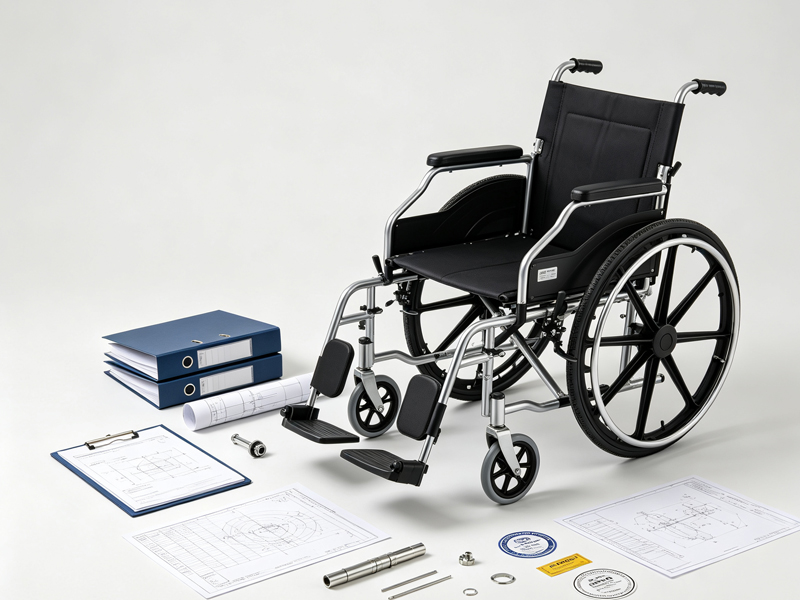
A missing document does not automatically mean the supplier is unreliable.
There may be a reasonable explanation. For example, a new model may still be undergoing testing, or certain documents may only be issued after a formal order.
The correct response is to ask specific questions.
Instead of saying:
“You don’t have the documents.”
ask:
“Which documents are currently available, which are pending, and when will the remaining documents be provided?”
Also ask whether the document applies to:
If a supplier repeatedly provides generic certificates that cannot be connected to the actual product, or refuses to identify the applicable testing and compliance basis, buyers should investigate further before making a large commitment.
For international wheelchair procurement, documentation should be treated as a verification tool rather than a formality.
A wheelchair supplier’s technical documents are much more than a collection of PDFs.
They form a record of what the product is, how it should be used, how it was tested, how it should be maintained, and what requirements it is designed to meet.
For buyers, the most important documents usually include the technical specification sheet, engineering drawing, user manual, test reports, compliance documentation, battery information, quality inspection records, packaging specifications, spare-parts list, and warranty information.
The exact documentation package will vary according to the wheelchair type, target market, and purchasing arrangement. A basic manual wheelchair does not require the same technical file as a powered wheelchair with a lithium battery and electronic controller.
The best approach is therefore not to demand a standard list blindly. Instead, buyers should identify the destination market, product type, intended use, and purchasing volume first, then build a documentation checklist around those requirements.
In the end, good technical documentation gives both the supplier and buyer something extremely valuable: a clear reference for the product they have agreed to manufacture, purchase, sell, and support.
For companies building a long-term wheelchair business, that clarity can be just as important as the wheelchair itself.
1. What is the most important technical document a wheelchair supplier should provide?
There is no single document that replaces all others. However, a detailed product specification sheet is usually the starting point because it defines the wheelchair’s dimensions, weight, load capacity, materials, components, and key performance parameters. For powered wheelchairs, battery, charger, electrical, testing, and compliance documentation are also particularly important.
2. Should a wheelchair supplier provide test reports and certificates?
Buyers should request the applicable test reports and conformity documentation for the exact wheelchair model and configuration they intend to purchase. The specific documents depend on the destination country, product type, applicable regulations, and relevant standards. Buyers should check the manufacturer name, model number, testing standard, report number, and date rather than relying only on a certificate logo or a supplier’s verbal statement.
3. What documents should I request before placing a bulk wheelchair order?
Before placing a large order, it is sensible to request at least the product specification, technical drawing, user manual, applicable compliance documents, relevant test reports, battery and charger information for electric models, quality-control information, packaging specifications, spare-parts list, and warranty terms. For OEM or customized wheelchairs, the approved technical drawing and final product specification are particularly important because they establish exactly what the supplier is expected to manufacture.