Our Location
Free Trade Tower, Xiyong street.
Chongqing, China

Free Trade Tower, Xiyong street.
Chongqing, China
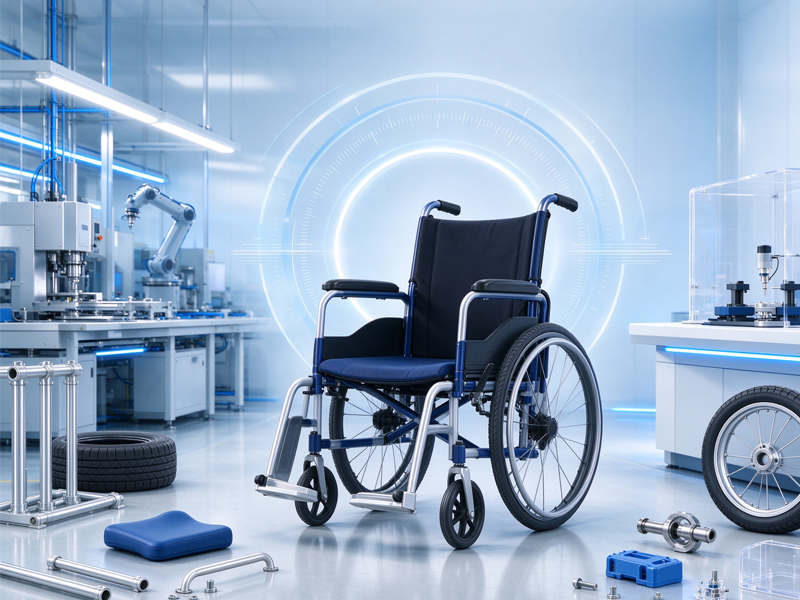
The frame looks strong. The wheels feel smooth. The seat appears comfortable. The folding mechanism works properly. The price fits the budget. The manufacturer has attractive product photos and perhaps an impressive-looking factory.
All of these things matter.
But there is another question that is often much more important than appearance:
How does the manufacturer control quality behind the product?
This is where ISO 13485 becomes relevant.
For companies purchasing wheelchairs for hospitals, rehabilitation centers, distributors, care organizations, government projects, or international markets, the manufacturer’s quality management system can have a direct impact on product consistency, regulatory compliance, traceability, risk management, and long-term cooperation.
ISO 13485:2016 is an internationally recognized quality management system standard specifically developed for organizations involved in medical devices. ISO states that the current edition was reviewed and confirmed in 2025, meaning ISO 13485:2016 remains the current published edition.
That does not mean an ISO 13485 certificate automatically makes every wheelchair better.
It means something more practical: the manufacturer has established a structured system for controlling processes that can affect the safety, conformity, and reliability of medical devices.
A wheelchair may look relatively simple compared with sophisticated medical equipment. There are no complex screens, advanced sensors, or complicated electronic systems on a basic manual wheelchair.
But simplicity in appearance does not mean simplicity in responsibility.
A wheelchair can carry a person’s body weight for hours every day. It may be used indoors, outdoors, in hospitals, rehabilitation facilities, nursing homes, transportation environments, and uneven terrain. Depending on the model, it can be folded, transferred, adjusted, pushed, propelled, tilted, reclined, or exposed to repeated mechanical loads.
Small manufacturing inconsistencies can therefore become meaningful problems.
A poorly controlled weld, for example, may affect structural integrity. A dimensional variation can influence assembly. An inconsistent brake component can affect operation. A change in material or supplier may alter performance. An incorrect label or missing production record can create traceability problems.
This is why choosing a wheelchair manufacturer should not be based solely on the finished product.
You also need to understand how that product is made and controlled.
ISO 13485 provides a framework for this kind of quality management. ISO describes it as a standard for the design and manufacture of medical devices, with requirements intended to help organizations consistently meet customer and applicable regulatory requirements.
For wheelchair buyers, this shifts the conversation from:
“Does this wheelchair look good?”
to:
“Can this manufacturer consistently produce the wheelchair according to controlled requirements?”
That is a much more useful question.
ISO 13485 is sometimes treated simply as another certificate that a factory can display on a wall.
It is better understood as a framework for managing the processes behind a medical device.
The standard covers areas connected with the quality management system and the medical device life cycle, including design and development, production, supplier-related processes, installation, servicing, and other activities depending on the organization’s scope. ISO also highlights risk management and risk-based decision-making as important aspects of ISO 13485:2016.
For a wheelchair manufacturer, this can translate into several practical areas that buyers should pay attention to.
One of the biggest advantages of a structured quality management system is process consistency.
Imagine ordering 1,000 wheelchairs.
You do not want the first 100 units to have one level of quality, the next 300 units to have another, and the final 600 units to vary depending on which production team happened to manufacture them.
Large-volume purchasing requires repeatability.
A professional wheelchair manufacturer should have defined procedures for purchasing, incoming materials, production, inspection, testing, nonconforming products, documentation, and release.
ISO 13485 does not tell a factory exactly what color a wheelchair should be or which wheel size it must use. Instead, it establishes requirements for managing the quality system around medical device production.
That difference matters.
The goal is not simply to make one excellent wheelchair.
The goal is to build a system capable of producing conforming wheelchairs repeatedly.
For distributors and institutional buyers, that repeatability can be more valuable than a particularly impressive sample.
A wheelchair is made from many individual components.
Depending on the design, these may include aluminum or steel tubing, upholstery, casters, rear wheels, hand rims, bearings, brakes, footrests, armrests, fasteners, cushions, plastic components, coatings, labels, packaging materials, and more.
The final product can only be as reliable as the processes used to control these inputs.
This is one reason supplier management matters.
A manufacturer may have excellent assembly workers, but if critical components are purchased without adequate specifications or supplier controls, quality can become inconsistent.
A mature medical device quality system creates a more systematic approach to purchasing and external providers.
For a buyer, this can be particularly important when a manufacturer tells you:
“We can make the price lower because we changed the supplier.”
The right question is not simply whether the new supplier is cheaper.
You should ask:
Was the supplier evaluated?
Were the materials or components verified?
Was the change documented?
Was the effect on product conformity assessed?
Does the manufacturer have a formal process for controlling supplier changes?
These questions reveal much more about a manufacturer’s quality culture than a factory tour alone.
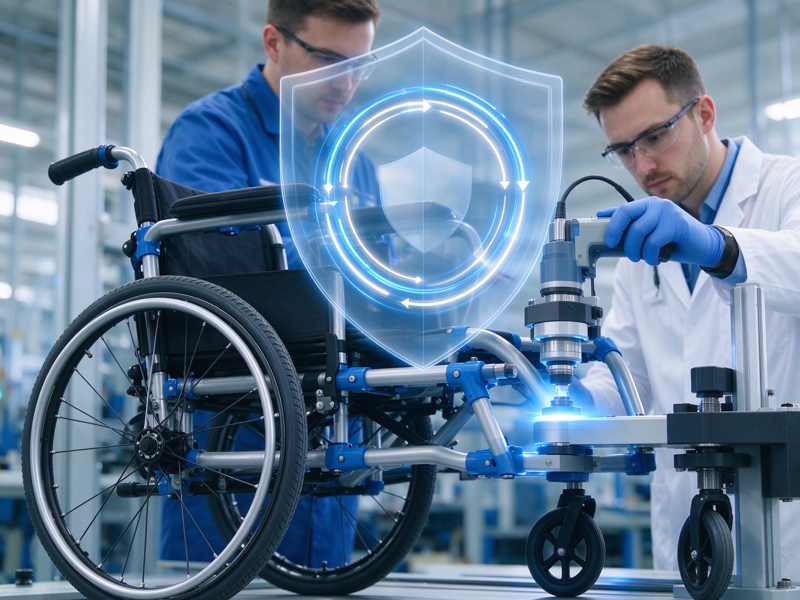
Every medical device involves some degree of risk.
ISO explains that ISO 13485:2016 places greater emphasis on risk management and risk-based decision-making than the previous edition.
For wheelchairs, risk management can involve many practical considerations.
Consider a folding wheelchair.
The manufacturer needs to consider how the folding mechanism operates, how components interact, whether the structure remains stable under intended use, and what could happen if a component does not perform as expected.
Consider wheelchair brakes.
The manufacturer needs to think about the intended function, the operating conditions, the components involved, and potential failure modes.
Consider adjustable footrests.
A manufacturer should consider whether the adjustment mechanism works as intended and whether the product information adequately communicates relevant use conditions.
This does not mean that ISO 13485 provides a single “wheelchair safety test.”
Instead, it establishes a broader quality management framework within which risks associated with medical devices are identified and controlled.
This is an important distinction for buyers.
ISO 13485 is about the manufacturer’s quality management system. It is not a product-performance certificate that eliminates the need to evaluate the specific wheelchair.
A responsible buyer should therefore look at ISO 13485 alongside applicable product standards, regulatory requirements, technical documentation, testing records, and actual product specifications.
Nobody wants to think about product problems.
But professional manufacturing is not built around the assumption that nothing will ever go wrong.
It is built around the ability to identify, investigate, correct, and prevent problems.
Imagine that a distributor discovers an issue affecting a particular batch of wheelchairs.
Without adequate records, the manufacturer may struggle to answer basic questions:
When were these units produced?
Which materials were used?
Which supplier provided the affected component?
Which production batch was involved?
Which inspection records were completed?
Were other products made using the same component?
Was the issue isolated or systemic?
A strong quality management system supports the documentation and traceability processes needed to investigate such situations.
This is especially important for international wheelchair distributors.
A distributor may have thousands of products already in warehouses, hospitals, retail channels, or customers’ homes.
If a problem occurs, knowing exactly which products are affected can make a major difference.
Good traceability can help limit the scope of an investigation instead of turning a small issue into an unnecessarily large one.
When choosing a wheelchair manufacturer, many buyers conduct a factory audit.
This is a good practice.
But a factory audit should go beyond checking whether the production floor looks clean.
A modern wheelchair factory can look impressive during a two-hour visit.
The real question is whether the factory’s processes remain controlled when nobody from the customer is watching.
ISO 13485 provides a structured quality framework that can make supplier audits more meaningful.
Instead of asking only:
“Is the factory clean?”
you can examine:
ISO’s own guidance describes the standard as relevant across areas such as customer requirements, design, development, production, supply chain, installation, servicing, and post-market surveillance.
That is why ISO 13485 can be useful as a starting point for supplier due diligence.
It gives buyers a framework for asking better questions.
Wheelchair manufacturers often serve customers in multiple countries.
This creates a complicated environment because medical device regulations are not identical everywhere.
A wheelchair intended for one market may face different registration, labeling, documentation, testing, or quality-system expectations in another.
ISO 13485 does not replace local medical device regulations.
This point should be made very clearly.
An ISO 13485 certificate does not automatically mean that a wheelchair is approved for sale in every country.
Instead, ISO 13485 provides an internationally recognized quality management framework that can support organizations in meeting applicable regulatory requirements.
ISO notes that the standard is specifically tailored to medical-device regulatory and safety requirements and can facilitate market access across countries.
For importers and distributors, this can reduce some of the uncertainty involved in evaluating an overseas manufacturer.
If you are sourcing wheelchairs internationally, you should still verify the regulatory requirements that apply to your specific destination market and product classification.
But starting with a manufacturer that understands medical-device quality systems can make the entire process more structured.
One common question from wheelchair buyers is:
“If a manufacturer has ISO 9001, do we still need ISO 13485?”
These standards are not interchangeable.
ISO 9001 is a general quality management standard applicable across many industries.
ISO 13485 is specifically designed for medical devices and places greater emphasis on regulatory requirements, medical-device risk management, and controls relevant to the medical-device life cycle. ISO itself distinguishes the two standards in this way.
Think about it this way.
A company manufacturing office furniture, automotive components, industrial equipment, and medical devices could all use quality management principles.
But medical devices introduce specific regulatory and safety considerations.
A wheelchair may be mechanically straightforward, but it is still a product used by people who may depend on it for mobility and daily activities.
Therefore, when evaluating a manufacturer whose business is specifically medical devices, ISO 13485 provides information that a general quality certification does not communicate by itself.
This does not mean ISO 9001 is meaningless.
It means that buyers should understand what each certification actually represents rather than treating all ISO certificates as equivalent.
This is perhaps the most important point in the entire discussion.
An ISO 13485 certificate is useful.
But it should never be the only factor in your supplier evaluation.
A certificate cannot tell you everything about a particular wheelchair model.
It cannot tell you whether the seat width is appropriate for your customers.
It cannot tell you whether the wheelchair is comfortable for long-term use.
It cannot tell you whether the folding mechanism feels convenient.
It cannot tell you whether spare parts are readily available.
It cannot tell you whether the manufacturer’s sales team responds quickly.
And it cannot tell you whether the factory understands your target market.
The certificate is one piece of evidence within a much larger evaluation.
A professional buyer should consider at least five dimensions:
| Evaluation Area | What to Look For |
|---|---|
| Quality Management | ISO 13485 certification and a functioning QMS |
| Product Quality | Testing, inspection, materials, construction and consistency |
| Regulatory Capability | Understanding of destination-market requirements |
| Manufacturing Capability | Production capacity, process control and equipment |
| After-Sales Support | Spare parts, complaints, warranty and corrective actions |
This approach produces a much more realistic picture of a wheelchair supplier.
If you are comparing several manufacturers, do not simply ask:
“Are you ISO 13485 certified?”
Ask for evidence.
For example:
Can you provide a valid ISO 13485 certificate and confirm the certification scope?
The scope matters because a certificate should be considered in relation to the activities and products covered by the certification.
You can also ask:
Which wheelchair models are covered by your quality management system?
How do you control critical suppliers?
How do you handle nonconforming products?
What happens when a customer reports a product problem?
How are design changes controlled?
How do you manage component substitutions?
Can you provide relevant test reports for the wheelchair model?
How do you ensure consistency between samples and mass production?
What is your procedure for corrective and preventive action?
How do you manage spare parts and after-sales service?
The quality of the answers can tell you a great deal.
A manufacturer that understands these questions should be able to explain its processes clearly.
A manufacturer that treats quality as a marketing slogan may focus primarily on sending you a certificate and avoid discussing how its system works.
That difference is worth noticing.
Another practical issue is certificate verification.
In international sourcing, buyers sometimes receive certificates as PDF files or screenshots.
Do not assume that every document you receive provides the same level of assurance.
Check the certification body’s details, certificate number, scope, validity, and relevant information.
ISO itself makes an important point: ISO does not perform certification. Certification is conducted by independent certification bodies.
That means buyers should distinguish between:
ISO publishing a standard
and
a certification body certifying a company’s management system.
This distinction is easy to overlook but important when conducting supplier due diligence.
If the manufacturer claims ISO 13485 certification, ask for the complete certificate and verify the information with the certification body where appropriate.
For a one-time purchase of a small number of wheelchairs, price may dominate the conversation.
For a long-term distributor or institutional buyer, the calculation is different.
Suppose you plan to purchase 5,000 wheelchairs over several years.
The initial unit price is only part of the total cost.
You also need to consider:
A manufacturer with controlled processes may help reduce uncertainty across these areas.
Again, ISO 13485 does not guarantee that a supplier will never experience quality problems.
No quality system can make that promise.
Its value lies in creating a structured system for controlling processes and responding when problems occur.
That is especially valuable in long-term business relationships.
When buyers inspect a wheelchair, they naturally look at the final product.
They check the frame.
They operate the brakes.
They fold the chair.
They inspect the upholstery.
They test the wheels.
But a high-quality wheelchair manufacturer should have controls long before the finished product reaches the inspection area.
Quality starts with requirements.
Then materials.
Then suppliers.
Then production processes.
Then inspections and testing.
Then product release.
Then packaging and distribution.
Then customer feedback and post-market information.
This lifecycle perspective is one of the reasons ISO 13485 is particularly relevant to medical device manufacturers. ISO describes the standard as covering organizations involved in different stages of the medical device life cycle, depending on their activities.
The finished wheelchair is therefore only the visible result of a much larger system.
When selecting a manufacturer, you are not really buying a wheelchair factory’s product.
You are also choosing its quality system, processes, people, suppliers, documentation, and approach to responsibility.
If you are currently sourcing manual wheelchairs, electric wheelchairs, lightweight wheelchairs, transport wheelchairs, pediatric wheelchairs, or other mobility products, the following checklist can be useful.
Before requesting a quotation
Confirm:
☐ The manufacturer specializes in medical devices or mobility equipment
☐ ISO 13485 certification is available
☐ The certificate is current and the scope is relevant
☐ Product specifications are clearly documented
☐ Applicable product testing can be provided
☐ The manufacturer understands your destination market
During supplier evaluation
Ask about:
☐ Incoming material inspection
☐ Supplier qualification
☐ Production process controls
☐ Final inspection
☐ Testing procedures
☐ Nonconforming product control
☐ Traceability
☐ Complaint handling
☐ Corrective action
☐ Change control
☐ After-sales support
Before mass production
Confirm:
☐ Approved samples
☐ Final specifications
☐ Packaging requirements
☐ Labeling requirements
☐ Inspection criteria
☐ Production schedule
☐ Quality agreement, if appropriate
☐ Communication procedures
☐ Spare-parts strategy
This checklist is simple, but it can prevent an important sourcing mistake: choosing a supplier because the sample looked good while failing to evaluate whether the manufacturer can reproduce that quality consistently at scale.
There is a subtle difference between buying a product and choosing a medical device manufacturer.
When you buy an ordinary consumer product, you may primarily evaluate price, design, convenience, and durability.
When you source wheelchairs professionally, you are also accepting responsibility for the quality of the supply chain behind the product.
That makes the manufacturer’s management system important.
ISO 13485 offers an internationally recognized framework specifically created for medical device quality management. ISO says its purpose includes helping organizations consistently meet customer and applicable regulatory requirements while managing quality throughout relevant parts of the product life cycle.
For a wheelchair buyer, this can translate into something very practical:
greater visibility into how quality is managed.
You can ask how materials are controlled.
You can ask how production is controlled.
You can ask how defects are handled.
You can ask how changes are documented.
You can ask how complaints are investigated.
You can ask how the manufacturer maintains consistency.
Those conversations are often much more valuable than simply asking for the lowest quotation.
A wheelchair is the final product you can touch.
ISO 13485 gives you a way to look at what happens behind that product.
It does not guarantee perfection, and it should not be treated as a substitute for product testing, regulatory review, supplier audits, or your own due diligence.
But when two wheelchair manufacturers appear similar on the surface, their quality management systems can provide an important additional dimension for comparison.
A reliable wheelchair manufacturer should be able to demonstrate more than production capacity.
It should be able to explain how it controls quality.
It should understand medical-device requirements.
It should have processes for managing suppliers, production, documentation, complaints, changes, and nonconforming products.
And, most importantly, it should be able to demonstrate that quality is part of the manufacturing process rather than simply part of the marketing language.
For hospitals, distributors, rehabilitation providers, importers, and mobility-equipment businesses, this is why ISO 13485 matters when choosing a wheelchair manufacturer.
The question is not simply:
“Can this factory make a wheelchair?”
The better question is:
“Can this manufacturer consistently make the right wheelchair, control the risks, document the process, respond when something goes wrong, and support the product throughout its intended life cycle?”
That is the level at which professional supplier selection begins.
1. Is ISO 13485 certification mandatory for every wheelchair manufacturer?
Not necessarily. The requirement depends on the manufacturer’s activities, product classification, and the regulations applicable in the target market. ISO 13485 itself is a quality management system standard for medical devices; it is not a universal statement that every wheelchair manufacturer everywhere must hold a certificate.
However, for buyers evaluating medical-device manufacturers, an ISO 13485-certified quality management system can be an important part of supplier due diligence. The applicable regulatory requirements of the destination country should always be checked separately.
2. Does ISO 13485 guarantee that a wheelchair is safe and high quality?
No.
ISO 13485 addresses the manufacturer’s quality management system. It does not mean that every individual product is automatically perfect, nor does it replace product-specific testing or regulatory requirements.
A buyer should still evaluate the wheelchair’s design, specifications, testing, materials, intended use, applicable standards, documentation, and actual production quality.
The most useful way to view ISO 13485 is as evidence of a structured quality-management approach—not as a guarantee of a particular product’s performance.
3. What should I check besides ISO 13485 when choosing a wheelchair manufacturer?
Look at the complete supplier picture.
Check the manufacturer’s relevant certifications and their scope, product testing documentation, manufacturing capabilities, quality-control procedures, supplier-management process, traceability system, complaint handling, corrective-action process, production capacity, spare-parts availability, warranty policy, and experience in your target market.
It is also worth ordering samples and, for larger projects, considering a factory audit or independent pre-shipment inspection.
In short, ISO 13485 should be one important part of the decision—not the entire decision.
A strong wheelchair supplier should be able to combine a controlled medical-device quality system with reliable products, transparent documentation, responsive communication, and dependable long-term service.