Our Location
Free Trade Tower, Xiyong street.
Chongqing, China

Free Trade Tower, Xiyong street.
Chongqing, China
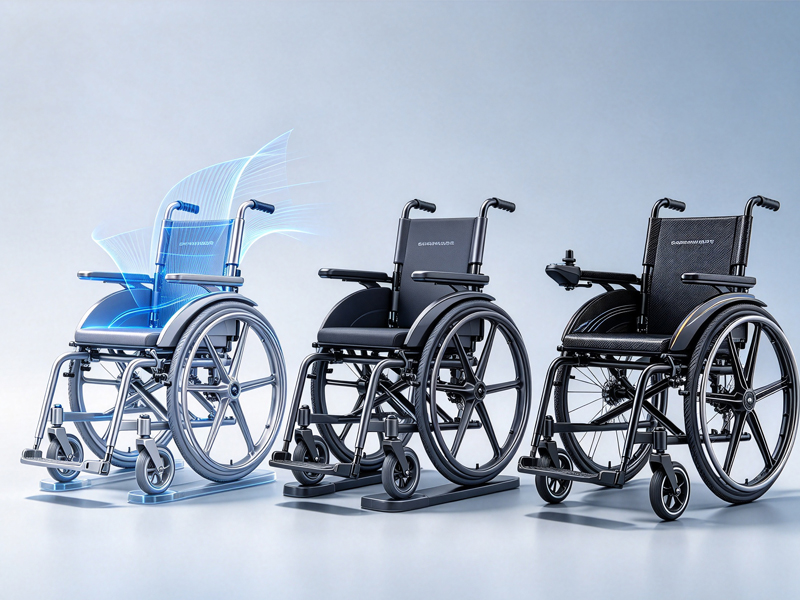
Three materials appear frequently in power wheelchair designs: aluminum, steel, and carbon fiber. Each offers a different combination of weight, structural strength, durability, maintenance requirements, and cost. A lightweight frame may be ideal for someone who travels regularly, while a heavier steel construction may make more sense for a user who prioritizes a robust platform and rarely needs to lift the chair into a vehicle.
There is no single material that works best for everyone. The right choice depends on the wheelchair’s design, the user’s weight and mobility requirements, the environments where the chair will be used, and the seating features needed throughout the day.
That last consideration deserves more attention than it often receives. A power wheelchair may include advanced seating options such as tilt-in-space or power recline, which influence how the chair supports the user during extended periods of sitting. These systems must work together with the frame, not simply be added as convenient extras.
So, when comparing aluminum vs steel vs carbon fiber power wheelchair frames, which material offers the best overall value? Let’s look beyond the product specifications and examine what each option means in everyday life.
The frame is the structural foundation of a power wheelchair. It supports the user, seating system, batteries, motors, and other components while helping the chair remain stable as it moves across different surfaces.
Unlike a stationary seat, a powered wheelchair experiences repeated loads throughout the day. It may travel over thresholds, cross uneven pavement, turn in confined spaces, climb ramps, or carry a seating system that changes position at the push of a button. These conditions place different demands on the frame.
Material choice affects several practical considerations:
However, the material alone does not determine performance. Tube dimensions, joint design, welding quality, manufacturing tolerances, and the manufacturer’s testing standards all matter.
A well-designed aluminum frame can be a better choice than a poorly engineered steel frame. Likewise, carbon fiber does not automatically make a wheelchair more comfortable or safer simply because it is lightweight.
The most useful comparison starts with how the complete wheelchair performs, rather than treating the material name as a guarantee of quality.
Aluminum has become a popular choice for lightweight power wheelchairs because it offers a useful balance between weight, strength, corrosion resistance, and manufacturing cost.
Compared with steel, aluminum has a much lower density. Manufacturers can use this characteristic to reduce frame weight, although the final savings depend on the design and the amount of reinforcement required.
For many users, this balance is exactly what makes aluminum attractive.
Imagine someone who uses a power wheelchair at home during the week but also visits family, attends appointments, and takes occasional weekend trips. The wheelchair needs to be sturdy enough for daily use without becoming unnecessarily difficult for a caregiver to handle during transportation.
An aluminum frame can be a sensible solution for this combination of needs.
The first advantage is weight. A lighter frame can make a meaningful difference when a wheelchair must be lifted, folded, or disassembled for transport. It can also reduce the burden on caregivers who regularly help move the equipment.
Aluminum also has good natural corrosion resistance because a thin oxide layer forms on its surface. This makes it less susceptible to ordinary rust than unprotected steel, particularly when the chair is exposed to occasional moisture.
Maintenance is still important. Surface finishes, fasteners, joints, electrical components, and other metal parts may require attention even when the main frame resists corrosion well.
Another benefit is availability. Aluminum alloys are widely used in mobility equipment, and manufacturers have considerable experience forming, joining, and reinforcing them for different wheelchair designs.
This makes aluminum a practical option for people who want a relatively lightweight chair without paying the premium often associated with carbon fiber.
Aluminum is not indestructible. Repeated stress, poor joint design, impact damage, or use beyond the manufacturer’s specified limits can compromise a frame over time.
Its fatigue behavior also differs from steel. Aluminum generally has no clearly defined endurance limit below which fatigue failure can be assumed never to occur. That does not mean aluminum wheelchairs are inherently short-lived; it means fatigue resistance must be addressed through engineering, material selection, and appropriate use.
Some aluminum designs compensate with larger tube sections or reinforced joints. This can improve structural performance, although it may reduce part of the potential weight advantage.
Aluminum is also not automatically inexpensive to repair. Welding a load-bearing wheelchair frame requires appropriate expertise, and unauthorized repairs may affect structural integrity or warranty coverage.
Best suited for: Users seeking a balanced combination of manageable weight, everyday durability, corrosion resistance, and reasonable cost.
Steel has a long history in mobility equipment. It remains relevant because it offers dependable structural performance, established manufacturing methods, and a relatively accessible material cost.
For some wheelchair users, minimizing weight is not the primary concern. The chair may spend most of its time at home, in a care facility, or on accessible routes where it does not need to be lifted regularly. In those circumstances, a heavier frame may be an acceptable trade-off for a design that meets the user’s load-bearing and durability requirements.
Steel is especially worth considering in heavy-duty and bariatric power wheelchair categories, although the manufacturer’s stated weight capacity—not the material itself—must determine whether a particular model is suitable.
Steel is strong, widely available, and familiar to wheelchair manufacturers and repair technicians. Depending on the alloy and frame geometry, it can be designed to withstand substantial loads and repeated mechanical stress.
Steel also has a useful characteristic: it can deform before fracturing under certain loading conditions. Its behavior depends on the specific grade, design, and type of force involved, but this ductility can be valuable in engineered structures.
For buyers working within a limited budget, steel may provide a more affordable route to a suitable power wheelchair. Its established fabrication and repair processes can also be advantageous when replacement parts and qualified local service are readily available.
A steel frame may make sense for someone who uses a wheelchair primarily indoors, has reliable ramp or lift access, and values a robust everyday platform more than minimum transport weight.
Weight is the obvious compromise.
Steel is considerably denser than aluminum, so a comparable design may be heavier. The difference becomes important when a family needs to place the wheelchair in a car, carry components through an airport, or move the chair without a vehicle lift.
The complete wheelchair matters here. A frame that seems manageable on paper may become much harder to transport once batteries, motors, seating equipment, and accessories are included.
Steel also requires appropriate corrosion protection. Painted, coated, or otherwise treated frames can resist rust effectively, but scratches and chipped finishes may expose the underlying metal to moisture. Users in wet or coastal environments should pay attention to surface damage and follow the manufacturer’s maintenance recommendations.
It is also important not to confuse weight with durability. A heavier chair is not automatically stronger than a lighter one. Frame geometry, material grade, joint construction, and testing determine how well the structure performs under its intended loads.
Best suited for: Buyers who prioritize cost, a robust structural platform, and an appropriate heavy-duty design, particularly when frequent lifting and transport are not major concerns.
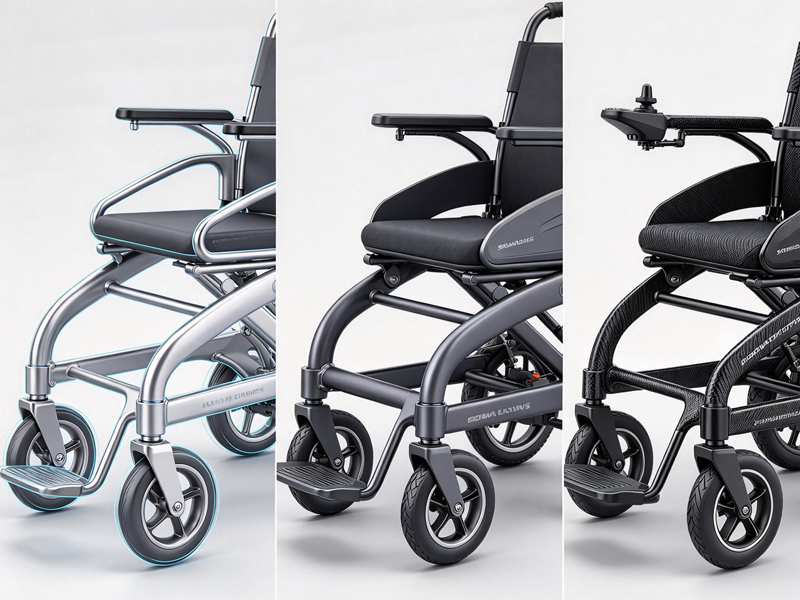
Carbon fiber takes a different approach to wheelchair construction. Rather than relying on a conventional metal frame, carbon fiber components use carbon fibers embedded in a resin matrix to create a lightweight composite structure.
The appeal is straightforward: carbon fiber can provide a high strength-to-weight and stiffness-to-weight ratio when engineered appropriately. This makes it attractive for premium mobility products where reducing weight is a central design goal.
For someone who travels frequently, lives in a home with limited storage space, or depends on another person to help transport a wheelchair, reducing the amount of equipment that must be lifted can have practical value.
Yet carbon fiber is not automatically the best choice simply because it can be lighter.
Weight reduction is the principal attraction. A suitably designed carbon fiber power wheelchair may be easier to lift or transport than a comparable metal-frame model.
That benefit can influence travel planning, vehicle loading, and daily handling. It may also be valuable for caregivers who repeatedly move the equipment and want to minimize physical strain.
Carbon fiber does not rust like steel, and composite structures can be engineered for high stiffness. Depending on the design, this can contribute to a solid, responsive feel during movement.
However, ride comfort should not be judged by frame material alone. Tire construction, suspension, seat cushioning, wheel configuration, and the surfaces encountered may have a greater influence on how much vibration reaches the user.
A lightweight frame also does not guarantee a long battery range. A lower overall wheelchair mass can reduce the energy required for movement, but actual range depends on many factors, including battery capacity, motor efficiency, terrain, user weight, temperature, and driving habits.
The first drawback is cost. Carbon fiber components typically involve more specialized manufacturing processes than conventional metal frames, and premium construction can significantly increase the purchase price.
The second is repairability. A damaged metal component may sometimes be repaired by an appropriately qualified specialist. Carbon fiber damage is more complicated because the condition of the fibers and resin may not be obvious from the surface.
A cracked or impact-damaged composite component should be assessed according to the manufacturer’s procedures. Replacement may be necessary, and improvised repairs are not appropriate for safety-critical structures.
Carbon fiber is also not immune to damage. A severe impact can compromise its structural integrity even when the exterior damage appears limited.
Before buying a carbon fiber power wheelchair, ask about the warranty, inspection requirements, availability of replacement components, and the service network that can support the chair after purchase.
Best suited for: Users who place a high priority on minimizing weight and can justify the additional purchase cost and specialized repair considerations.
The following table summarizes the general trade-offs. These are material-level tendencies, not guaranteed specifications for every power wheelchair.
| Feature | Aluminum | Steel | Carbon Fiber |
|---|---|---|---|
| Relative material weight | Low | High | Very low potential |
| Structural strength | Depends on alloy and design | Depends on grade and design | Depends on fiber orientation and composite design |
| Corrosion resistance | Generally good | Requires suitable protection | Does not rust like steel |
| Initial cost | Moderate | Often lower | Often highest |
| Repair options | Specialist assessment required | Specialist assessment required | Often requires specialist assessment or replacement |
| Transport convenience | Generally good | More challenging if the chair is heavy | Excellent when the complete chair is genuinely lightweight |
| Maintenance priorities | Inspect joints and fatigue-related damage | Inspect coatings, corrosion, and joints | Inspect for impact and composite damage |
| Typical appeal | Everyday balance | Cost and robust construction | Weight reduction and portability |
One distinction deserves particular attention: frame weight is not the same as total wheelchair weight.
A wheelchair may use a lightweight frame but still weigh considerably more after its motors, batteries, powered seating, and accessories are installed. Similarly, two chairs made from the same material can have very different total weights because of their designs.
Ask manufacturers for both the complete chair weight and the heaviest component that must be lifted during transport. If a wheelchair cannot be safely lifted by the intended caregiver, its low advertised frame weight may not solve the real problem.
Frame material is only part of the decision. The seating system can be equally important, especially for people who spend much of the day in their power wheelchair.
In its article, Aluminum vs Steel vs Carbon Fiber Power Wheelchair Frames Which Is Best, Marc’s Mobility explains that tilt and recline serve different purposes. Understanding that distinction helps buyers evaluate whether a particular frame and seating configuration will support their everyday needs.
A tilt-in-space system moves the seat, backrest, and foot support together while maintaining the same seat-to-back angle.
For example, someone sitting with their hips at approximately a right angle can tilt the entire seating system backward without substantially changing that hip angle.
This movement shifts the distribution of body weight across the seating surface. It is often used in pressure management for people who cannot independently reposition themselves.
Tilt may also help some users manage fatigue or positional discomfort, depending on their clinical circumstances and prescribed seating setup.
The frame and base must accommodate the tilt mechanism and its range of motion while maintaining appropriate stability. Buyers should therefore confirm that the specific wheelchair supports the required seating configuration and that the manufacturer has approved the intended combination.
A recline system moves the backrest relative to the seat, increasing the angle between them.
This can be useful for people who need changes in hip positioning, require assistance with certain personal-care routines, or benefit from a prescribed change in posture.
Reclining is not interchangeable with tilting. As the backrest moves, the user’s body may slide against the seating surface, potentially increasing shear forces on the skin. The correct technique, cushion, seat geometry, and positioning system can all matter.
Some users need both tilt and recline because the two functions address different requirements. A combined seating system may provide more flexibility, but it can also add mechanical complexity, components, and weight.
This is where the frame comparison becomes more meaningful. Someone choosing carbon fiber primarily to reduce transport weight should verify whether the actual model can accommodate the required tilt or recline system. A person who needs a comprehensive powered seating package should compare complete configurations rather than choosing a frame material in isolation.
There is no universal rule that carbon fiber is unsuitable for advanced seating or that steel is necessary for tilt and recline. Compatibility depends on the particular product’s engineering and approved specifications.
Before purchasing, consider the following questions:
For users with pressure injury risk, reduced sensation, limited ability to shift weight, or significant postural needs, a seating assessment by a qualified rehabilitation professional is especially important.
A lighter frame is valuable only if the complete wheelchair also provides the support, positioning, and functionality the user needs.
Instead of choosing a material based on its reputation, start with the situations the wheelchair must handle every day.
<PRIVATE_PERSON> lives independently and uses a power wheelchair mainly indoors, with occasional trips to nearby shops. The chair does not need to be lifted into a vehicle often, and budget is a major consideration. A suitable steel model may provide the right balance of affordability and structural performance.
Another user travels regularly for medical appointments and family visits. A caregiver loads the wheelchair into a vehicle several times a week. In this situation, an aluminum model may provide a more practical compromise between weight, cost, and everyday usability.
A third user frequently travels and wants to minimize the physical effort required to transport mobility equipment. If a suitable carbon fiber power wheelchair meets the user’s seating, weight-capacity, and driving requirements, the additional cost may be worthwhile.
These examples are not strict rules. A steel wheelchair can be appropriate for travel when it is transported using a suitable lift or ramp. An aluminum chair may be too heavy for a particular caregiver. A carbon fiber chair may be unsuitable if its seating options do not meet the user’s needs.
The best decision comes from matching the complete wheelchair to the user’s real circumstances.
Material comparisons can become misleading when they focus on strength without considering how a wheelchair is engineered.
A power wheelchair must safely support the user and all installed equipment under its intended operating conditions. Always check the manufacturer’s specified weight capacity for the exact model and configuration.
Do not assume that steel automatically supports more weight than aluminum or carbon fiber. The capacity depends on the complete structure, its joints, seating system, wheelbase, and testing.
Stability matters just as much. A wheelchair’s center of gravity, wheel arrangement, seat height, tilt range, and accessory placement all influence its behavior. Adding a powered seating system can change the weight distribution, so the approved configuration is more important than the frame material alone.
Comfort also deserves a broader assessment. Frame stiffness is one factor, but it cannot predict the entire ride experience. Cushion design, suspension, tire pressure where applicable, seat dimensions, posture, and the surfaces used each day influence comfort.
If possible, test the chair on surfaces similar to those you encounter regularly. Check how it turns, how it handles thresholds, whether the seating remains supportive, and whether the controls are easy to operate.
The goal is not to purchase the lightest or strongest wheelchair on paper. It is to find a chair that performs reliably in your actual environment.
The initial price is only one part of the ownership equation.
A lower-cost wheelchair may be the better investment when it meets the user’s needs, has accessible replacement parts, and can be maintained locally. A premium lightweight model may offer greater value to someone who transports it frequently and benefits substantially from its lower weight.
Before making a decision, compare the following:
Warranty coverage. Find out what the warranty covers for the frame, seating mechanism, electronics, and batteries. Ask whether accidental damage and unauthorized modifications affect coverage.
Repair availability. Check whether qualified technicians can service the wheelchair in your area. Ask how damaged frame components are assessed and whether replacement parts are readily available.
Expected use. Consider daily travel distance, outdoor exposure, ramps, thresholds, and the frequency of loading and unloading.
Replacement costs. A specialized component may be expensive or take time to obtain. This matters when the wheelchair is essential to everyday independence.
Caregiver effort. A lighter chair may reduce the effort required for handling, but the actual benefit depends on which components must be lifted and how frequently transport takes place.
Regular inspections are important regardless of material. Follow the manufacturer’s maintenance schedule and have unusual noises, looseness, visible cracks, deformation, or impact damage assessed promptly. Do not continue using a wheelchair if a suspected structural problem could compromise safety.
For carbon fiber, pay particular attention to damage following a significant impact. For steel, inspect the protective finish and any areas exposed to moisture. For aluminum, check joints and other high-stress areas as directed by the manufacturer.
A wheelchair is a long-term mobility tool. Reliable service, appropriate fit, and a suitable seating configuration can matter far more than the prestige associated with a particular material.
If you are still comparing aluminum, steel, and carbon fiber power wheelchair frames, narrow the decision down to three priorities.
First, determine your functional requirements. Confirm the necessary weight capacity, seating dimensions, control options, and whether tilt, recline, or other powered seating functions are needed.
Second, assess portability realistically. Consider the complete wheelchair’s weight, the heaviest removable component, vehicle access, and whether a caregiver will need to lift it. If you rarely transport the chair, paying a substantial premium for the lightest possible frame may offer limited practical benefit.
Third, evaluate lifetime support. Compare warranty terms, maintenance requirements, replacement-part availability, and the cost of repairs.
For many everyday users, aluminum offers an appealing balance of weight, cost, and corrosion resistance. Steel remains a sensible option when budget and a robust, appropriately engineered platform are the priorities. Carbon fiber is worth considering when substantial weight reduction makes a meaningful difference to transport and daily handling.
None of these materials is universally superior. The right wheelchair is the one that meets the user’s physical needs, fits the intended environment, and remains practical to maintain over time.
If advanced seating is required, involve a qualified seating professional before committing to a particular model. A wheelchair that combines the correct frame, suitable seating functions, and appropriate positioning support will generally be more useful than one selected on material specifications alone.
Ultimately, the best power wheelchair frame is not simply the lightest, strongest, or least expensive. It is the foundation of a complete mobility system that supports comfort, safety, independence, and everyday life.
1. Is aluminum or steel better for a power wheelchair?
Neither is automatically better. Aluminum is generally lighter and naturally corrosion-resistant, making it a practical choice for many everyday users who need a balance between portability and cost. Steel is heavier but can provide a robust, economical frame when properly designed. The best option depends on the wheelchair’s tested weight capacity, construction quality, transport requirements, and intended use.
2. Is a carbon fiber power wheelchair worth the extra cost?
A carbon fiber power wheelchair may be worth the additional investment if reducing weight makes transportation significantly easier. This can be especially valuable for frequent travelers or users whose caregivers regularly load the chair into a vehicle. However, carbon fiber models can cost more and may require specialized assessment or component replacement after damage. Compare the complete wheelchair’s weight, seating options, warranty, and repair support before deciding.
3. Does frame material affect tilt and recline functionality?
Frame material alone does not determine whether a power wheelchair supports tilt or recline. These functions depend on the specific frame design, seating mechanism, weight capacity, and manufacturer-approved configuration. Tilt moves the seating system as a unit while maintaining the seat-to-back angle, whereas recline opens the angle between the seat and backrest. If you need either function—or both—confirm compatibility with the exact wheelchair model and consult a qualified rehabilitation professional about your positioning requirements.