Our Location
Free Trade Tower, Xiyong street.
Chongqing, China

Free Trade Tower, Xiyong street.
Chongqing, China

For people who rely on powered mobility, the right wheelchair can make these everyday experiences considerably easier. Yet finding a suitable model is not always straightforward. Traditional electric wheelchairs can be bulky, difficult to transport, and inconvenient to store in smaller homes or vehicles. Lightweight models, on the other hand, must offer more than easy handling. They also need to provide dependable power, comfortable seating, practical safety features, and enough flexibility for different environments.
This is where a lightweight foldable electric wheelchair with remote control becomes an appealing option.
Designed to combine powered movement with convenient storage and transport, this type of wheelchair can help users maintain greater independence without making everyday travel unnecessarily complicated. The Iyasomed YSE130X Foldable Electric Wheelchair is one model worth considering, particularly for people who want automatic folding, a compact storage footprint, and a balance of portability and everyday functionality.
The value of a portable power wheelchair becomes especially clear when you look beyond the journey itself.
Consider what happens before leaving home. The wheelchair needs to be positioned near the door, a companion may need to prepare the car, and there may be bags, shopping, or other items to organize. Once the destination is reached, the chair needs to be unloaded, unfolded, and ready for use. Every additional step can make an otherwise enjoyable outing feel more demanding.
A foldable electric wheelchair is designed to simplify this process.
Instead of leaving a full-size mobility device permanently assembled, users can fold the chair for storage or transport when appropriate. This can be useful for households with limited space, people who regularly travel by car, and families who want a powered wheelchair that fits more naturally into their existing routines.
Weight is another important consideration. A lighter frame can make a wheelchair easier for a caregiver to handle during loading and unloading. However, the term “lightweight” needs to be understood in context. Some folding power chairs remain relatively heavy because they include motors, batteries, wheels, and a reinforced frame. Buyers should therefore check the actual transport weight, including whether the battery can be removed to make handling easier.
The Iyasomed YSE130X addresses portability through an aluminium frame and an automatic folding mechanism. According to the manufacturer’s published specifications, its weight is approximately 31 kg without the battery and 35 kg in the stated complete configuration. The distinction matters: this is a more transport-conscious design than many conventional powered chairs, but it is not necessarily light enough for every user to lift independently.
For someone who regularly travels with a companion, the combination of powered mobility and foldable storage may be more important than achieving the lowest possible weight.
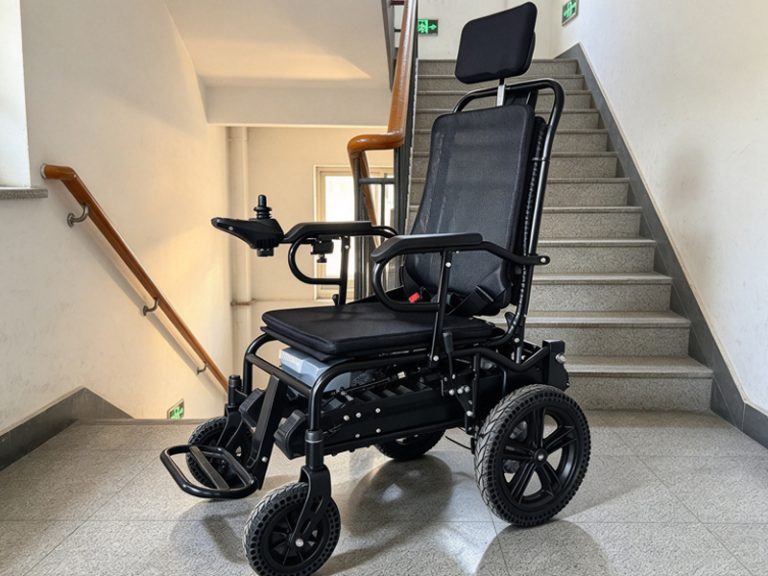
The Iyasomed YSE130X Foldable Electric Wheelchair combines an aluminium frame, dual electric motors, a lithium battery, and remote-controlled automatic folding in one portable mobility solution.
Its appeal lies in how these features work together rather than in any single specification. A powerful motor is useful, but it does not solve storage problems. A compact frame is helpful, but it is less practical if folding takes considerable effort. Comfortable seating is important, but users also need a chair that can be transported without turning every outing into a complicated operation.
The YSE130X aims to address these different needs in a single design.
Here is an overview of its published specifications.
| Feature | Iyasomed YSE130X Specification |
|---|---|
| Frame material | Aluminium alloy |
| Product weight | Approximately 31–35 kg, depending on configuration |
| Maximum user weight | 120 kg |
| Seat width | 48 cm |
| Seat depth | 45 cm |
| Seat height | 50 cm |
| Cushion thickness | 8 cm |
| Backrest height | 43 cm |
| Overall dimensions | 98 × 63 × 110 cm |
| Folded dimensions | 78 × 63 × 48 cm |
| Motor configuration | Dual 250 W motors |
| Battery | 24 V 12 Ah lithium battery |
| Advertised driving range | Approximately 15–25 km |
| Maximum speed | 6 km/h |
| Advertised climbing ability | Up to 15° |
| Charging time | Approximately 4–6 hours |
| Braking system | Electromagnetic brakes |
| Folding mechanism | Automatic folding with remote control |
| Manual operation | Manual mode available |
Specifications are based on the manufacturer’s product information. Actual performance can vary with user weight, terrain, temperature, battery condition, and driving habits. Confirm the exact configuration and current specifications with the seller before purchasing.
For buyers comparing a lightweight electric wheelchair with remote control, these figures provide a useful starting point. More importantly, they help explain how the chair may fit into real-world mobility needs.
One of the most distinctive features of the YSE130X is its remote-controlled automatic folding system.
On a conventional folding wheelchair, the user or caregiver usually needs to operate the folding mechanism manually. Depending on the design, this may involve releasing locks, adjusting the frame, and applying physical effort to collapse or reopen the chair.
An automatic folding mechanism offers a different approach. With the YSE130X, the remote control allows the user or caregiver to initiate the folding or unfolding process without relying entirely on manual handling.
This can be particularly useful when preparing the wheelchair for storage in a vehicle, putting it away at home, or getting ready to leave after a day out.
For older adults and people with limited upper-body strength, reducing repetitive physical effort can make the overall experience more manageable. Caregivers may also appreciate having fewer manual steps to complete during transport.
It is important, however, to distinguish between automatic folding and remote driving. The remote-controlled folding function is designed to operate the folding mechanism; buyers should not assume it provides unrestricted remote driving unless the manufacturer explicitly confirms that capability for the selected configuration.
The practical advantage is straightforward: the wheelchair is designed to make the transition between use and storage easier.
Before purchasing, it is worth asking the seller to demonstrate the complete folding cycle. Check how the chair behaves on a level surface, whether it needs to be positioned in a particular way, and what precautions are required around the moving frame. Keep hands, clothing, and other objects clear of the folding mechanism, and follow the supplied operating instructions.
A good folding system should not simply save time. It should also be predictable and easy to use correctly.
The frame is one of the most important parts of any electric wheelchair. It affects structural strength, overall weight, durability, and the amount of effort required to transport the device.
The YSE130X uses an aluminium alloy frame, a material commonly chosen for mobility equipment because it can provide a useful balance between strength and weight.
For people who travel regularly, this construction can make a difference when the chair needs to be moved between rooms, loaded into a vehicle, or stored away after use. It also helps support the overall portability-focused design.
Nevertheless, aluminium construction does not mean that the wheelchair is effortless to lift. At approximately 31–35 kg, depending on the configuration, the YSE130X may still require assistance when being placed into a car trunk.
That distinction is particularly important for buyers with limited lifting ability.
Before making a decision, consider how the wheelchair will actually be transported. Measure the available boot space, check the loading height, and determine whether a family member or caregiver will be available when needed. If lifting is difficult, a suitable vehicle ramp or other approved loading aid may be worth considering.
The folded dimensions of 78 × 63 × 48 cm provide a useful reference when measuring storage space. Remember to allow additional room for the shape of the trunk, surrounding luggage, and any accessories that must travel with the chair.
Portability is not determined by weight alone. A well-designed folding mechanism, manageable dimensions, and a realistic transport plan all contribute to a more convenient experience.
Battery capacity is another major consideration when selecting an electric wheelchair for daily mobility and travel.
The YSE130X is equipped with a 24 V 12 Ah lithium battery and dual 250 W motors. The manufacturer’s stated driving range is approximately 15–25 km per charge, with a maximum speed of 6 km/h.
For many users, this combination may be suitable for local outings, shopping trips, visits to public spaces, and other everyday activities. A powered wheelchair can reduce the physical effort associated with moving over longer distances, allowing users to focus more on where they want to go rather than how far they can comfortably travel.
However, advertised range should always be treated as an estimate rather than a guarantee.
Actual battery performance depends on several variables, including the user’s weight, road surface, gradients, outside temperature, frequency of stopping and starting, and battery condition. Repeatedly driving uphill or across rough ground can use more energy than travelling along smooth, level pavement.
For that reason, it is sensible to plan a journey with a comfortable reserve rather than assuming that the maximum advertised range will be available every time.
A simple routine can help:
The published charging time for the YSE130X is approximately four to six hours. This can make overnight charging or charging between outings convenient, provided the battery and charger are used according to the manufacturer’s instructions.
For frequent travellers, the removable lithium battery is also worth discussing with the seller. Its design may simplify certain transport arrangements, but it does not automatically mean the wheelchair is approved for every airline or transport operator.

A wheelchair that is easy to fold and transport still needs to provide appropriate seating support. This is especially important for users who spend extended periods in the chair.
The YSE130X has a 48 cm seat width, 45 cm seat depth, 50 cm seat height, and an 8 cm thick cushion. Its backrest measures 43 cm in height, and the armrests can be flipped up to make side access easier.
These dimensions offer a useful starting point when assessing fit.
The 48 cm seat width may provide comfortable room for some adults, but seat measurements should never be judged in isolation. The user’s hip width, posture, clothing, and preferred sitting position all influence how well a chair fits. A seat that is too narrow can create pressure, while one that is too wide may make it harder to maintain a stable position.
Seat depth is equally important. Ideally, the seat should support the thighs without placing excessive pressure behind the knees. The relationship between seat height, foot support, and the user’s leg length should also be considered.
The 8 cm cushion provides a substantial layer of padding, which may improve everyday comfort. However, cushion thickness alone does not establish pressure-relief performance or suitability for someone with particular medical or postural needs.
For users who have reduced sensation, a history of pressure injuries, or specific seating requirements, professional assessment may be necessary before choosing a wheelchair.
Flip-up armrests are another practical detail. They can make lateral transfers easier for people who are able to transfer safely with the appropriate support. Users should confirm that the armrests can be positioned as needed and that the transfer method is suitable for their individual abilities.
Comfort is personal. Whenever possible, check the seat measurements, try the chair, and discuss any specific support requirements before purchasing.
Electric wheelchairs need to do more than move. They must allow the user to control movement and stop appropriately in the environments where the chair will be used.
The YSE130X features electromagnetic brakes, dual 250 W motors, and a published climbing capability of up to 15°. Its maximum stated speed is 6 km/h.
Electromagnetic braking is designed to help control the chair when the drive system is disengaged or the brakes are activated, depending on the operating configuration. Users should understand exactly how the braking system works on their model and practise stopping in a safe, open area before travelling independently.
The stated climbing capability is also relevant, but it should not be interpreted as permission to attempt every slope measuring 15 degrees. Safe performance depends on the surface, traction, load, approach angle, battery condition, and other factors. Wet pavement, loose gravel, uneven ground, and cross-slopes may introduce additional risks.
A sensible approach is to become familiar with the chair on level, predictable surfaces before gradually expanding the range of environments.
New users should practise starting, stopping, turning, and navigating confined spaces. Caregivers should also understand the controls, braking behaviour, and any manual-mode procedures.
It is equally important to distinguish between a wheelchair that can handle some outdoor routes and one designed for demanding off-road use. The YSE130X is presented as a mobility solution for everyday indoor and outdoor use, but its suitability for a particular route should be confirmed against the manufacturer’s operating guidance.
The goal is not simply to reach a destination. It is to do so with confidence, appropriate preparation, and a clear understanding of the equipment’s limits.
A portable electric wheelchair is often most useful when it fits naturally into several parts of daily life rather than serving just one purpose.
At home: The folding design can help when storage space is limited. Before buying, measure doorways, turning areas, and the locations where the chair will be parked or charged.
For shopping and appointments: The stated range of 15–25 km may support many local outings, depending on route conditions and the user’s needs. Shopping centres, clinics, and other destinations may offer relatively smooth surfaces, although ramps and narrow spaces should be considered.
For family visits: A folding chair can be easier to accommodate in a vehicle than a permanently assembled mobility device. The actual convenience will depend on the vehicle’s cargo dimensions and the availability of assistance with lifting.
For parks and outdoor spaces: The powered drive system can help users cover suitable paved paths and other appropriate surfaces. Check route conditions in advance, especially if the destination includes steep gradients, loose surfaces, or uneven ground.
For travel: The folding system and removable lithium battery may be useful for journeys that involve a car or other forms of transport. Air travel requires additional planning, including confirmation of battery specifications, airline approval, and handling procedures.
The same wheelchair will not be equally suitable for every environment. Someone who mainly travels between home and local shops may have very different requirements from someone who regularly visits rural areas or needs specialised seating support.
Thinking about the most common journeys first is usually the best way to narrow down the options.
The idea of taking a powered wheelchair on holiday is appealing, especially for people who want to explore unfamiliar places without relying entirely on walking.
The YSE130X is marketed with travel in mind, and its removable lithium battery and automatic folding mechanism may simplify certain aspects of transportation.
However, a foldable design does not automatically guarantee airline approval.
Airlines and aviation authorities apply specific rules to mobility devices powered by lithium batteries. Requirements may depend on the battery’s watt-hour rating, whether the battery can be removed safely, how spare batteries are handled, and the airline’s own procedures.
Although the product lists a 24 V 12 Ah battery, buyers should obtain the manufacturer’s official battery documentation before arranging a flight. They should also contact the airline in advance to confirm acceptance, notification requirements, battery handling, and whether any additional documentation is needed.
Do not assume that a removable battery alone resolves every airline requirement.
For road trips, the key questions are more straightforward: will the folded chair fit in the vehicle, can it be loaded safely, and is there enough space for luggage and other travel equipment?
Planning these details ahead of time can prevent unnecessary stress on the day of departure.
The right wheelchair should match the user’s physical needs, everyday environment, transport arrangements, and budget. Before choosing the YSE130X or another portable electric wheelchair, consider the following points.
1. User weight and seating fit
The YSE130X has a published maximum user weight of 120 kg. The user must remain within the manufacturer’s specified limit, and seating dimensions should be checked carefully.
2. Total weight and loading requirements
Confirm the weight of the exact configuration you intend to purchase. Ask whether the quoted weight includes the battery, and consider whether someone will need to lift the chair into a vehicle.
3. Folded size and storage space
Compare the stated folded dimensions of 78 × 63 × 48 cm with the available space in your car or home. Allow additional clearance for loading and handling.
4. Driving range
Think about the distance of your typical outings rather than choosing solely by the maximum advertised range. A realistic estimate should include the return journey and a reserve for unexpected detours.
5. Comfort and support
Check seat width, depth, cushion construction, back support, and armrest design. If the user has specialised positioning or pressure-management needs, seek appropriate professional advice.
6. Terrain and safety
Identify the surfaces and gradients the chair will encounter regularly. Ask the seller for guidance on slope limits, braking, turning, and suitable operating conditions.
7. Service and after-sales support
Ask about warranty coverage, battery replacement, spare parts, technical assistance, and maintenance procedures. For powered mobility equipment, access to support can be just as important as the initial purchase.
8. Transport and airline requirements
If the wheelchair will be used for air travel, confirm the exact battery specifications and obtain approval from the airline before departure.
These questions help turn a general product comparison into a practical decision based on real needs.
The Iyasomed YSE130X is worth considering for buyers who want a portable powered wheelchair with automatic folding, an aluminium frame, and features suited to everyday mobility.
Its strongest selling points are the remote-controlled folding mechanism, compact folded dimensions, dual 250 W motors, removable lithium battery, and padded seat with flip-up armrests. Together, these features address several common concerns associated with transporting and storing a powered wheelchair.
The advertised 15–25 km range and maximum speed of 6 km/h may suit many local trips, while the 120 kg maximum user weight provides a clear reference point for assessing suitability.
There are also practical considerations to keep in mind. At approximately 31–35 kg depending on configuration, the chair may still require assistance for vehicle loading. The advertised range will vary with real-world conditions, and air travel requires separate confirmation of battery and airline requirements. Users with specialised seating needs should also verify whether the seat and support features are appropriate for them.
For someone who prioritises compact storage, reduced manual folding effort, and convenient everyday mobility, the YSE130X offers a combination of features that deserves a closer look.
For someone who needs an especially lightweight chair for independent lifting, advanced postural support, or frequent travel over challenging terrain, it may be sensible to compare additional models before making a decision.
The most suitable wheelchair is not necessarily the one with the longest specification sheet. It is the one that fits the user, supports the journeys they actually make, and can be handled safely within their daily routine.
Explore the product and confirm the latest specifications here:
Iyasomed YSE130X Foldable Electric Wheelchair – Official Product Page
Before placing an order, contact the seller to confirm the current price, availability, included accessories, warranty terms, delivery arrangements, and the exact configuration being offered.
1. What is the driving range of the Iyasomed YSE130X lightweight foldable electric wheelchair?
The manufacturer lists an approximate driving range of 15–25 km per charge. The wheelchair uses a 24 V 12 Ah lithium battery and dual 250 W motors. Actual range depends on user weight, terrain, gradients, temperature, battery condition, and driving habits. For longer journeys, plan conservatively and leave sufficient battery capacity for the return trip.
2. Can the YSE130X be folded using a remote control?
Yes. The YSE130X features a remote-controlled automatic folding mechanism designed to make folding and unfolding more convenient. This can reduce the amount of manual effort needed when preparing the wheelchair for storage or transport. Users should follow the manufacturer’s instructions and keep hands and objects clear of the moving frame. The folding remote should not be assumed to provide remote driving unless that function is explicitly confirmed.
3. Is the Iyasomed YSE130X suitable for air travel?
The YSE130X is designed with travel in mind and features a removable lithium battery. However, airline acceptance depends on applicable battery requirements and the individual airline’s policies. Before booking, obtain the official battery documentation, confirm the handling procedure with the manufacturer, and contact the airline directly. A folding mechanism and removable battery do not, by themselves, guarantee approval for air transport.