Our Location
Free Trade Tower, Xiyong street.
Chongqing, China

Free Trade Tower, Xiyong street.
Chongqing, China
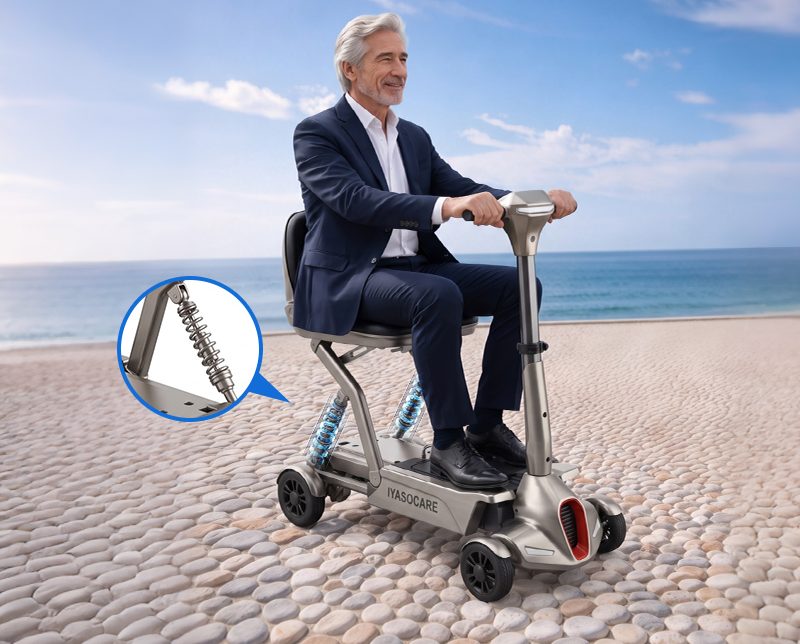
Choosing a mobility scooter is about more than finding a vehicle that moves from one place to another. For people who want greater independence, easier transportation, and a more comfortable daily routine, the right scooter can make a meaningful difference. It should be practical enough for everyday errands, compact enough to transport when needed, and reliable enough to support a variety of short-distance journeys.
A lightweight electric mobility scooter with a foldable design offers an appealing combination of portability, comfortable seating, electric power, and space-saving storage. Designed with an aluminum alloy frame, a 250W motor, multiple battery configurations, and manual or electric folding options, this type of scooter addresses several common challenges associated with traditional mobility equipment.
Its compact folding dimensions make it particularly interesting for users who travel by car, have limited storage space, or want a mobility solution that can be packed away between trips. Meanwhile, its ergonomic seat, suspension system, electromagnetic braking, and smart-control features aim to make everyday operation more convenient.
Traditional mobility scooters can provide dependable assistance, but their size and weight may create difficulties when it comes to transportation and storage. A large model might work well around the home or in an outdoor environment, yet become inconvenient when placed inside a vehicle or stored in a small apartment.
A foldable electric mobility scooter approaches this problem differently. Instead of requiring a permanent parking area, it can be folded into a more compact configuration when not in use.
The model discussed here measures approximately 970 × 500 × 1,000 mm in its normal operating configuration. When folded, its dimensions reduce to approximately 440 × 500 × 710 mm. This is a substantial reduction in length, making the scooter easier to store in suitable spaces.
For people who frequently travel between home, shopping areas, hotels, or family residences, that compact shape can be especially useful. It may also appeal to caregivers who need to store mobility equipment without dedicating an entire room to it.
The folding mechanism is available in manual and electric configurations. Manual folding offers a straightforward mechanical approach, while electric folding can reduce the physical effort required to prepare the scooter for storage. The precise operating procedure and any additional power requirements should be confirmed for the selected configuration.
One important distinction is worth keeping in mind: foldable does not automatically mean effortless to lift. The listed net weight is approximately 24 kg, while the gross weight is approximately 28 kg, excluding the battery according to the supplied specifications. The final carrying weight will depend on the battery and configuration.
For buyers who expect to lift the scooter into a car regularly, it is sensible to check the complete assembled weight, battery removal procedure, and available lifting assistance before making a purchase.
The frame is one of the most important parts of any mobility scooter. It affects structural stability, handling, durability, portability, and the overall user experience.
This scooter uses an aluminum alloy frame with a specified wall thickness of 2 mm and a corrosion-resistant glossy coating. Aluminum alloy is commonly selected for portable mobility equipment because it offers a useful balance between structural strength and relatively low weight.
Compared with a heavier construction, a thoughtfully engineered aluminum frame can help reduce the burden of transporting the scooter. This is particularly relevant when the equipment needs to be folded, moved through a doorway, or loaded into a vehicle.
The glossy protective coating also contributes to the product’s finish and can help protect the frame against ordinary environmental exposure. As with any coated metal structure, however, scratches, damaged joints, and prolonged exposure to moisture should be addressed appropriately to maintain its condition.
ABS components complement the frame by providing a lightweight material for selected external and structural covers. The combination of aluminum alloy and ABS supports a design that prioritizes portability without relying entirely on heavy metal panels.
Of course, material selection alone does not establish the scooter’s maximum structural safety. Buyers should also consider the quality of welds and joints, folding-lock design, fasteners, fatigue testing, and manufacturer documentation.
The stated maximum load capacity is 100 kg. Users should remain within this limit and account for clothing, bags, and other items carried on the scooter.
For everyday use, a well-designed lightweight frame can offer an attractive middle ground between mobility support and convenient transportation. The most suitable option is one that combines low weight with dependable structural engineering, rather than simply minimizing the number on the scale.
Portability matters, but it should never come at the expense of basic comfort. A mobility scooter that folds neatly yet feels uncomfortable after a short journey may not be a practical long-term choice.
This model includes an ergonomic seat with a high-strength nano-fabric material. The supplied material specification lists a tear strength of 5,000 N. That figure describes a material-related property and should not be interpreted as a complete measure of seat durability, comfort, or product safety.
The seating dimensions provide a useful starting point when assessing fit:
A 420 mm seat width offers a reference for comparing the scooter with other compact mobility models. However, users should consider their seated hip width, clothing, preferred posture, and the space needed to get on and off comfortably.
Seat depth is equally important. A seat that is too short may offer insufficient thigh support, while an excessively deep seat may press against the back of the knees. The listed 400 mm depth should therefore be compared with the user’s individual measurements.
The 400 mm backrest height provides additional support, although actual comfort also depends on backrest angle, cushioning, firmness, and adjustability.
For users who spend extended periods sitting, these details deserve careful attention. Anyone with specific postural or pressure-management requirements may benefit from an assessment by a qualified mobility specialist.
The goal is not merely to find a seat that fits the scooter’s compact design. It is to find one that fits the person who will use it.
At the heart of the scooter is a 24V, 250W brushless motor, although the product description also mentions a brushed-motor option. Buyers should confirm which motor type is included in the specific model they intend to purchase.
A 250W motor is suited to a compact mobility platform designed primarily for controlled, low-speed journeys. The stated maximum speed is 6 km/h, which is approximately 3.7 mph.
This speed specification places the scooter in a practical range for many short-distance mobility activities, such as moving around suitable pedestrian areas, visiting nearby shops, or navigating large indoor environments where powered mobility devices are permitted.
The actual experience will depend on the rider’s weight, surface conditions, battery charge, tire condition, and terrain. A motor’s rated power alone does not establish its ability to maintain speed on every incline or under every load.
The stated climbing capability is 6 degrees. This figure should not be confused with a 6% gradient: a 6-degree slope is approximately a 10.5% gradient. Buyers should verify how the manufacturer measures climbing performance and whether the rating applies under a specified load and battery condition.
Even when a scooter has a published climbing rating, steep ramps, wet surfaces, uneven paving, and abrupt changes in elevation require additional caution. The manufacturer’s operating instructions should determine which slopes are appropriate.
The listed driving range is 10–30 km per charge, equivalent to approximately 6.2–18.6 miles. That is a broad range rather than a guaranteed distance.
For example, someone making short trips around a neighborhood may have different range requirements from someone planning a full day of shopping and sightseeing. A larger battery can provide additional energy capacity, but actual range still depends on operating conditions.
A sensible approach is to plan journeys with a reserve rather than assuming that the maximum advertised range will always be available. Battery age, temperature, terrain, frequent stopping, and rider weight can all affect practical distance.
For regular use, the most valuable performance characteristic is often not maximum speed or maximum range in isolation. It is predictable operation that matches the user’s daily routine.
Battery selection is one of the most important purchasing decisions because it influences operating range, charging requirements, weight, replacement costs, and long-term convenience.
This scooter is offered with several stated battery configurations:
| Battery configuration | Nominal voltage | Nominal energy |
|---|---|---|
| 24V 10Ah lithium battery | 24V | 240Wh |
| 24V 20Ah lithium battery | 24V | 480Wh |
| 24V 20Ah semi-solid-state battery | 24V | 480Wh |
| 24V 30Ah semi-solid-state battery | 24V | 720Wh |
Nominal energy is calculated by multiplying nominal voltage by rated amp-hours. Actual usable energy may differ.
The 10Ah lithium battery may be appropriate for users whose journeys are relatively short and whose charging opportunities are frequent. It offers the lowest nominal energy capacity among the listed configurations.
A 20Ah battery provides twice the nominal energy of a 10Ah battery at the same voltage. This can offer greater flexibility for users who make several trips between charges.
The 20Ah and 30Ah semi-solid-state options provide additional choices for people who prioritize battery capacity. The 30Ah version has 50% more nominal energy than the 20Ah version at the same voltage, although this does not necessarily translate into exactly 50% more real-world driving distance.
The manufacturer also describes the semi-solid-state option as offering improved safety and energy density. Such benefits depend on the actual cell chemistry, battery architecture, manufacturing quality, battery-management system, and independent test results. The term alone is not proof that a particular battery is safer than every conventional lithium-ion alternative.
Before choosing a battery, ask the supplier for the exact cell type, battery weight, charger specifications, protection functions, applicable transport documentation, and relevant safety test reports.
It is also important to confirm whether the advertised 10–30 km range applies to every battery option or only to selected configurations.
The stated charging time is approximately 5–8 hours. This is a useful planning estimate, but the actual duration will depend on battery capacity, charger output, initial state of charge, and charging characteristics.
A larger battery may take longer to recharge if the same charger is used. For people who rely on the scooter daily, charging overnight or during a predictable period can help keep the equipment ready for the next journey.
Always use the charger approved for the specific battery configuration. Avoid charging with damaged cables or connectors, and follow the manufacturer’s instructions concerning ventilation, temperature, storage, and charging supervision.
A good battery is not simply the one with the highest capacity. It is the one that provides enough usable range while remaining compatible with the user’s transportation needs, charging routine, and budget.
Small wheels help a mobility scooter remain compact, but they also make suspension design and surface selection particularly important.
This model uses a 6-inch front wheel and an 8-inch rear wheel. The supplied specification identifies the tires as solid polyurethane (PU), meaning they do not depend on air pressure in the same way as conventional pneumatic tires.
One practical advantage of solid tires is that they cannot develop an ordinary puncture from a nail or sharp stone. They also avoid the routine pressure checks associated with air-filled tires.
There is a trade-off, however. Solid tires can transmit more vibration over rough surfaces than well-maintained pneumatic tires. Their ride quality therefore depends heavily on the suspension system, tire compound, wheel design, and road conditions.
The scooter is described as having a dual-suspension arrangement, including a front double-wishbone system and rear independent suspension.
A double-wishbone front suspension generally uses paired control arms to guide wheel movement. An independent rear suspension allows the rear wheels to respond to surface changes with a degree of separation rather than relying entirely on a rigid axle arrangement.
When correctly engineered, these features can help improve wheel contact and reduce the impact of certain surface irregularities.
For everyday users, the difference may be most noticeable when traveling over minor paving joints, smoother ramps, or slightly uneven paths. Nevertheless, a small-wheeled scooter should not be treated as an off-road vehicle. Large potholes, deep gravel, broken paving, and high curbs may remain unsuitable.
The best riding experience comes from combining appropriate suspension with sensible route selection and a speed suited to the surroundings.
Braking deserves particular attention in a mobility product designed for everyday use.
The scooter features an electromagnetic parking-brake system, and the supplied specifications list a braking distance of no more than 3 meters.
An electromagnetic brake typically uses electrical control to engage a braking mechanism. Depending on the design, a system may apply braking automatically when drive power is removed or when a control condition is met.
The exact operating behavior should be confirmed in the manufacturer’s manual. Buyers should not assume that every electromagnetic system operates identically or that the parking brake replaces all other braking and safety functions.
The stated braking distance also needs context. Stopping performance can vary with speed, total load, surface grip, gradient, battery condition, and test procedure. Ask whether the 3-meter figure was measured from the maximum rated speed of 6 km/h and under which conditions.
A responsible user should test the controls and braking behavior in a clear, level area before normal use, following the supplied instructions.
The product description also lists full LED lighting and an automotive-grade instrument panel. Lighting can help improve visibility in suitable conditions, while an instrument panel may make operating information easier to monitor. The actual display functions should be confirmed for the selected model.
Smart features include Bluetooth, NFC, and remote control. These can potentially improve convenience, but the manufacturer should clarify which functions each feature supports. For instance, Bluetooth connectivity does not automatically mean that a scooter supports smartphone navigation, app-based diagnostics, or remote driving.
Likewise, the presence of NFC does not establish the exact access-control functions available.
Before purchase, ask about battery-level indications, fault warnings, lighting controls, remote-control range, anti-theft functions, and the behavior of the scooter if an electronic component fails.
Safety depends on the complete system: mechanical construction, braking, electrical protection, visibility, instructions, maintenance, and the user’s ability to operate the equipment comfortably.
Both folding configurations can be useful, but the right choice depends on how the scooter will be handled.
Manual folding may appeal to buyers who prefer a straightforward mechanism with fewer powered folding components. It can also be convenient when the scooter is stored near a power source only occasionally.
Electric folding may be attractive to users who want to reduce the effort involved in folding and unfolding the scooter. It can also be useful when caregivers frequently prepare the equipment for transportation.
However, electric folding does not necessarily mean the entire scooter becomes lighter. The mechanism may add components, and its operation may depend on a functioning electrical system or a separate power arrangement.
For either version, ask the supplier about the folding sequence, locking mechanism, pinch points, emergency release, folded stability, and whether the battery must be removed before transport.
The folded dimensions of 440 × 500 × 710 mm provide a useful basis for checking storage compatibility. Still, a vehicle’s usable cargo opening, internal shape, and loading height matter as much as its published cargo volume.
Measure the intended storage area before ordering. If the scooter will be placed in a car trunk, confirm that it can pass through the opening without awkward lifting or excessive tilting.
A folding design works best when the complete process—from preparing the scooter to securing it for transport—is manageable for the person who will perform it.

A compact electric mobility scooter may suit several types of users, provided their physical needs, environment, and intended journeys match the product’s capabilities.
Older adults seeking everyday mobility support
People who find longer walking distances tiring may appreciate a powered option for suitable short journeys. The compact frame and seated operating position can make everyday outings more manageable, although users should be able to operate the controls and transfer on and off safely.
People who travel regularly
The folding design may appeal to people who visit relatives, stay in hotels, or transport their scooter by car. The final carrying weight and loading procedure should be considered carefully, especially when assistance is unavailable.
Caregivers and families
A compact scooter can be easier to store when it is not in use. Its portability may also simplify certain transportation arrangements, provided the caregiver can manage the folding and lifting process safely.
Mobility equipment retailers and distributors
The combination of folding options, battery configurations, and smart-control features may make the product relevant to retailers serving customers with different mobility requirements. Distributors should obtain complete technical documentation, applicable certifications, warranty terms, spare-parts availability, and battery shipping requirements before listing it for sale.
This scooter may be less suitable for people who need extensive outdoor travel over rough terrain, a substantially higher load capacity, or specialized seating and positioning support. In those cases, a larger or more specialized mobility device may be a better fit.
The right product should be selected around the user’s actual routine rather than the length of its feature list.
The following table summarizes the supplied specifications. Features marked as options should be verified against the exact model and configuration being purchased.
| Specification | Details |
|---|---|
| Product type | Lightweight foldable electric mobility scooter |
| Overall dimensions | 970 × 500 × 1,000 mm |
| Folded dimensions | 440 × 500 × 710 mm |
| Seat width | 420 mm |
| Seat depth | 400 mm |
| Backrest height | 400 mm |
| Net weight | Approximately 24 kg, stated without battery |
| Gross weight | Approximately 28 kg, stated without battery |
| Maximum load | 100 kg |
| Frame material | Aluminum alloy and ABS |
| Frame wall thickness | 2 mm, as specified |
| Front wheel | 6 inches |
| Rear wheel | 8 inches |
| Tire type | Solid PU, as specified |
| Motor | 24V, 250W; brushed or brushless options stated |
| Maximum speed | 6 km/h |
| Stated driving range | 10–30 km |
| Climbing capability | 6 degrees, as stated |
| Braking system | Electromagnetic parking brake |
| Stated braking distance | ≤3 m |
| Folding options | Manual or electric |
| Charging time | Approximately 5–8 hours |
| Battery options | 24V 10Ah/20Ah lithium; 24V 20Ah/30Ah semi-solid-state |
| Suspension | Front double wishbone and rear independent suspension, as described |
| Smart features | Bluetooth, NFC, remote control |
| Lighting | Full LED lighting, as described |
| Package dimensions | 430 × 600 × 850 mm |
Important specification note: The supplier should confirm the final packaged configuration, battery-inclusive weight, exact motor type, battery chemistry, charging requirements, and test conditions for the range, slope, and braking claims. The stated packaging dimensions should also be checked against the actual shipping carton because the relationship between the carton dimensions and the folded product dimensions may depend on the packing arrangement.
Technical specifications are useful, but they do not answer every question that matters during daily use. A few practical checks can prevent costly surprises.
Start with fit. Compare the seat dimensions with the intended user’s measurements, and consider whether the backrest and seat provide suitable support.
Next, evaluate portability realistically. A scooter listed at approximately 24 kg without its battery may weigh more when fully assembled. Ask for the total ready-to-use weight and whether the battery is removable.
Then confirm battery performance. Request the expected range for each battery option under clearly described test conditions. Find out whether the charger is included, how long a full charge takes, and how replacement batteries can be obtained.
Ask for documentation covering electrical protection, battery testing, braking performance, and applicable product requirements in the destination market. For use in the United States, confirm which federal, state, local, transportation, and facility rules apply to the particular device and intended use rather than assuming that one general classification covers every situation.
Finally, investigate after-sales support. Folding mechanisms, controllers, batteries, motors, tires, and charging equipment may eventually require service or replacement. Warranty coverage, repair instructions, and spare-parts availability can make a significant difference over the life of the product.
A good supplier should be willing to explain the technical details clearly and provide documentation that matches the actual model.
The lightweight electric mobility scooter with foldable design brings together several features that many users value: a compact storage profile, an aluminum alloy frame, a seated riding position, a 250W motor, multiple battery choices, suspension, and electromagnetic braking.
Its stated 6 km/h maximum speed and 10–30 km driving range position it as a potential option for short-distance mobility rather than demanding long-range or rugged-terrain travel.
The choice between lithium and semi-solid-state batteries allows buyers to compare nominal energy capacity and charging needs, while manual and electric folding configurations offer different approaches to transportation convenience.
Yet the most important purchasing decision is not simply whether a scooter has the latest features. It is whether the complete product fits the user’s body, travel habits, storage arrangements, and support requirements.
Before committing, confirm the actual battery-inclusive weight, the performance of the selected configuration, the folding procedure, the braking test conditions, and the availability of local service. These details are more useful than relying on headline claims alone.
For people seeking a compact mobility solution that can be stored between journeys and transported when necessary, this type of foldable electric scooter is worth evaluating. With the right fit, realistic range expectations, and proper maintenance, it can offer a convenient way to approach everyday trips with greater flexibility.
1. How far can a lightweight foldable electric mobility scooter travel on one charge?
The stated driving range is 10–30 km (approximately 6.2–18.6 miles) per charge. Actual distance depends on battery capacity, rider weight, terrain, temperature, speed, and battery condition. Buyers should confirm the expected range for their chosen battery configuration and leave a reserve for the return journey.
2. Is this foldable electric mobility scooter easy to transport?
Its folded dimensions are approximately 440 × 500 × 710 mm, which may make storage in suitable vehicles or compact spaces easier. However, the listed net weight is approximately 24 kg without the battery, so the complete scooter may be heavier. Check the battery-inclusive weight, folding procedure, and loading requirements before purchasing.
3. Should I choose a lithium battery or a semi-solid-state battery?
The best option depends on capacity, total weight, cost, charging requirements, and verified safety information. The listed lithium options are 24V 10Ah and 24V 20Ah, while the semi-solid-state options are 24V 20Ah and 24V 30Ah. Ask the manufacturer for the exact battery chemistry, independent test documentation, expected range, and replacement costs before deciding.