Our Location
Free Trade Tower, Xiyong street.
Chongqing, China

Free Trade Tower, Xiyong street.
Chongqing, China
Sourcing wheelchairs is about much more than finding a manufacturer with competitive prices. For medical equipment distributors, healthcare providers, rehabilitation centers, wholesalers, and mobility product brands, choosing the right manufacturing partner can directly affect product quality, customer satisfaction, profit margins, and long-term business growth.
The challenge is that not all wheelchair manufacturers offer the same level of expertise, production capability, or quality control. Some specialize in affordable manual wheelchairs for high-volume distribution, while others focus on lightweight folding models, electric mobility solutions, or customized products for specific user needs. Even manufacturers offering similar products can differ significantly in engineering capabilities, regulatory compliance, delivery reliability, and after-sales support.
A wheelchair may look impressive in a catalog, but its real value becomes clear only after examining how it performs in everyday use. Is the frame durable? Are the brakes reliable? Can replacement parts be obtained easily? Can the manufacturer maintain consistent quality across multiple production batches?
These are the questions worth asking before placing an order.
Whether you are launching a new mobility product line or expanding an established distribution business, understanding what to look for when sourcing wheelchairs from manufacturers will help you make informed purchasing decisions. The objective is not simply to find the lowest price. It is to build a reliable supply relationship that supports your business over time.
Before comparing quotations, take a closer look at each manufacturer’s product range and manufacturing expertise. A supplier that specializes in one type of wheelchair may not be the best choice for every purchasing requirement.
For example, a distributor supplying hospitals and nursing homes may prioritize durability, ease of maintenance, and standardized specifications. A retailer serving active users may focus on lightweight frames, compact folding mechanisms, and maneuverability. Businesses supplying home-care equipment may need a wider selection of manual wheelchairs, transport chairs, and powered models.
Understanding these differences helps you identify manufacturers whose expertise aligns with your target market.
Manual wheelchairs remain a common choice for healthcare facilities, medical equipment distributors, and home-care providers. Their relatively simple mechanical structure can make them easier to maintain, although frame construction, brake performance, wheel quality, and seating design still require careful evaluation.
Lightweight wheelchairs are attractive to customers who frequently transport or store their mobility equipment. When evaluating these models, examine the balance between overall weight, structural strength, folding convenience, and maximum user weight.
Electric wheelchairs require additional technical considerations, including motor performance, battery specifications, controller responsiveness, charging systems, and the availability of electrical replacement parts.
Specialized models, such as pediatric, bariatric, and reclining wheelchairs, require closer attention to the needs of their intended users. Buyers should verify dimensions, support features, weight ratings, and other relevant specifications before selecting a product.
A broad catalog can be useful, but product variety alone does not prove manufacturing capability. Some suppliers manufacture products in-house, while others source finished products or components from third parties. Either arrangement can work, provided the supplier offers appropriate quality oversight and accountability.
Ask which production processes are performed at the manufacturer’s own facility, which components are purchased externally, and how finished products are inspected. If a supplier claims expertise in electric wheelchairs, for instance, ask about its experience with electrical testing, battery integration, troubleshooting, and component replacement.
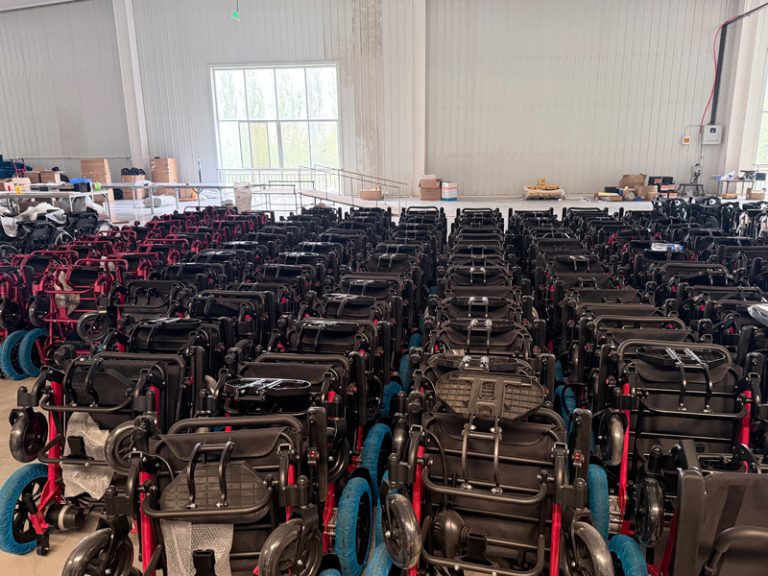
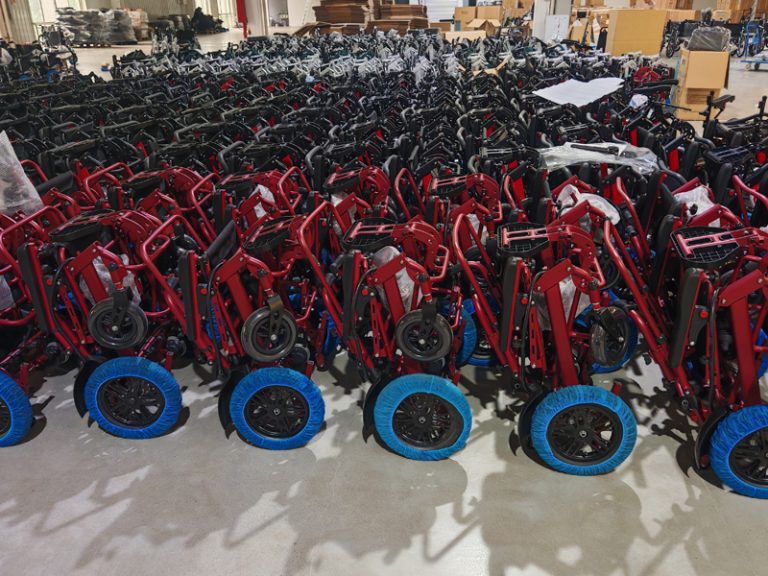
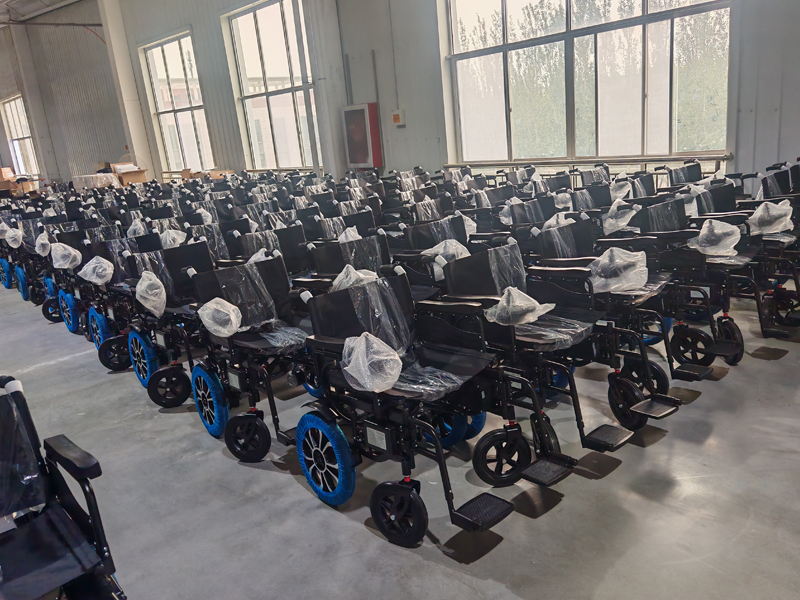
Request a current product catalog, detailed technical specifications, and photographs or videos of the actual production facility. For larger orders, consider a factory visit or independent inspection before committing.
The best manufacturer is not necessarily the one with the largest product range. It is the one that understands your requirements and can consistently supply the products your customers need.
Product quality should be one of the most important considerations when sourcing wheelchairs from manufacturers. A wheelchair is a mobility aid that users may depend on every day, sometimes for many years. Problems involving the frame, brakes, wheels, or seating system can affect both usability and safety.
Start with the frame. Wheelchair frames may be made from steel, aluminum alloys, or other materials, depending on the intended application. Steel can offer durability and cost advantages, while aluminum can help reduce overall weight. However, material choice alone does not determine product quality.
Frame geometry, welding quality, joint design, surface treatment, and manufacturing consistency also matter. Ask the manufacturer for material specifications rather than relying on general descriptions such as “heavy-duty” or “premium quality.”
The next step is to examine the components that affect everyday performance.
Frame construction and folding mechanism: Inspect welds, structural stability, hinges, and locking mechanisms. A folding wheelchair should open and close smoothly, lock securely, and avoid excessive looseness during normal use.
Brakes and locking systems: Brakes should engage reliably and remain accessible to the intended user or caregiver. Their design should suit the wheelchair’s intended application, and performance should be verified through appropriate testing.
Wheels and tires: Examine wheel alignment, tire construction, caster movement, rolling resistance, and replacement availability. Poor-quality casters can make a wheelchair difficult to maneuver, especially on uneven indoor surfaces.
Seat and backrest: Check upholstery strength, stitching, cleaning requirements, comfort, and resistance to ordinary wear. Seat width, seat depth, and backrest support should match the intended users.
Armrests and footrests: These components should remain secure during use and be easy to adjust, remove, or replace where the design allows.
Weight capacity and stability: Confirm the stated maximum user weight and the conditions under which the rating applies. Request supporting test documentation and verify that the model is suitable for its intended use.
For electric wheelchairs, the inspection process should also cover motor operation, controller responsiveness, battery specifications, charging behavior, wiring protection, and relevant electrical safety features.
A sample inspection should go beyond checking whether the product looks attractive. Fold and unfold the wheelchair repeatedly, apply the brakes, maneuver it through representative turns, inspect accessible fasteners, and review how easily routine maintenance can be performed. More demanding tests should follow appropriate standardized procedures rather than improvised testing alone.
It is equally important to understand how the manufacturer manages defects. Ask how nonconforming products are identified, recorded, corrected, and prevented from recurring. A supplier with a documented quality management system should be able to explain its inspection stages and provide relevant records.
Ultimately, quality is not simply about passing a single inspection. It is about maintaining consistent performance across different production batches.
Regulatory compliance is essential when sourcing wheelchairs for international markets. A product that can be sold in one country may require additional documentation, testing, labeling, registration, or conformity assessment in another.
This is particularly important for importers, distributors, and private-label brands, which may have responsibilities for ensuring that products placed on their target markets meet applicable requirements.
Instead of asking whether a manufacturer has “all the necessary certificates,” identify the specific requirements for your destination market and the exact wheelchair model you intend to purchase.
For example, buyers sourcing wheelchairs for the European Union should determine which product regulations and conformity assessment requirements apply to the particular model. CE marking is not a universal quality certificate, and its presence does not independently prove that every regulatory obligation has been fulfilled.
In the United States, buyers should investigate applicable Food and Drug Administration requirements for the product, including device classification, establishment registration, listing, and other obligations where relevant. FDA establishment registration or device listing should not be mistaken for FDA approval.
Technical standards may also be relevant. Depending on the wheelchair type and intended use, applicable standards may include parts of the ISO 7176 series, which address areas such as stability, braking effectiveness, strength, dimensions, and other wheelchair performance characteristics. The relevant parts depend on the specific product and its intended application.
When reviewing compliance documents, pay attention to the following:
Do not assume that documentation for one wheelchair automatically covers every model in a supplier’s catalog. Manual and electric wheelchairs can have different compliance considerations, even when sold under the same brand.
You should also verify that the legal entity named in the documentation matches the manufacturer or responsible organization relevant to the transaction. If an external laboratory performs the testing, request the complete report and confirm that the laboratory and testing scope are appropriate.
For higher-value orders, an independent compliance review can help identify gaps before shipment. This is usually easier to manage than discovering documentation problems after the products arrive at the destination port.
The key principle is straightforward: establish the regulatory requirements before finalizing your product selection, not after negotiating the price.
A wheelchair manufacturer may produce excellent samples but struggle to maintain consistent quality when an order increases from a few dozen units to several hundred or several thousand.
Production capacity is therefore an important part of supplier evaluation, especially for wholesalers and distributors that depend on regular replenishment.
Ask about the manufacturer’s normal monthly output, current production workload, typical lead times, and ability to accommodate seasonal demand. These figures should be supported by a realistic discussion of available production lines, staffing, component supply, and order scheduling.
Be cautious when a supplier promises unusually short delivery times without asking detailed questions about your order. Manufacturing lead times can vary according to product complexity, order quantity, customization requirements, packaging, and the availability of key components.
For electric wheelchairs, battery availability and shipping arrangements can introduce additional planning requirements. Imported components, motors, controllers, and specialized electronic parts may also affect production schedules.
It helps to distinguish between three separate timelines.
Sample lead time is the time required to prepare and deliver a product sample.
Production lead time is the period needed to manufacture and inspect the confirmed order.
Total delivery lead time includes production, packaging, export documentation, freight, customs clearance, and final transportation, as applicable.
This distinction prevents misunderstandings when comparing suppliers. One manufacturer may quote a short factory production period but require additional time for packaging or component procurement.
Supply chain resilience deserves equal attention. Ask whether critical components have approved alternative suppliers, how shortages are managed, and whether product specifications can change without prior notification.
For recurring orders, discuss minimum order quantities, reorder lead times, demand forecasts, and procedures for handling unexpected demand. A supplier that understands your sales cycle may be better positioned to support growth than one focused only on completing the current purchase.
A useful sourcing practice is to establish written expectations for delivery dates, production updates, inspection milestones, and notification of delays. For larger shipments, consider pre-shipment inspection and clear procedures for resolving discrepancies before the goods leave the factory.
Reliable supply is not simply about producing quickly. It is about delivering the correct products, in the agreed quantities, with consistent quality and predictable timing.
Price is naturally important when sourcing wheelchairs from manufacturers, but the lowest unit quotation does not always represent the best commercial deal.
Two wheelchairs may appear similar in a product catalog while differing in frame materials, component specifications, upholstery quality, packaging, included accessories, and warranty coverage. Unless these details are aligned, a direct price comparison can be misleading.
Begin by asking each supplier to quote the same specifications. Include the model, frame material, seat width, maximum user weight, wheel configuration, accessories, packaging requirements, branding, and quantity. For powered models, specify battery type and capacity, motor configuration, charger, and other relevant features.
Next, calculate the total landed cost rather than focusing only on the factory price.
Important cost components include:
Incoterms also affect the comparison. An EXW quotation, an FOB quotation, and a DDP quotation may allocate transportation, export formalities, import clearance, duties, and other responsibilities differently. Make sure the quotation specifies the applicable Incoterm, named place, and relevant version of the rules, such as Incoterms 2020.
For example, a manufacturer offering a lower FOB price may still be more economical than a supplier quoting a higher delivered price, depending on freight arrangements and import costs. Conversely, an attractive factory price can become expensive if the product requires frequent repairs or replacement components are difficult to obtain.
Consider the expected cost of quality failures, not just the initial purchase. Damaged shipments, inconsistent dimensions, missing accessories, and warranty disputes can reduce margins and consume considerable staff time.
For repeat purchases, ask whether the manufacturer offers volume-based pricing, annual purchasing arrangements, or more favorable terms for consolidated orders. However, avoid purchasing more inventory than your business can reasonably sell simply to obtain a lower unit price.
A structured comparison spreadsheet can help you evaluate three to five shortlisted suppliers using identical product requirements and cost assumptions.
The objective is not to pay the highest price. It is to understand what you are paying for and whether the product, service, and risk profile justify the investment.
For businesses developing their own wheelchair brands, customization can provide a significant competitive advantage. It allows distributors to differentiate their product offerings, maintain a consistent brand identity, and respond to the needs of specific customer groups.
However, not every manufacturer has the same level of OEM or ODM capability.
OEM services typically involve producing products according to a buyer’s specifications, while ODM services generally involve adapting or developing designs based on the manufacturer’s existing engineering capabilities. Suppliers may use these terms differently, so buyers should confirm exactly what is included.
Before selecting a partner for a customized project, establish which changes the factory can support. These might include logo printing, frame colors, upholstery materials, packaging design, accessory selection, or more substantial engineering modifications.
Simple branding changes are generally easier to implement than modifications affecting structural strength, braking performance, electrical systems, or stability. Changes that influence safety or regulatory compliance may require additional testing and documentation.
Ask about minimum order quantities for customized products, sample approval procedures, artwork requirements, tooling fees, development costs, and ownership of custom designs.
Intellectual property should be addressed in writing. If you provide proprietary designs, branding assets, or technical specifications, clarify how they may be used and whether the manufacturer can supply similar products to other customers.
For new product development, request a documented process covering design review, prototype production, testing, revisions, and final approval. Avoid approving mass production based only on a digital rendering or an early prototype that differs from the final specifications.
It is also important to establish change-control procedures. If the factory needs to replace a component because of a supply shortage, it should obtain the required approval before introducing a change that could affect quality, performance, or compliance.
A strong OEM or ODM partner does more than print your logo on an existing wheelchair. It helps translate your market requirements into a manufacturable, testable, and commercially viable product.
Supplier relationships often appear straightforward during the quotation stage. The real test comes when a shipment is delayed, a component fails, or a customer needs a replacement part several months after purchase.
For this reason, communication quality should be treated as a meaningful selection criterion rather than a secondary convenience.
During the sourcing process, observe how the manufacturer responds to technical questions. Does it provide clear specifications? Can it explain differences between models? Does it acknowledge limitations, or does it promise that every requirement can be met without further discussion?
A capable supplier should be able to communicate with your purchasing, quality assurance, logistics, and product development teams. If a technical issue arises, you should know whom to contact and what information is needed to resolve it.
Warranty terms deserve the same attention. Ask what the warranty covers, how long coverage lasts, which components have different warranty periods, and what exclusions apply. Electric wheelchair batteries, for example, may have different coverage conditions from frames or mechanical components.
Also clarify whether the manufacturer pays for replacement parts, labor, return freight, or other costs associated with an approved claim. Warranty language that appears generous can be less useful if the claims process is difficult or responsibilities remain unclear.
Spare-parts availability is particularly important for products used in healthcare facilities and rental fleets. Ask whether the supplier can provide common replacement components, including casters, tires, brake assemblies, armrests, footrests, upholstery, and relevant electrical parts.
Find out whether these components will remain available for a reasonable period and whether technical documentation is provided for authorized maintenance.
For distributors, an agreed after-sales procedure may include:
These expectations should be documented before the first shipment.
A supplier that handles problems professionally can protect your reputation with customers and reduce the long-term cost of doing business. In many cases, dependable after-sales support is more valuable than a small reduction in the initial unit price.
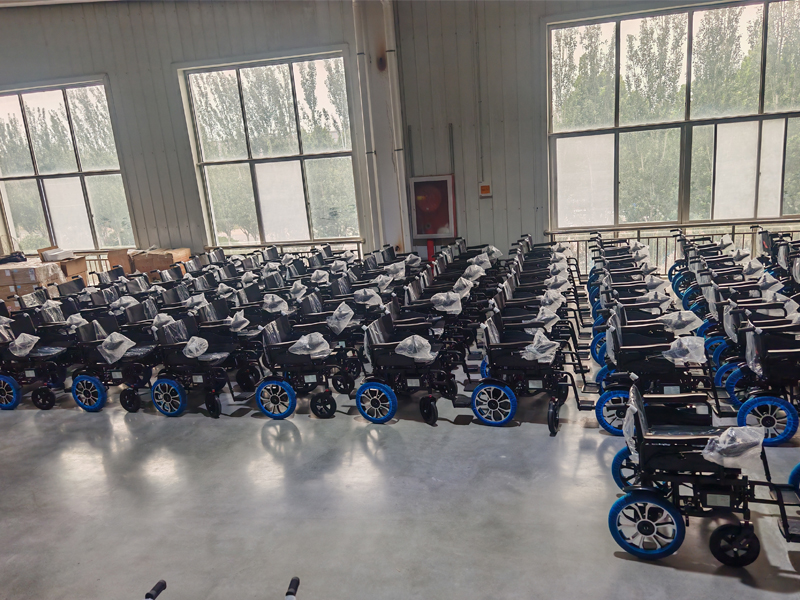
Once a manufacturer appears suitable, take time to verify that its claims match its actual business operations.
Start with basic business checks. Confirm the company’s registered identity, business address, relevant export experience, and the relationship between the contracting entity and the factory. If you are working with a trading company rather than a direct manufacturer, determine how it manages production, inspection, and supplier accountability.
A trading company can provide useful sourcing support, product variety, and communication services. The important question is whether the supplier arrangement offers the level of production visibility and control your business requires.
Next, request product samples. A sample allows you to assess finish quality, assembly, dimensions, packaging, and ease of use before approving a larger order. Where possible, obtain samples from the production model that will actually be supplied, not a specially prepared demonstration unit.
For larger purchases, a factory audit or third-party inspection can provide additional confidence. Depending on the risk and order value, an inspection may cover raw materials, in-process quality controls, finished-product checks, carton markings, quantities, and packaging.
You should also establish an approved product specification before mass production. This document should identify the relevant dimensions, materials, components, accessories, labels, packaging, and acceptance criteria. Both parties should agree on how deviations will be handled.
Payment terms should be evaluated carefully as well. Verify the beneficiary’s identity, ensure that bank details match the legitimate contracting arrangement, and avoid making changes to payment instructions based solely on an unexpected email. Any request to redirect funds should be independently confirmed through a trusted communication channel.
For an initial order, a smaller trial shipment can help reveal practical issues before you scale up. It provides an opportunity to evaluate product consistency, shipping performance, documentation, and customer feedback under real operating conditions.
A dependable manufacturer should welcome reasonable verification. If a supplier refuses to provide basic specifications, cannot explain its quality procedures, or pressures you to make an immediate large payment, take those warning signs seriously.
Selecting a wheelchair manufacturer is ultimately a process of balancing product suitability, quality, compliance, cost, and long-term reliability.
A useful approach is to evaluate potential suppliers against a consistent set of criteria rather than relying on price quotations or sales presentations alone.
Consider the following example weighting when comparing shortlisted manufacturers:
| Evaluation factor | Suggested weight |
|---|---|
| Product quality and safety | 25% |
| Regulatory compliance and documentation | 20% |
| Manufacturing capability and delivery reliability | 15% |
| Total landed cost | 15% |
| After-sales service and spare parts | 10% |
| OEM/ODM capability and product flexibility | 10% |
| Communication and business transparency | 5% |
| Total | 100% |
These weightings are illustrative rather than universal. A distributor selling regulated medical devices may place greater emphasis on compliance, while a brand developing customized products may give more weight to engineering capability.
Score each shortlisted supplier against the same criteria, using documented evidence wherever possible. A manufacturer with a slightly higher price may be the stronger choice if it offers more consistent quality, clearer compliance documentation, and better support throughout the product lifecycle.
It is also wise to develop relationships with more than one qualified supplier when commercial conditions allow. A backup source can reduce dependence on a single factory and provide flexibility when production capacity or component availability changes.
At the same time, avoid spreading purchasing volume across too many suppliers without a clear reason. Concentrating repeat orders with qualified partners can improve communication, simplify quality management, and support better commercial terms.
Finally, treat supplier evaluation as an ongoing responsibility. Review delivery performance, defect rates, warranty claims, customer feedback, and changes in product specifications after the relationship begins. A manufacturer that performed well during the first order should continue to meet agreed expectations as volumes increase.
The strongest wheelchair sourcing strategy is built on evidence, clear requirements, and consistent communication. When these elements are in place, buyers are better positioned to protect their margins, meet customer expectations, and develop a supply chain that can support sustainable growth.
1. How do I choose a reliable wheelchair manufacturer?
Start by confirming that the manufacturer’s product range matches your target market and technical requirements. Evaluate its production capabilities, quality control procedures, relevant compliance documentation, sample quality, delivery performance, and after-sales support. For significant orders, consider a factory audit or independent inspection before committing. Compare suppliers using the same specifications and total-cost assumptions rather than choosing solely on the basis of the lowest quotation.
2. What certifications should I check when sourcing wheelchairs internationally?
The required documentation depends on the destination country, wheelchair type, and intended use. Relevant considerations may include applicable ISO 7176 series testing, European conformity requirements, and U.S. FDA requirements where applicable. Ask for documentation covering the specific model you plan to purchase and verify its scope and validity. Do not assume that a CE mark, ISO certificate, or FDA establishment registration automatically proves that every product meets all requirements for your market.
3. Is it better to buy wheelchairs directly from manufacturers or through trading companies?
Buying directly from a manufacturer may offer greater production visibility, more direct technical communication, and better opportunities for customization, particularly for larger or recurring orders. Trading companies can offer broader product selection, consolidated sourcing, and support with communication or logistics. The best option depends on your order volume, technical needs, budget, and internal resources. In either case, verify the supplier’s business identity, clarify who controls production and quality, and establish written agreements covering specifications, inspection, delivery, and warranty responsibilities.
Sourcing wheelchairs from manufacturers requires a careful assessment of far more than price. Product quality, user safety, regulatory compliance, production capacity, customization options, and after-sales service all influence the success of a purchasing decision.
By defining your requirements early, verifying supplier claims, comparing total landed costs, and establishing clear quality standards, you can reduce sourcing risks and build stronger manufacturing partnerships.
For healthcare distributors, importers, wholesalers, and mobility brands, the right supplier is one that consistently delivers safe, suitable products and provides the support needed to keep customers satisfied long after the initial purchase.