Our Location
Free Trade Tower, Xiyong street.
Chongqing, China

Free Trade Tower, Xiyong street.
Chongqing, China
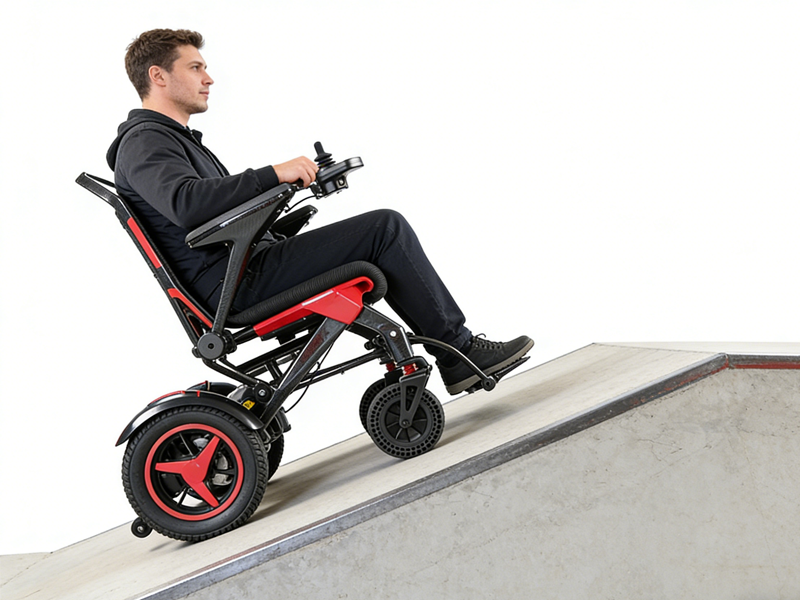
Navigating hills in daily life can be one of the most common concerns for electric wheelchair users. The good news is that most modern power chairs can handle inclines—but only if the right components work together. Think of it like driving a car: a compact sedan and a 4×4 both get you from point A to B, but only one can tackle rough, hilly terrain with confidence.
Understanding what makes a wheelchair capable of climbing slopes safely is crucial. It’s not just about the motor—it’s about torque, traction, battery life, and design all coming together. This guide walks you through everything you need to know to pick a chair that meets your environment and lifestyle, without guessing or risking your safety.
Electric wheelchairs aren’t all created equal. Some can handle gentle ramps, while others are engineered to conquer steep driveways or uneven outdoor terrain. The secret lies in three core elements:
1. Motor Power – The motor is the “engine” of your wheelchair. High torque allows the chair to push both your body weight and its own up an incline without slowing down or overheating.
2. Drive Configuration – How power is delivered to the wheels significantly affects performance. Rear-wheel drive (RWD), mid-wheel drive (MWD), and front-wheel drive (FWD) all have pros and cons. RWD is usually best for outdoor hill climbing due to superior traction.
3. Slope Rating – Every manufacturer provides a “maximum slope” rating. This number, given in degrees or percentage, indicates the steepest incline the chair was tested to handle under ideal conditions.
Other factors like user weight, battery health, and tire condition also play a vital role in real-world performance.
| Key Factor | Why It Matters | What to Look For |
|---|---|---|
| Motor Power | Moves you uphill without strain | Higher wattage or HP, designed for outdoor use |
| Drive Type | Traction and stability on slopes | RWD for best uphill grip; MWD for indoor stability |
| Slope Rating | Max tested incline | 6°–12° depending on model; check manufacturer specs |
| User Weight | Affects motor load and battery drain | Stay comfortably under the max weight limit |
| Battery Capacity | Supports power-hungry climbs | High Ah rating, fully charged before hill use |
Climbing a slope isn’t just about motor strength—it’s a balance of forces. Think of your wheelchair as a vehicle: the motor is the engine, the battery is the fuel, and the tires are your contact with the road. Every element must work in harmony:
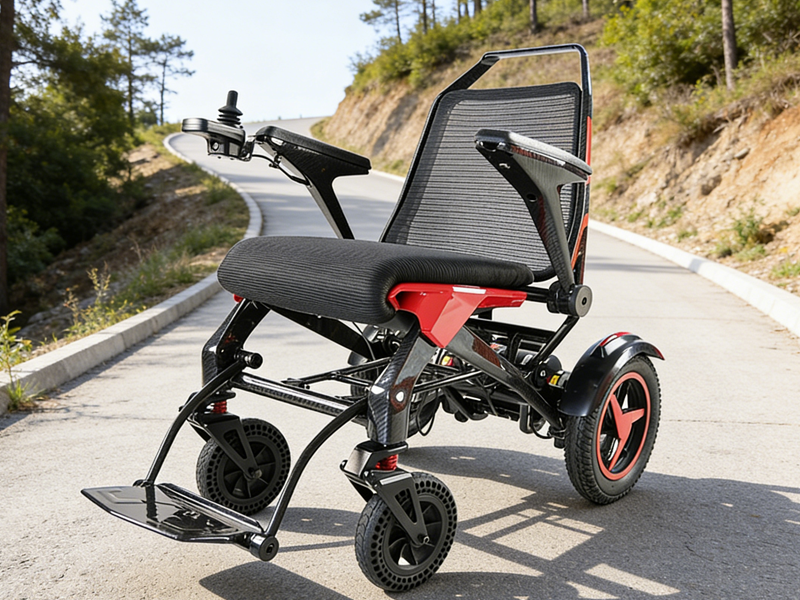
Torque: Provides the necessary push against gravity.
Battery: Delivers steady power for the duration of the climb.
Tires: Ensure traction on surfaces like wet grass, gravel, or slick pavement.
Even a powerful motor can’t overcome weak tires or a drained battery. The combined weight of the user and any cargo also changes the hill-climbing capacity.
Where the chair delivers power affects traction and stability. On inclines:
Rear-Wheel Drive (RWD): Excels outdoors; weight naturally shifts back, enhancing grip.
Mid-Wheel Drive (MWD): Best for indoor maneuverability; may struggle on steep slopes.
Front-Wheel Drive (FWD): Rare for heavy-duty slopes; limited traction uphill.
For most standard models, slopes between 6° and 12° are manageable, roughly corresponding to a 10%–20% grade. Real-world conditions—wet pavement, debris, or uneven surfaces—can reduce this capability.
A slope rating is a manufacturer’s benchmark. For example:
6° slope (~10.5% grade): Typical for accessibility ramps, handled easily by standard indoor/outdoor chairs.
10° slope (~17.6% grade): Steeper driveways or hilly sidewalks; requires heavy-duty or all-terrain models.
Important: Always treat slope ratings as maximum safe limits, not routine targets. Operating regularly at the maximum can reduce safety and accelerate wear on your chair.
Safety is as important as power when navigating inclines. Key strategies include:
Maintain a steady, slow pace: Avoid sudden acceleration or abrupt turns.
Leaning forward: Helps keep the center of gravity balanced when climbing.
Pre-trip checks: Inspect tires, battery charge, and the route for obstacles.
Dealing with traction loss: Stop, reverse slightly, and retry from a better angle. Avoid sudden acceleration.
Studies show that 55% of wheelchair users have experienced incidents on uneven surfaces, with 88% involving tips or falls—emphasizing the importance of preparation and maintenance.
If you regularly encounter slopes, you need a model designed for the challenge:
High-Torque Motor: Powers uphill movement without straining.
Rear-Wheel Drive: Optimizes traction and stability.
Advanced Suspension: Keeps wheels in contact with the ground for maximum grip.
Anti-Tip Wheels: Prevent backward tipping on steep inclines.
For outdoor hilly terrain, RWD is generally superior. Mid-wheel drive excels indoors, but uphill performance outdoors is limited. Always prioritize a chair that exceeds your maximum expected incline and weight needs.
1. What slope can a standard electric wheelchair handle?
Most standard models can safely handle 6°–10° slopes, enough for accessibility ramps and most sidewalks. Heavy-duty or all-terrain chairs may reach up to 12°, but always check the specific manual.
2. How does user weight affect performance?
Closer to the chair’s maximum weight capacity, the motor and battery must work harder, reducing climbing ability and accelerating battery drain. Always choose a chair that provides a comfortable margin.
3. How important is battery level for hill climbing?
Battery health is critical. A low or aging battery may fail to provide the consistent power needed, leaving you stranded or risking backward roll. Always start climbs with a fully charged, healthy battery.
In conclusion, an electric wheelchair can conquer hills safely if it is the right model for your environment and is properly maintained. Understanding torque, drive configuration, slope ratings, and safety practices allows you to make confident, informed choices. With the right chair and preparation, slopes become just another part of your daily mobility—not a barrier.