Our Location
Free Trade Tower, Xiyong street.
Chongqing, China

Free Trade Tower, Xiyong street.
Chongqing, China
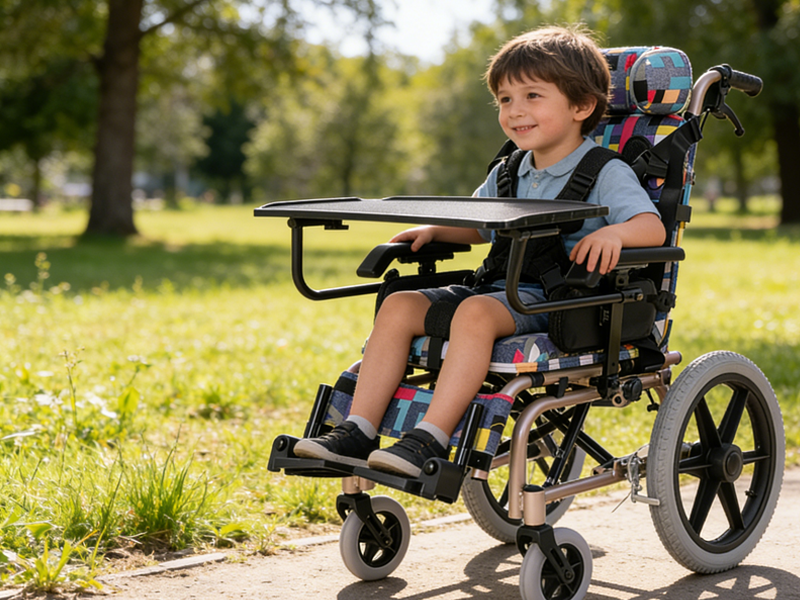
For families navigating a diagnosis of Cerebral Palsy (CP), mobility is rarely just a practical concern. It is emotional, developmental, and deeply personal. The right wheelchair can open doors to independence, confidence, social connection, and physical health. The wrong one can limit comfort, restrict participation, and create avoidable long-term complications.
For many parents, the journey begins with a simple but overwhelming question: Which wheelchair is right for my child?
The answer is never one-size-fits-all.
A common misconception is that wheelchairs represent “giving up” on walking. In reality, for children with CP who cannot walk independently or safely, early wheelchair provision is a form of early intervention.
When introduced at the right stage, a well-designed paediatric wheelchair can:
Support healthy posture and skeletal development
Reduce the risk of hip dislocation, scoliosis, and contractures
Enable age-appropriate exploration and play
Decrease fatigue and pain
Improve participation at home, school, and in the community
Children learn through movement. If a child cannot move independently, their opportunities to interact with the world shrink. A wheelchair restores those opportunities at floor level, table height, and beyond—allowing children to engage with peers, siblings, and their environment on more equal terms.
Importantly, early mobility does not prevent therapeutic walking practice. Many children use a wheelchair alongside standing frames, gait trainers, or physiotherapy programmes. Mobility and therapy should work together, not compete.
Every child with CP presents differently. Muscle tone, balance, coordination, endurance, and cognitive ability all influence wheelchair choice.
Before focusing on brands or models, families should consider how their child moves and interacts with the world:
Can your child use their arms effectively for propulsion or steering?
Do they fatigue quickly, even with support?
Is trunk or head control limited?
Are involuntary movements present?
Does your child seek independence, or prefer assisted mobility?
These questions help determine whether a manual, powered, or hybrid solution is most appropriate. They also guide decisions around seating systems, harnesses, lateral supports, headrests, and control interfaces.
A paediatric wheelchair should never force a child to adapt to it. The equipment must adapt to the child.
Children grow quickly, and CP does not pause development. One of the most important factors in wheelchair selection is adjustability.
Modern paediatric wheelchairs are designed with growth in mind. Adjustable frame lengths, seat widths, footrests, and back supports allow a single chair to evolve with the child over many years. In many cases, a well-chosen chair can be used for ten to twelve years, depending on growth patterns and medical changes.
However, adjustability should never compromise posture. As children grow, reassessment is essential. Regular reviews with therapists or mobility specialists ensure that seating continues to support neutral pelvic alignment, spinal symmetry, and balanced weight distribution.
Planning ahead also means considering future environments: secondary school, independent travel, social activities, and even sport. A wheelchair chosen only for “now” may limit opportunities later.
For children with CP, posture is not about appearance; it is about function, comfort, and long-term health.
A stable, neutral pelvis is the foundation of good seating. Without proper pelvic positioning, the spine compensates, leading to curvature, pain, and reduced respiratory function over time.
Effective seating systems typically focus on:
Pelvic stability, controlling tilt, rotation, and lateral shift
Even weight distribution to prevent pressure injuries
Trunk support that allows movement without collapse
Head alignment for visual engagement and communication
Cushion choice plays a critical role. Cushions that are too thick may compromise leg support, while cushions that are too thin may fail to manage pressure. A commonly recommended guideline is a cushion thickness of approximately three finger widths—balancing comfort with functional support.
Memory foam and contoured cushions are popular options because they mould to the child’s body, offering consistent support while accommodating growth and movement.
Footrest height is equally important. If the feet are not supported correctly, pelvic alignment is compromised. Ideally, the entire thigh should rest evenly on the seat, with hips and knees positioned comfortably at functional angles.
The debate between manual and powered wheelchairs is often framed too narrowly. The real question is not which is better, but which best supports your child’s independence and wellbeing.
Manual wheelchairs may suit children with sufficient upper-body strength and coordination. They encourage active movement, cardiovascular engagement, and may be easier to transport. Some children enjoy the sense of control and physical feedback manual propulsion provides.
Powered wheelchairs, on the other hand, can be life-changing for children who lack endurance or strength. They enable independent exploration, reduce reliance on caregivers, and support participation over longer distances and durations. Modern paediatric powered chairs often include programmable speed settings, allowing children to learn safely and gradually build confidence.
Many families find that mobility needs evolve over time. A child may begin with assisted or powered mobility and later transition to partial self-propulsion, or use different chairs for different contexts.
Mobility equipment must fit into real lives, not ideal scenarios.
Parents of children with CP perform frequent transfers—between wheelchairs, car seats, school chairs, and beds. Poorly designed or excessively heavy equipment increases the risk of injury for both child and caregiver.
Lightweight frames, detachable components, and foldable designs can make a significant difference to daily routines. Transport compatibility is another critical factor. Many families rely on adapted vehicles, and not all wheelchairs are suitable for travel.
Crash-tested wheelchairs that meet international safety standards provide reassurance during vehicle transport and may be required for school or community services in some countries.
A wheelchair should never isolate a child socially. On the contrary, it should facilitate inclusion.
Children care deeply about how they interact with peers. The appearance, size, and functionality of a wheelchair can influence confidence and willingness to engage socially. Custom colours, accessories, and personalised features may seem minor, but they often matter greatly to young users.
Mobility also enables access to sport and recreation. Across the world, adaptive sports programmes demonstrate that CP does not limit ambition.
Organisations such as Cerebral Palsy Sport play a vital role in creating opportunities for children and young adults with physical disabilities. Athletes like Yasmin Somers show what is possible when access meets aspiration, having represented England at the Cerebral Palsy World Championships.
For many children, a wheelchair is not a limitation—it is a gateway.
Choosing a paediatric wheelchair is not a single purchase; it is a long-term partnership between families, clinicians, and equipment providers.
The best outcomes occur when decisions are made collaboratively, with careful assessment, trial periods, and ongoing review. What works today may need adjustment tomorrow—and that is not failure, but growth.
A wheelchair that supports comfort, posture, independence, and social participation can transform not only how a child moves, but how they experience the world.
1. Will introducing a wheelchair too early stop my child from learning to walk?
No. Early wheelchair use does not prevent walking development. In fact, it often supports it by reducing fatigue and enabling children to conserve energy for therapy and practice.
2. How often should a paediatric wheelchair be reassessed?
At minimum, seating and fit should be reviewed annually, or sooner during growth spurts or if posture, comfort, or medical needs change.
3. Is a powered wheelchair suitable for young children?
Yes. With appropriate programming, supervision, and training, powered mobility can safely support independence even in early childhood.