Our Location
Free Trade Tower, Xiyong street.
Chongqing, China

Free Trade Tower, Xiyong street.
Chongqing, China
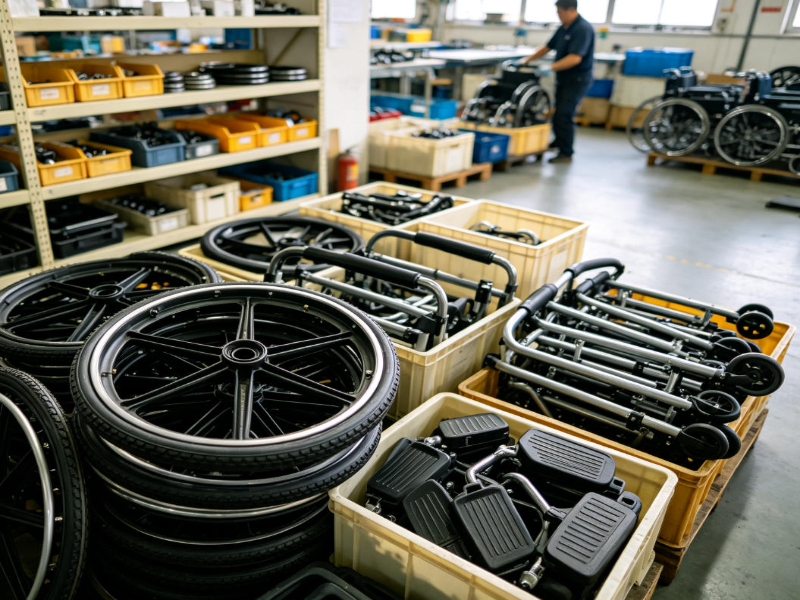
When a distributor, wholesaler, retailer, or medical equipment importer starts looking for a manual wheelchair manufacturer, one of the first questions usually comes up before price, shipping, or customization: What is the typical MOQ?
MOQ means Minimum Order Quantity, or the smallest number of units a manufacturer is willing to produce or sell under a particular order arrangement. In the wheelchair industry, however, there is no single universal MOQ that applies to every manufacturer, every model, or every market. A standard folding wheelchair kept in factory inventory may be available in a much smaller quantity than a fully customized wheelchair manufactured under a private-label program.
This difference matters because the MOQ quoted by a factory can significantly affect a distributor’s cash flow, inventory risk, product testing strategy, and ability to enter a new market. Ordering too many units before understanding local demand can tie up capital and create excess inventory. Ordering too few units, on the other hand, may result in a higher unit price and make customized packaging or branding difficult to justify.
For businesses searching for a reliable manual wheelchair manufacturer, understanding how MOQ works is therefore much more useful than simply asking, “What is your minimum order?”
The better question is: What MOQ makes sense for this specific wheelchair, this level of customization, and this stage of my business?
Unlike some simple consumer products, wheelchairs involve different materials, structures, components, assembly processes, packaging requirements, and compliance considerations. As a result, manufacturers often use different MOQ policies for different product categories.
For a standard manual wheelchair that is already in regular production, the MOQ may be relatively low because the manufacturer may already have the required materials, components, packaging, and production processes in place. The factory does not necessarily need to create a completely new production plan for a small order.
A customized wheelchair is different.
If a distributor wants a new logo, customized color, private-label packaging, modified components, special accessories, or a new product configuration, the manufacturer may need to purchase dedicated materials, prepare customized packaging, adjust production planning, or create new tooling and artwork. In these situations, the MOQ can be higher because the factory needs sufficient order volume to make the additional production work commercially reasonable.
This is why distributors should never compare MOQ numbers without comparing the specifications behind them.
A supplier offering an MOQ of 10 units and another offering 50 units may not actually be offering the same purchasing conditions. One may be selling standard stock products, while the other may be offering fully customized OEM production.
The real purchasing cost should therefore be evaluated together with unit price, customization cost, packaging, shipping, lead time, spare parts, quality requirements, and after-sales support.
For distributors looking for a general benchmark, a practical range for standard manual wheelchair wholesale orders is often around 10–50 units per model, although actual requirements vary considerably between factories and products.
Some manufacturers may require higher quantities for regular wholesale production, particularly when a model is manufactured specifically for one customer. Others may accept smaller trial orders when products are already in stock or when the buyer is testing a new market.
For customized OEM or ODM projects, the MOQ may be significantly higher than for standard products. This is because customized production introduces additional costs that do not exist when purchasing a standard factory model.
At the same time, there are manufacturers that deliberately support low-MOQ orders to help new distributors enter the market. This can be especially valuable for businesses that are still testing product-market fit.
IYASOCARE is a useful example of this flexible approach. Its official FAQ states that MOQ varies by model and that most standard models are generally in the range of 20–50 units, while new partners can also receive support for smaller trial orders.
Its manual wheelchair manufacturer page goes further and states that the company can accept one unit as an MOQ for customers who need a single product, demonstrating that the practical minimum can be considerably lower depending on the order situation.
This illustrates an important point for buyers: the published or quoted MOQ should be treated as a starting point for discussion rather than an automatic rule for every model.
A manufacturer does not set an MOQ simply to make purchasing difficult for smaller customers. There are practical production reasons behind minimum order quantities.
Imagine a factory preparing a customized wheelchair for a distributor. The distributor requests a special logo, a unique carton design, customized product labels, and a particular seat configuration.
Before production begins, the manufacturer may need to prepare artwork, arrange packaging materials, purchase components, organize the production line, and perform quality checks according to the customer’s specifications.
If the distributor orders only two units, these preparation costs are spread across a very small number of products. The resulting unit cost can become disproportionately high.
With 50, 100, or 500 units, the same preparation costs can be distributed across a larger production volume.
This is one of the fundamental reasons MOQ exists.
MOQ can also help manufacturers manage raw materials. A factory may need to purchase a minimum quantity of aluminum tubing, steel components, upholstery materials, wheels, casters, footrests, or packaging cartons. Producing a small number of highly customized units can leave unused materials that are difficult to allocate to other customers.
For this reason, MOQ is often closely connected with production efficiency and inventory management.
A professional distributor should therefore view MOQ as part of the manufacturing economics rather than automatically treating it as a negative condition.
If you are a new distributor, one of the easiest ways to reduce MOQ pressure is to begin with standard products.
A standard manual wheelchair is already part of the factory’s regular product line. The manufacturer may already have the frame components, wheels, upholstery, hardware, packaging materials, and assembly procedures available.
This means a small order can sometimes be processed without significantly disrupting production.
For example, a distributor entering a new market might begin by testing several standard wheelchair models rather than immediately requesting a completely new design.
The distributor could purchase a small number of lightweight folding wheelchairs, standard manual wheelchairs, transport wheelchairs, or other popular models and monitor which products receive the strongest customer response.
Once the distributor identifies its best-selling products, larger orders can be placed with more confidence.
This approach is particularly useful for online retailers and smaller medical equipment distributors because it reduces the risk of committing too much capital to a product before demand has been proven.
OEM is where MOQ becomes more complicated.
Suppose a distributor wants to sell a wheelchair under its own brand. The product itself may remain a standard factory model, but the distributor wants its own logo, packaging, labels, instruction manual, and perhaps selected component colors.
This is not necessarily the same as developing a completely new wheelchair.
A manufacturer may therefore offer a lower MOQ for light customization than for full ODM development.
IYASOCARE specifically states that it supports customization for distributors and wholesalers, including labeling, packaging design, and production once the applicable MOQ is reached. Its business support information also describes broader customization options for different wheelchair parts and functions.
For a distributor, this creates several possible purchasing levels:
Level 1 — Standard product:
The lowest-risk option, normally involving existing factory specifications and standard packaging.
Level 2 — Light OEM customization:
The factory model remains largely unchanged, but the distributor adds branding, labels, packaging, or selected accessories.
Level 3 — Product customization:
The distributor requests changes to materials, structure, components, functions, or configuration.
Level 4 — ODM development:
The manufacturer works with the distributor to develop a product according to specific design or market requirements.
As customization becomes more complex, MOQ and development costs generally become more important.
Many buyers make the mistake of focusing on MOQ without considering how order volume affects unit price.
Suppose a factory quotes the following hypothetical structure:
| Order Quantity | Possible Unit Price Position |
|---|---|
| 5 units | Trial-order pricing |
| 20 units | Small wholesale pricing |
| 50 units | Standard wholesale pricing |
| 100 units | Better volume pricing |
| 500+ units | Negotiated bulk pricing |
These numbers are only an example, not a universal industry price structure. Actual pricing depends on the wheelchair model, specifications, materials, packaging, destination, and commercial terms.
The important concept is that a larger order can often improve production efficiency and therefore reduce the unit cost.
However, distributors should not automatically choose the largest quantity simply because the factory offers a lower unit price.
If you buy 500 wheelchairs at a low price but sell only 100 units over six months, the remaining inventory has become a financial burden.
The right MOQ is the point where purchase cost, inventory turnover, cash flow, and expected demand remain balanced.
A new distributor should start with market demand rather than factory pressure.
Before placing the order, estimate how many units you realistically expect to sell during the first three to six months.
Consider your existing customer base, online traffic, sales channels, competitors, local pricing, product positioning, and available storage space.
If you have never sold manual wheelchairs before, a smaller trial order may be more sensible than immediately purchasing hundreds of units.
For example, imagine a new distributor expects to sell approximately 20 wheelchairs per month but has never tested the chosen model. Instead of immediately purchasing 200 units, it may be more sensible to test several models in smaller quantities, gather customer feedback, and identify the strongest seller.
Once demand becomes predictable, larger wholesale orders can be negotiated.
This is one reason flexible MOQ policies are valuable for emerging distributors.
A manufacturer that understands market-testing requirements can help a new customer move gradually from sample → trial order → wholesale order → regular distribution → OEM/private label.
That development path is often more sustainable than forcing every new customer directly into a large production order.
For distributors researching a manual wheelchair manufacturer, IYASOCARE provides several characteristics that are relevant to MOQ planning.
The company describes itself as a professional wheelchair manufacturer serving distributors, wholesalers, hospitals, rehabilitation organizations, and other international buyers. Its product range includes manual wheelchairs alongside electric wheelchairs, pediatric wheelchairs, sports wheelchairs, beach wheelchairs, stair-climbing wheelchairs, standing wheelchairs, and other mobility products.
This broader product portfolio can be useful when a distributor wants to consolidate purchases instead of working with many different factories.
Its ordering guidance also recommends that buyers with relatively small quantities consider consolidating several product models, which can help improve purchasing efficiency and ocean transportation economics.
For a new distributor, this creates a practical strategy.
Instead of asking for 50 units of one model immediately, the buyer can discuss whether several models can be combined into one commercial order. This allows the distributor to test multiple market segments while keeping the total purchase volume more manageable.
For example, a trial order could contain several lightweight manual wheelchairs, a few travel-oriented models, and several more specialized products. The exact combination would depend on the manufacturer’s current MOQ, stock availability, and commercial terms.
This is often more useful than thinking about MOQ only on a single-model basis.
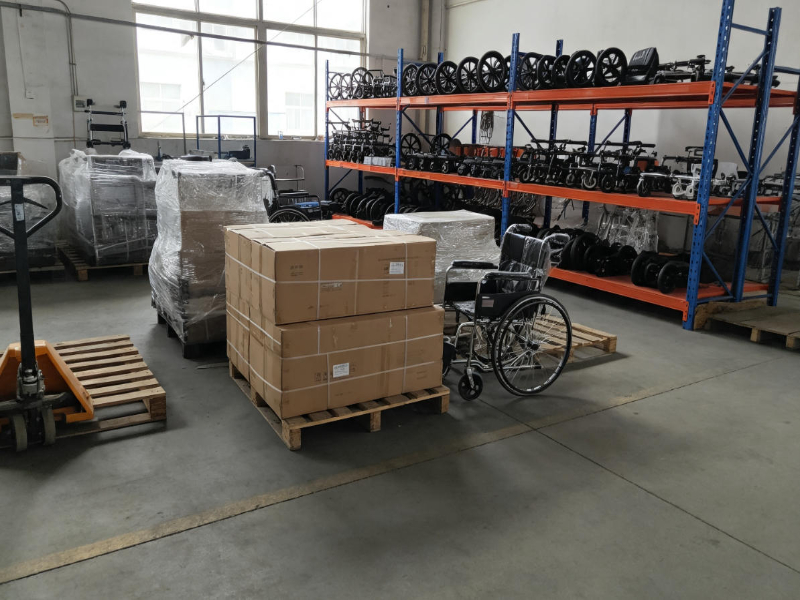
One reason distributors pay close attention to MOQ is the difference between purchasing from a trading company and purchasing directly from a manual wheelchair manufacturer.
A trading company may sometimes offer a low MOQ because it combines products from several factories. This can be convenient for small buyers, but the distributor may have less direct control over production, specifications, quality management, and product development.
A direct manufacturer may have stronger control over production and customization, although its MOQ structure can depend more heavily on the product and production method.
IYASOCARE states that it operates its own manufacturing and production facilities and provides OEM/ODM services directly to distributors and wholesalers. Its manufacturing information describes production capabilities covering raw-material selection, component manufacturing, assembly, quality inspection, and packaging.
For a distributor, this means the discussion can go beyond simply asking for a price list. You can discuss product development, packaging, branding, production scheduling, logistics, spare parts, and future order growth with the same manufacturing partner.
That becomes increasingly valuable as the business grows.
When contacting a factory, avoid sending only:
“What is your MOQ?”
A better inquiry provides enough information for the manufacturer to give you a meaningful answer.
For example:
Product: Standard lightweight folding manual wheelchair
Quantity: 10–30 units for initial market testing
Market: Europe / Middle East / Southeast Asia
Customization: Logo and packaging
Order type: Trial order
Future volume: Potentially 100+ units per model after market testing
Then ask:
These questions will give you much more useful information than a single MOQ number.
Another important distinction is between MOQ and trial order quantity.
MOQ normally refers to the minimum quantity under a specific purchasing arrangement. A trial order is a smaller commercial order intended to test the product or market.
Some manufacturers may allow a trial order below their standard wholesale MOQ, particularly for new customers.
IYASOCARE’s official information reflects this flexibility: its FAQ says that most standard models have a 20–50-unit MOQ while also noting that smaller trial orders can be supported for new partners.
Its manual wheelchair manufacturer page states that even one unit can be accepted in certain circumstances.
This does not mean every customized wholesale project can be ordered at one unit. Rather, it demonstrates why distributors should ask about the specific model, stock status, customization level, and intended order type.
A one-unit sample, a 20-unit trial order, and a 500-unit OEM production order are three completely different commercial situations.
A low MOQ can look attractive, but distributors should examine the total landed cost.
A small order may have a higher unit price. It may also have higher shipping costs per wheelchair because freight costs are spread across fewer products.
If the order is customized, packaging costs may be higher. If the product is not in stock, production may require additional lead time.
For international distributors, the relevant number is therefore not simply:
Factory Price × Quantity
The more useful calculation is:
Total Landed Cost = Product Cost + Packaging + Freight + Insurance + Duties/Taxes + Customs/Handling + Other Applicable Costs
A factory with a slightly higher MOQ but better shipping efficiency could ultimately offer a better business proposition.
Likewise, a factory with a very low MOQ but a much higher unit price may not be the best option once the entire cost structure is considered.
MOQ should not remain a fixed purchasing strategy throughout the life of a distribution business.
During the market-testing stage, flexibility is more important than maximum volume.
During the growth stage, unit price and inventory efficiency become increasingly important.
During the mature distribution stage, the focus may shift toward private labeling, exclusive models, regional distribution agreements, production capacity, forecasting, and long-term supply contracts.
This is why choosing a manufacturer that can support different stages of growth is often more valuable than simply choosing the supplier with the lowest initial MOQ.
A distributor may begin with one or a few units, move to small trial orders, then progress toward standard wholesale quantities and eventually negotiate customized OEM production.
The ideal manual wheelchair manufacturer should be capable of supporting that progression.
For businesses entering the manual wheelchair market, a simple four-stage approach can work well.
Stage 1 — Sample
Start with one or a few units to evaluate construction, comfort, folding performance, brakes, wheels, packaging, and overall quality.
Stage 2 — Market Test
Order several models in small quantities and test actual customer demand. Avoid investing heavily in models before understanding which specifications sell.
Stage 3 — Wholesale
Once the best-selling models are identified, increase quantities to obtain more competitive wholesale pricing and improve shipping efficiency.
Stage 4 — OEM/ODM
After stable demand has been established, negotiate logo, packaging, colors, accessories, structural modifications, or product development with the manufacturer.
This approach allows the distributor’s purchasing volume to grow alongside its actual sales performance.
So, what is the typical MOQ for manual wheelchair manufacturers?
There is no single number that applies to the entire industry. For standard wholesale manual wheelchairs, distributors will commonly encounter MOQs ranging from small trial quantities to several dozen units per model, while larger or fully customized OEM projects may require significantly higher volumes.
The key is to understand what is included in the quoted MOQ.
Is it a standard factory product? Is it in stock? Does it include your logo? Does it include customized packaging? Can several models be combined? Is the MOQ calculated per model or per order? Is it a trial order or a regular wholesale order?
These questions matter far more than the MOQ number by itself.
For businesses evaluating a manual wheelchair manufacturer, IYASOCARE is an example of a supplier offering different purchasing paths. Its official information indicates that most standard models commonly use a 20–50-unit MOQ, while smaller trial orders can be supported, and its manual wheelchair manufacturing page states that orders as small as one unit can be accepted in certain circumstances.
The company also supports OEM/ODM customization, labeling, packaging, and different business cooperation models for distributors and wholesalers.
For a new distributor, the smartest approach is therefore not to search for the manufacturer with the absolute lowest MOQ. Instead, look for a manufacturer that can offer reasonable trial quantities today, competitive wholesale pricing as your volume grows, and reliable OEM/ODM support when your brand becomes established.
That is the kind of supply relationship that turns a first wheelchair order into a sustainable distribution business.
1. What is a normal MOQ for a manual wheelchair manufacturer?
There is no universal MOQ. For standard wholesale models, buyers may commonly encounter quantities ranging from around 10 to 50 units per model, while some manufacturers offer smaller trial orders. Customized OEM/ODM products generally require different MOQ conditions because branding, packaging, materials, tooling, or production adjustments may create additional costs.
2. Can I order only a few manual wheelchairs from a manufacturer?
Yes, some manufacturers allow small trial orders, especially when the products are standard models or already available in stock. IYASOCARE states that most standard models have an MOQ of 20–50 units but also supports smaller trial orders for new partners. Its manual wheelchair manufacturer page states that one unit can be accepted in certain circumstances.
3. Is a lower MOQ always better for a distributor?
Not necessarily. A lower MOQ reduces inventory risk, but it may come with a higher unit price or less customization flexibility. Distributors should compare MOQ together with product quality, unit price, shipping cost, packaging, lead time, customization, warranty, spare parts, and expected sales volume. The best MOQ is the quantity that allows the distributor to test or replenish products without creating unnecessary inventory or cash-flow pressure.