Our Location
Free Trade Tower, Xiyong street.
Chongqing, China

Free Trade Tower, Xiyong street.
Chongqing, China
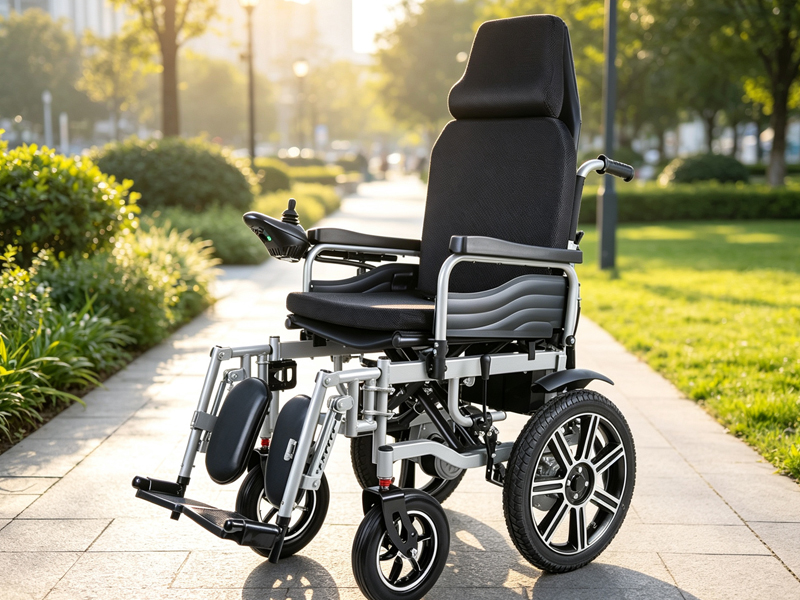
Choosing a wheelchair for an adult is rarely just about finding something that moves from one place to another. For people who spend several hours a day in a wheelchair, the chair becomes part of their daily living environment. It needs to provide adequate back support, allow useful changes in position, remain stable during movement, and fit naturally into everyday routines such as eating, resting, traveling, getting in and out of a vehicle, and moving around the home.
That is why a high back reclining wheelchair for adults can be worth considering when a conventional wheelchair does not provide enough upper-body support or positioning flexibility.
However, choosing one is not as simple as looking for the largest backrest or the widest reclining range. A wheelchair that looks comfortable in a product photograph may not necessarily be the right match for a particular user’s body size, mobility level, home environment, or transportation needs.
For many adults, the more practical question is:
What combination of back support, reclining adjustment, seating dimensions, mobility, safety, and portability will make daily life easier?
The first mistake people often make when shopping for a reclining wheelchair is starting with the product specifications.
A better approach is to start with the person who will use the chair.
An adult who can independently control a wheelchair but becomes uncomfortable after sitting for a few hours may have very different requirements from someone who needs a caregiver to assist with positioning. Likewise, someone who primarily uses a wheelchair indoors does not necessarily need the same combination of wheel size, range, frame construction, and folding capability as someone who regularly travels outdoors.
Before comparing models, think about five simple questions:
These questions immediately narrow the field.
A reclining wheelchair is generally designed to allow the back support to move away from the upright position. High-back designs provide additional support higher up the torso and, depending on the design, may provide head and neck support as well.
Manual reclining wheelchairs and electric reclining or high-back electric wheelchairs should also be distinguished. A manual reclining wheelchair usually requires a caregiver or another person to adjust the reclining mechanism, while an electric wheelchair can provide powered mobility and may offer greater independence for users who have sufficient hand and cognitive control to operate a joystick.
This distinction matters because reclining and powered mobility are two separate functions. A wheelchair can have a reclining back without being powered, and a powered wheelchair can have an adjustable back without being a clinical tilt-in-space system.
A standard wheelchair typically has a relatively upright backrest. This is suitable for many users, particularly those who have good trunk control and do not need frequent positional changes.
A high-back reclining wheelchair goes further by combining greater back support with an adjustable back angle.
The purpose is not simply to create a chair that can “lean backward.” Reclining can make it easier to change posture during longer periods of sitting, accommodate different activities, and provide a more relaxed position when appropriate.
Professional wheelchair guidance also points out an important trade-off: reclining mechanisms, higher back supports, elevating legrests, and associated hardware can add weight to a manual wheelchair and make transportation or self-propulsion more difficult.
That is one reason buyers should avoid assuming that a heavier, more complicated chair is automatically better.
The ideal chair is the one whose features solve the user’s actual problems without creating unnecessary difficulties elsewhere.
For example, if the wheelchair will frequently be lifted into a car, a large heavy frame may become frustrating even if it provides excellent support. If the user spends most of the day sitting and has limited trunk control, however, a more supportive high-back configuration may be far more valuable than saving a few kilograms.
In other words, support and practicality need to be considered together.
One of the most obvious specifications on a reclining wheelchair is its backrest angle.
The number can be useful, but it should not be considered in isolation.
For example, a wheelchair with a very large reclining range may sound impressive, but the practical value depends on how the user is positioned, whether the legrests can accommodate the change in angle, how the head is supported, and whether the chair remains stable throughout the adjustment.
Research and clinical guidance around wheelchair positioning also emphasize that combinations of seating functions can be important for pressure redistribution. Tilt, recline, and elevating legrests can work together differently from simply reclining the backrest alone.
This is an important distinction for shoppers.
Recline is not the same thing as tilt-in-space.
With recline, the angle between the seat and back changes. With tilt-in-space, the seat and back generally move together while maintaining their relative relationship. These functions have different positioning characteristics and should not be treated as interchangeable.
For an adult looking for a high-back reclining wheelchair, the practical questions are therefore:
These questions are more useful than simply asking whether a chair reclines to a particular number of degrees.
A wheelchair can have an excellent backrest and still feel uncomfortable if the seat dimensions are wrong.
Seat width is particularly important.
If the seat is too narrow, the user’s hips and thighs may feel compressed. If it is too wide, the user may have difficulty maintaining a stable sitting position and may need to lean sideways for support.
Seat depth matters as well. A seat that is too deep can make it difficult for a shorter user to position the pelvis correctly while maintaining appropriate support under the thighs. A seat that is too short may provide inadequate thigh support.
The relationship between seat height, seat depth, backrest height, footrest position, and armrest height also influences overall posture.
This is why adults should not choose a wheelchair simply because the maximum user weight appears suitable.
Weight capacity tells you whether the frame can support the user; it does not tell you whether the wheelchair actually fits the user.
The YSE109, for example, has a listed seat width of 46 cm (approximately 18.1 inches) and a seat depth of 45 cm (approximately 17.7 inches). Its listed seat height is 54 cm, while the backrest height is 75 cm. These measurements provide a useful starting point for comparing the chair with the user’s own body dimensions.
Before ordering, measure the user rather than guessing.
A good wheelchair should feel supportive without forcing the body into an awkward position.
High-back wheelchairs are particularly relevant when an adult needs more support than a conventional wheelchair backrest provides.
Some users naturally fatigue when maintaining an upright position for long periods. Others may benefit from a larger contact area across the back. A higher backrest can also provide additional support when the back is reclined.
That does not mean every adult needs a high-back wheelchair.
Someone who has strong trunk control, regularly self-propels, and spends limited time in the wheelchair may prefer a lighter conventional design.
By contrast, a user who spends extended periods seated, needs more upper-body support, or values the option of changing position may find a high-back design more appropriate.
The key is to match the backrest to the user’s physical requirements rather than treating “high back” as a universal sign of comfort.
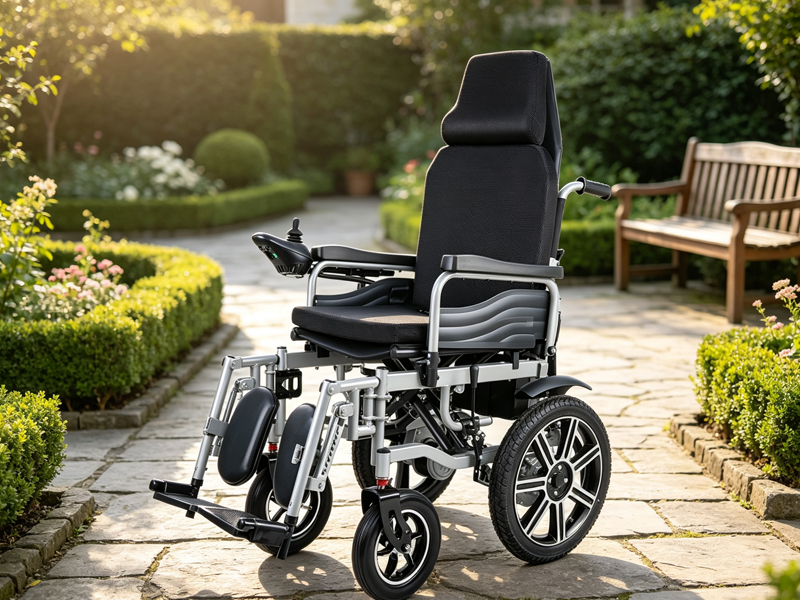
For buyers who want a combination of high-back support, reclining adjustment, powered mobility, and folding portability, the IYASOCARE YSE109 is an interesting option.
The YSE109 is not simply a traditional manual reclining wheelchair with a large backrest. It is a high-back foldable electric wheelchair, which changes the buying equation considerably.
According to the manufacturer’s specifications, the backrest can be adjusted from 90° to 150°, giving the user several positioning options between an upright sitting posture and a substantially reclined position. The high back can also be removed and converted to a lower-back configuration, giving the chair some additional flexibility for different situations.
That flexibility is useful because not every activity requires the same seating position.
An upright position may be preferable while eating, talking with other people, or maneuvering through tighter indoor spaces. A more reclined position may be more comfortable when resting or during a longer journey.
The important point is that the YSE109 gives the user a range of positions rather than forcing them to remain in one fixed back angle.
| Feature | YSE109 specification |
|---|---|
| Type | High-back foldable electric wheelchair |
| Seat width | 46 cm |
| Seat depth | 45 cm |
| Seat height | 54 cm |
| Backrest height | 75 cm |
| Backrest adjustment | 90°–150° |
| Maximum load | 130 kg |
| Maximum speed | 6 km/h |
| Driving range | Up to 15 km |
| Motor | 250W × 2 |
| Rear wheels | 16 inches |
| Front wheels | 10 inches |
| Battery | 24V 12Ah lead-acid |
| Charging time | Approximately 4–6 hours |
| Maximum climbing ability | 15° |
| Normal dimensions | 110 × 64 × 125 cm |
| Folded dimensions | 79 × 39 × 74 cm |
| Full lying dimensions | 170 × 64 × 85 cm |
| Net/gross weight listed | 47 kg / 52 kg |
| Frame | Steel |
These specifications are taken from the current YSE109 product page and should be checked again with the manufacturer before purchase because product specifications can change.
One of the biggest advantages of a foldable electric wheelchair is that it can potentially serve two purposes at once.
It provides powered mobility during everyday use, but it can also be folded for storage and transportation.
The YSE109 has a listed folded size of 79 × 39 × 74 cm, compared with a normal size of 110 × 64 × 125 cm. The manufacturer specifically describes the chair as suitable for folding into a compact form for storage or placement in a vehicle trunk.
This is particularly relevant to adults who want to travel by car.
A wheelchair that works beautifully inside a home but cannot realistically be transported may end up being used less often. Portability therefore should not be treated as an optional luxury.
At the same time, buyers should pay attention to the listed weight.
The YSE109 is not an ultra-light wheelchair. The manufacturer lists net/gross weights of approximately 47 kg and 52 kg.
That is an important practical consideration.
Folding the chair makes its physical dimensions smaller, but folding does not magically make a powered wheelchair lightweight. A 47 kg wheelchair may still require two people, a loading aid, or a suitable vehicle arrangement for comfortable transportation.
So if portability is one of your priorities, ask two separate questions:
Can it fold?
and
Can I safely handle its weight?
Those are not the same question.
For some adults, the biggest limitation is not the inability to sit comfortably. It is the effort required to move the wheelchair.
Self-propelling a manual wheelchair requires repeated upper-body movement. For someone with limited arm strength, shoulder discomfort, fatigue, or reduced endurance, that may make independent mobility difficult.
The YSE109 uses two 250W motors and a 360-degree joystick control system. The manufacturer describes the joystick as suitable for one-handed operation and includes a simple interface with a battery indicator.
This can be particularly useful for users who have sufficient hand control to operate a joystick but do not have the strength or endurance to manually propel a wheelchair over longer distances.
The chair also offers both electric and manual modes. This provides a practical backup when the battery is low or when a caregiver needs to push the wheelchair.
That kind of redundancy is valuable in real-world use.
A mobility device should ideally have a plan for the less-than-perfect situations that inevitably occur.
Wheelchair buyers often focus heavily on how a chair behaves on a smooth indoor floor.
Real life is rarely that simple.
Driveways, sidewalks, small thresholds, gravel, uneven pavement, ramps, grass, and speed bumps can all change the riding experience.
The YSE109 uses 16-inch rear wheels and 10-inch front wheels, together with a shock-absorption system and rear anti-tip wheels. The manufacturer also lists a maximum climbing ability of 15°.
These features suggest that the chair is intended for more than perfectly flat indoor surfaces.
Still, a specification such as “15° climbing ability” should not be interpreted as permission to tackle every ramp or hill at that angle.
Actual outdoor safety depends on the surface, ramp condition, traction, user weight, battery level, speed, weather, and driving technique.
For any wheelchair, the safest approach is to treat maximum specifications as technical limits rather than everyday targets.
When people compare wheelchairs, they often spend more time discussing speed, battery range, and appearance than safety.
For a high-back reclining wheelchair, safety deserves to be near the top of the list.
The YSE109 includes a seat belt, adjustable footrests, flip-up/reversible armrests, manual and electronic parking brakes, and rear anti-roll wheels.
Each feature addresses a different practical situation.
The seat belt can help keep the user positioned securely during movement.
Flip-up armrests can make lateral transfers easier in suitable situations.
Adjustable footrests help accommodate different leg positions and can make getting on and off the chair easier.
Parking brakes reduce the chance of unwanted movement when the chair is stationary.
Rear anti-tip wheels provide additional protection against backward tipping, particularly when negotiating slopes or uneven surfaces.
These features do not eliminate risk, of course. Users and caregivers still need to follow appropriate operating procedures and use ramps, transfers, and slopes carefully.
A reclining backrest changes the relationship between the user’s torso, head, hips, and legs.
That means head and neck support should not be overlooked.
This is especially important for users who have limited trunk control or who may spend substantial periods in a reclined position.
The YSE109 has a high backrest and a listed backrest height of 75 cm, while its backrest can be adjusted through a 90°–150° range.
However, the appropriate amount of head and neck support depends on the individual.
A high back is not automatically equivalent to a clinically configured head-support system.
If the user has significant postural or neurological needs, a seating assessment by a qualified clinician or rehabilitation professional may be appropriate before selecting a wheelchair.
The goal should be to maintain a stable, comfortable posture rather than simply achieving the maximum possible recline.
Another easy-to-miss issue is the relationship between the backrest and the legs.
When the back moves backward, the user’s body position changes. If the feet are left in an inappropriate position, the user may feel as though they are sliding, the knees may be positioned awkwardly, or pressure may be concentrated in undesirable areas.
This is why adjustable legrests are an important part of a reclining wheelchair.
The YSE109 includes adjustable footrests and describes a 90° adjustable footrest configuration.
For everyday use, this can help accommodate different sitting and transfer positions.
When evaluating any reclining wheelchair, check whether the leg support system is genuinely compatible with the reclining function rather than treating the backrest and footrests as completely independent features.
The word “comfort” appears in almost every wheelchair description online.
It is understandable because comfort matters.
But comfort is difficult to measure unless you break it into specific factors.
For a high-back reclining wheelchair, comfort may include:
The YSE109 addresses several of these areas through its adjustable backrest, high-back design, adjustable footrests, shock absorption, and powered movement.
But no wheelchair can guarantee comfort for every adult.
The user’s body shape, posture, clothing, cushion requirements, daily sitting duration, and physical condition all matter.
This is why specifications should be treated as a starting point rather than a substitute for fitting.
The YSE109 may be particularly relevant to adults who want several functions in one mobility device.
For example, it may be worth considering for someone who:
These characteristics do not mean the YSE109 is suitable for everyone.
For someone looking for an extremely lightweight wheelchair to lift into a car alone, its approximately 47 kg net weight may be a major consideration.
Similarly, someone specifically seeking a clinical tilt-in-space seating system should not assume that a reclining high-back electric wheelchair is an equivalent product.
The right product category depends on the user’s actual mobility and positioning requirements.
Before placing an order, create a simple checklist.
1. Measure the user
Measure hip width, thigh length, lower-leg length, and overall seated height.
Do not rely solely on average adult dimensions.
2. Check the weight capacity
Make sure the user’s weight, clothing, cushion, and any equipment carried on the chair remain within the manufacturer’s stated limit.
For the YSE109, the listed maximum load is 130 kg.
3. Check the actual folded size
If the wheelchair will be transported in a car, measure the trunk opening as well as the available trunk space.
A folded wheelchair may fit inside a trunk but still be difficult to place through a narrow opening.
4. Think about the chair’s weight
Folding dimensions are only half of the portability equation.
The YSE109’s listed net weight of 47 kg means buyers should plan realistically for lifting and loading.
5. Consider the driving range
The YSE109 lists a driving range of up to 15 km.
Actual range can vary depending on user weight, terrain, temperature, battery condition, speed, and frequency of stopping and starting.
6. Look at charging requirements
The listed charging time is approximately 4–6 hours, so users should consider where the wheelchair will be charged and whether a suitable electrical outlet is readily available.
7. Check the home environment
Measure doorways, hallways, bathroom entrances, elevators, and turning spaces.
A wheelchair that fits the user but cannot comfortably enter the bathroom is not a practical solution.
8. Think about transfers
If the user regularly transfers between the wheelchair and a bed, sofa, toilet, or car seat, features such as flip-up armrests and adjustable footrests can become especially important.
9. Consider professional seating advice
For adults with significant postural, neurological, orthopedic, or pressure-management needs, professional assessment can be extremely valuable.
The easiest way to understand the difference is to think about the user’s priorities.
A standard wheelchair may be preferable when the user:
A high-back reclining wheelchair may make more sense when the user:
A high-back electric wheelchair such as the YSE109 adds another dimension: powered mobility.
The user is not only choosing a backrest configuration; they are choosing an electric mobility platform that can be folded and transported.
That makes the purchase more substantial, but potentially more versatile.
This distinction deserves repeating because it is one of the most common sources of confusion when researching wheelchairs online.
A reclining wheelchair changes the back angle.
A tilt-in-space wheelchair changes the orientation of the seat and back together.
Some advanced wheelchairs combine tilt, recline, elevating legrests, and other positioning functions. Clinical guidance recognizes that combining these functions can offer different pressure-management and positioning possibilities.
The YSE109 should therefore be understood primarily as a high-back foldable electric wheelchair with an adjustable reclining backrest, rather than automatically categorized as a full clinical tilt-in-space system.
That distinction makes the buying decision clearer and prevents unrealistic expectations.
The best high-back reclining wheelchair for an adult is not necessarily the one with the longest list of features.
It is the one that fits the user’s body, mobility ability, daily routine, transportation needs, and environment.
For some adults, that may be a traditional manual reclining wheelchair.
For others, powered mobility will be more important than minimizing weight.
For users who want a combination of high-back support, adjustable reclining, electric operation, and folding portability, the IYASOCARE YSE109 deserves a place on the comparison list. Its 90°–150° adjustable backrest, 130 kg stated load capacity, 15 km listed driving range, dual 250W motors, adjustable footrests, safety features, manual/electric operating modes, and folding dimensions give it a practical combination of mobility and positioning features.
At the same time, its approximately 47 kg net weight means it should not be mistaken for an ultra-light travel wheelchair. Buyers should think carefully about how the chair will be loaded, unloaded, stored, and transported.
Ultimately, a good wheelchair purchase starts with a simple question:
What does the user need to do more comfortably and independently every day?
Once that question is answered, specifications such as recline angle, seat width, battery range, motor power, wheel size, and folding dimensions become much easier to evaluate.
For more information about the YSE109, including its current specifications and configuration, visit the manufacturer’s product page: https://www.iyasomed.com/products/wheelchair-yse109/
1. What is the best recline angle for a high-back wheelchair?
There is no single recline angle that is ideal for every adult. The appropriate position depends on the user’s posture, comfort, physical condition, activity, and support requirements. A useful reclining range gives the user flexibility rather than forcing one fixed position. The YSE109, for example, provides a listed backrest adjustment range of 90° to 150°, allowing the user to move between a more upright and more reclined position.
2. Is a high-back reclining wheelchair suitable for elderly adults?
It can be, particularly for older adults who need additional upper-body support, spend extended periods in a wheelchair, experience fatigue while sitting upright, or want the ability to change their sitting position. However, age alone should not determine the choice. Seat dimensions, trunk control, transfer ability, weight, home environment, and the person’s ability to operate the wheelchair should all be considered.
3. Is the IYASOCARE YSE109 a good choice for travel?
The YSE109 is designed with portability in mind because it folds to a listed size of 79 × 39 × 74 cm and can be stored in a vehicle trunk. It also offers powered mobility, which can be useful during longer outings. However, its listed net weight of approximately 47 kg means users should plan carefully for loading and unloading. It is better described as a foldable electric wheelchair with travel-friendly dimensions rather than an ultra-lightweight travel wheelchair.