Our Location
Free Trade Tower, Xiyong street.
Chongqing, China

Free Trade Tower, Xiyong street.
Chongqing, China
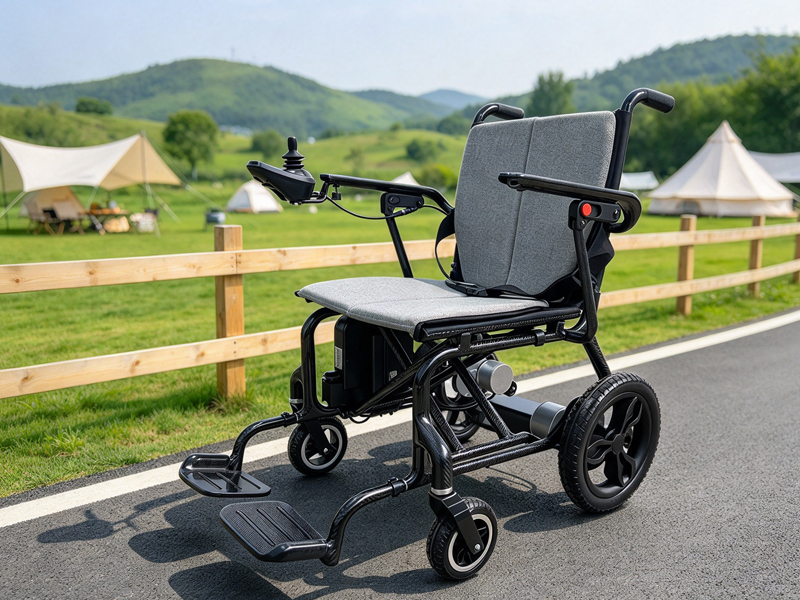
Choosing a reliable lightweight carbon fiber folding wheelchair supplier is an important decision for medical equipment distributors, mobility product brands, wholesalers, and rehabilitation equipment retailers. As customers increasingly value portability, comfort, and convenient transportation, carbon fiber folding wheelchairs have become an attractive option in the premium mobility market.
However, finding the right supplier involves much more than comparing product prices or choosing the lightest wheelchair in a catalog. Material quality, structural design, manufacturing consistency, product testing, customization capabilities, and after-sales support all influence the long-term value of a sourcing decision.
A wheelchair may look impressive in product photos, but its real performance depends on how well the frame is engineered, how reliably the folding mechanism works, and how consistently the manufacturer controls production quality. For businesses purchasing in bulk, these details directly affect customer satisfaction, warranty costs, and brand reputation.
So, how do you choose a lightweight carbon fiber folding wheelchair supplier that can meet your commercial requirements and support long-term growth? The following guide explores the most important factors to consider before placing an order.
Before evaluating potential suppliers, it helps to understand why carbon fiber is used in modern wheelchair design.
Carbon fiber composites combine high stiffness with relatively low weight. Compared with conventional steel frames, and in many applications aluminum alloy frames, carbon fiber structures can reduce the weight users and caregivers need to handle. This makes them particularly attractive for people who frequently travel, transfer a wheelchair between vehicles, or store mobility equipment in limited spaces.
For wheelchair users, the advantage is practical rather than purely technical. A lighter chair can be easier to lift into a car, move through an airport, or store at home. For caregivers, reduced lifting effort can make everyday transportation more manageable.
The folding mechanism adds another layer of convenience. A well-designed folding wheelchair should collapse into a compact form without requiring complicated procedures or excessive physical effort. Its folded dimensions, locking mechanism, and overall balance matter just as much as the frame material.
Nevertheless, carbon fiber is not automatically the best solution for every application. Its performance depends on fiber orientation, resin systems, structural geometry, joint design, and manufacturing quality. Carbon fiber components can also be vulnerable to certain impact or localized damage, making appropriate inspection and maintenance important.
This is why experienced buyers evaluate the complete wheelchair rather than focusing exclusively on the material advertised in a product description.
A useful starting point is to define the intended application. A wheelchair designed for frequent travel may prioritize minimum lifting weight and compact storage, while a model intended for intensive institutional use may require different durability, serviceability, and maintenance characteristics.
Once the target application is clear, it becomes much easier to identify suppliers with the right engineering capabilities.
Not every company advertising carbon fiber wheelchairs has the same level of manufacturing expertise.
Some businesses operate their own production facilities and manage frame assembly, quality inspections, and final testing. Others act primarily as trading companies, sourcing finished products from third-party manufacturers. Neither business model is automatically unsuitable, but buyers should understand exactly who is responsible for engineering, production, and quality control.
When searching for a lightweight carbon fiber folding wheelchair manufacturer, begin by examining its product portfolio and manufacturing background.
Does the company specialize in mobility equipment? Can it explain how its carbon fiber frames are manufactured and inspected? Does it have experience producing folding structures, or does it simply offer a limited number of products purchased from another factory?
These questions help distinguish a supplier with genuine technical knowledge from one that relies mainly on marketing materials.
A professional manufacturer should be able to explain its production processes in understandable terms. For example, it should discuss how frame components are formed, how structural connections are designed, how assembly tolerances are controlled, and how finished products are inspected.
For carbon fiber products, buyers should also ask about material traceability, composite processing controls, and procedures for identifying defects. These considerations are particularly important because internal composite damage may not always be obvious during a simple visual inspection.
Factory transparency is another useful indicator. Request a virtual factory tour, production photographs, or a live video inspection if an in-person visit is impractical. Ask to see the assembly area, quality inspection procedures, and finished-product testing process.
A supplier that can provide consistent, specific answers is generally easier to evaluate and work with than one that responds to technical questions with broad promises.
For larger orders, it is also worth understanding whether the supplier has sufficient production capacity to maintain consistent quality as order volumes increase.
The objective is not simply to find a company that sells carbon fiber wheelchairs. It is to find a manufacturing partner that understands the product and can reproduce the required specifications reliably.

One of the most common sourcing mistakes is comparing wheelchairs using only their advertised weight.
A product described as ultra-lightweight may still be inconvenient to transport if its folding structure is bulky, its battery is difficult to remove, or its individual components are awkward to handle.
Before requesting quotations, prepare a clear specification sheet covering the features that matter most to your target customers.
| Specification | What to check | Why it matters |
|---|---|---|
| Total weight | Weight with and without removable accessories | Determines actual lifting convenience |
| Folded dimensions | Length, width, and height when folded | Affects vehicle storage and shipping |
| Maximum user weight | Manufacturer’s rated capacity | Supports appropriate user selection |
| Seat dimensions | Seat width, depth, and available adjustments | Influences comfort and fit |
| Folding mechanism | Locking system and folding procedure | Affects convenience and safety |
| Braking system | Brake design and verified performance | Supports controlled stopping |
| Battery configuration | Removability, charging, and replacement | Influences maintenance and transport |
| Warranty | Coverage, exclusions, and duration | Clarifies after-sales responsibilities |
If you are sourcing an electric carbon fiber folding wheelchair, additional specifications become important, including motor performance, controller operation, battery capacity, charging time, and electrical safety documentation.
Ask suppliers to clarify exactly how product weight is measured. Does the quoted figure include the battery, footrests, armrests, and other removable components? If two suppliers use different measurement methods, their advertised figures may not be directly comparable.
The same principle applies to folding dimensions. A supplier should provide actual measurements rather than relying on descriptions such as “compact” or “travel-friendly.”
Load capacity also deserves careful attention. A higher rated capacity should be supported by appropriate engineering and testing, not simply a sales claim. Buyers should verify that the selected model is suitable for the intended user population.
When comparing quotations, place the technical specifications side by side. This simple step makes it easier to identify meaningful differences and prevents a low price from distracting you from important product limitations.
Carbon fiber is often associated with premium performance, but the material name alone does not guarantee a high-quality wheelchair.
The finished structure depends on the entire engineering process, from material selection to component manufacturing and final assembly.
For example, fiber orientation influences how a composite component responds to different loads. Wall thickness, component geometry, resin quality, and connection design can all affect structural behavior. A well-designed frame must account for the forces generated during everyday use, including repeated loading, turning, folding, and movement over uneven surfaces.
When evaluating a potential supplier, ask what quality controls are applied to the carbon fiber components.
Useful questions include:
The answers should be specific to the product and manufacturing process.
It is also important to understand the difference between a carbon fiber structural frame and a wheelchair that uses carbon fiber primarily for decorative or non-load-bearing components. If carbon fiber is a major reason for the product’s premium price, the supplier should clearly identify which components use the material.
Durability testing is equally important. Wheelchairs experience repeated mechanical stress, so buyers should request relevant test reports rather than relying exclusively on static load demonstrations.
The ISO 7176 series provides internationally recognized wheelchair testing methods covering areas such as static stability, braking effectiveness, and structural strength and durability. Which parts apply depends on the wheelchair design and intended use.
For example, ISO 7176-8 addresses requirements and test methods for static, impact, and fatigue strength. Buyers should ask whether the specific model has been tested against applicable requirements and request the corresponding documentation.
A test report for a different model, frame configuration, or manufacturer may not demonstrate that the product being purchased has undergone the same evaluation.
The key is to connect every important performance claim to verifiable evidence. This approach helps reduce the risk of receiving a product that looks premium but fails to deliver the expected reliability.
Product compliance should be evaluated before a supplier is selected, not after the order has been manufactured.
Different markets have different requirements for medical devices, mobility products, labeling, technical documentation, and product testing. A wheelchair intended for distribution in the United States may face different regulatory obligations from one sold in the European Union or another market.
Start by identifying the destination country and the exact product category. Manual folding wheelchairs and powered folding wheelchairs may have different applicable requirements.
For a supplier claiming compliance with ISO 13485, request a copy of its quality management system certificate. Check the issuing organization, validity period, certified legal entity, and scope of certification.
Remember that ISO 13485 certification relates to a quality management system. It does not, by itself, prove that every wheelchair made by the company complies with every product safety requirement.
Similarly, CE marking should not be treated as a universal quality certificate. For products marketed as medical devices in the European Union, the applicable requirements under the Medical Device Regulation (EU) 2017/745 must be assessed, including classification, conformity assessment, and technical documentation where relevant.
For the United States, verify the applicable FDA requirements for the specific device. Establishment registration, device listing, premarket authorization, and exemption status are distinct regulatory matters. Registration alone does not establish that a product has FDA approval or clearance.
A qualified supplier should be able to explain which requirements apply to the exact model you intend to import and provide appropriate supporting documents.
Before finalizing an order, confirm that product labels, user manuals, warnings, and other required documentation are suitable for the destination market.
This step may appear administrative, but overlooking compliance can create costly delays, restrict distribution, or expose your business to regulatory problems.
For distributors and private-label brands, the right supplier may need to do more than provide an existing product.
OEM and ODM services can help businesses develop a differentiated product line, establish brand recognition, and adapt a wheelchair to specific customer preferences.
Possible customization options include branding, packaging, user manuals, seat configurations, upholstery, accessory combinations, and selected product specifications. The actual options depend on the manufacturer’s capabilities and the design of the wheelchair.
Before requesting customization, separate cosmetic changes from engineering changes.
Adding a logo to approved packaging is generally different from modifying the frame structure, folding mechanism, braking system, or electrical components. Structural and functional changes may affect product performance, testing requirements, and regulatory compliance.
A capable supplier should explain which modifications are available, which require engineering review, and which may require additional validation.
It should also provide a clear process for approving samples, confirming drawings, controlling revisions, and authorizing mass production.
This is particularly important when launching a private-label product. If the sample differs from the production version, even small changes in components or assembly can affect the customer experience.
Ask whether the supplier can maintain an approved product specification and notify you before making significant changes to materials, components, or manufacturing processes.
Minimum order quantities are another practical consideration. A supplier may offer extensive customization but require a large initial order. Smaller businesses may benefit more from a partner that supports pilot orders and gradual volume increases.
The best OEM/ODM relationship balances flexibility with disciplined production control. Customization should strengthen your market position without creating unnecessary technical or compliance risks.
Price matters in every sourcing decision, but the lowest quotation does not always represent the best commercial value.
A carbon fiber folding wheelchair may carry a higher purchase price because of material costs, manufacturing complexity, engineering requirements, and quality control. However, the financial impact of a supplier extends well beyond the initial invoice.
Consider the full landed cost, including product price, packaging, international freight, insurance, customs duties, taxes, inspection expenses, and local handling costs where applicable.
For lightweight products, shipping calculations deserve special attention. Lower product weight can reduce some transportation costs, but bulky packaging may still create significant freight expenses. Accurate carton dimensions and shipment weights are therefore essential when comparing suppliers.
After-sales costs should also be included.
A supplier that offers a slightly lower price but provides inconsistent quality or limited spare parts may create additional expenses through returns, warranty claims, replacement shipments, and customer support.
For electric models, ask about the availability of batteries, controllers, chargers, motors, wheels, and other replacement components. For manual models, confirm the availability of folding hardware, brakes, upholstery, and other serviceable parts.
Request a written quotation that clearly separates product pricing, customization charges, tooling costs where applicable, packaging, and other fees.
It is also worth reviewing payment terms, production lead times, order quantity requirements, and the supplier’s policy for defective products.
A useful comparison should consider at least three dimensions:
Commercial value = purchase cost + logistics cost + expected after-sales cost.
This is a purchasing framework rather than a precise accounting formula, but it encourages a more complete assessment of supplier value.
The objective is to choose a partner that supports sustainable margins and reliable customer service, rather than one that simply offers the lowest initial price.
A product sample is one of the most valuable tools available during supplier evaluation.
Specifications and certificates provide important information, but they cannot fully replace a physical assessment of the wheelchair.
Whenever possible, request a sample of the exact model you intend to purchase. If your order includes multiple configurations, confirm whether each variation requires separate evaluation.
Start with basic usability. Fold and unfold the wheelchair several times. Check whether the mechanism operates smoothly, whether the locking system engages correctly, and whether the chair remains stable when opened.
Inspect the frame, connection points, wheels, brakes, upholstery, and other components. Look for visible defects, inconsistent finishing, loose fittings, and signs of poor assembly.
For electric wheelchairs, also evaluate the controller, battery installation, charging process, acceleration, turning behavior, and braking performance in accordance with the manufacturer’s instructions.
These checks are preliminary product evaluations, not substitutes for formal safety or durability testing.
If you are placing a substantial order, agree on a written inspection plan. Define the product specifications, acceptable workmanship, packaging requirements, inspection stages, and the procedure for handling nonconforming units.
Where appropriate, use a qualified third-party inspection service to verify production quality before shipment.
It is also sensible to keep an approved reference sample or an agreed specification record. This provides a benchmark for comparing future batches and helps resolve disputes if the delivered products differ from the original agreement.
A supplier that welcomes reasonable quality checks demonstrates a willingness to make its performance measurable.
A supplier relationship does not end when the goods leave the factory.
For international buyers, communication quality can influence everything from order accuracy to customs documentation and warranty resolution.
Pay attention to how a supplier responds during the quotation process. Does it answer technical questions directly? Are specifications consistent across emails, quotations, and product documents? Does it explain limitations honestly, or does it promise that every request is possible?
These early interactions can reveal how the company may handle more complicated issues later.
Production planning is equally important. Ask for the normal lead time, the factors that can delay delivery, and the process used to communicate changes. If your business depends on seasonal sales or retail launch dates, delivery reliability may be more valuable than a small price reduction.
After-sales support deserves a written agreement. Clarify the warranty period, covered defects, exclusions, response times, replacement procedures, and responsibility for transportation costs.
For carbon fiber frames, ask how structural damage is assessed and whether damaged components can be replaced. Because significant composite damage may require component replacement rather than conventional metal-frame repair, the supplier should provide clear guidance on inspection and service procedures.
For electric models, confirm whether troubleshooting information and replacement parts are available to your service team.
Spare-parts availability can have a substantial effect on customer satisfaction. A wheelchair that cannot be returned to service because a small component is unavailable may create more frustration than a higher-priced model with dependable support.
A good supplier should help you manage the entire product lifecycle, from initial sourcing and delivery to maintenance and replacement parts.
Once you have narrowed your options, compare suppliers using a consistent evaluation process.
Rather than making the decision based on a single attractive feature, assess manufacturing capability, product performance, compliance documentation, pricing, communication, and service support together.
A simple internal scorecard can help your purchasing team make a more objective decision.
| Evaluation area | Suggested weighting |
|---|---|
| Product quality and durability evidence | 25% |
| Manufacturing capability and consistency | 20% |
| Regulatory documentation | 15% |
| Total landed cost | 15% |
| After-sales service and spare parts | 15% |
| Communication and delivery reliability | 10% |
| Total | 100% |
These weightings are an example, not an industry standard. Adjust them according to your market, order volume, product type, and risk tolerance.
A supplier serving a premium travel brand may need to demonstrate exceptional portability and customization capabilities. A distributor supplying healthcare institutions may place greater emphasis on durability, documentation, serviceability, and long-term parts availability.
Once a supplier is selected, establish a clear process for repeat orders. Keep approved specifications, sample records, inspection reports, packaging details, and agreed lead times on file.
For ongoing purchases, monitor defect rates, delivery performance, customer complaints, warranty claims, and the supplier’s responsiveness. Periodic reviews help identify problems before they become recurring costs.
A long-term partnership should improve both product consistency and operational efficiency. As the relationship develops, the supplier may also help identify product improvements, streamline packaging, and introduce suitable models for new customer segments.
Ultimately, the best lightweight carbon fiber folding wheelchair supplier is not necessarily the largest company or the one with the most impressive catalog. It is the partner that can consistently deliver a safe, well-engineered product, provide credible documentation, communicate clearly, and support your business after the sale.
Choosing a lightweight carbon fiber folding wheelchair supplier requires a balance of technical evaluation and commercial judgment.
Carbon fiber offers meaningful advantages for portability, but material choice alone does not determine product quality. The frame design, folding mechanism, braking system, component selection, and manufacturing controls all influence the finished wheelchair.
Before committing to a supplier, define your target market, compare complete product specifications, verify applicable compliance documents, test samples, and calculate the total cost of ownership. Just as importantly, confirm that the supplier can maintain consistent quality and provide reliable after-sales support.
For importers, wholesalers, and private-label brands, a disciplined sourcing process can reduce avoidable risks and create a stronger foundation for long-term growth.
The most successful purchasing decisions are based on evidence rather than promises. When a supplier can demonstrate its capabilities and meet your requirements consistently, you can move forward with greater confidence.
1. What should I look for in a lightweight carbon fiber folding wheelchair supplier?
Look for a supplier with relevant manufacturing experience, transparent product specifications, documented quality controls, and appropriate product testing. Verify the applicable regulatory documentation for your target market, request a sample, and confirm warranty terms, spare-parts availability, and delivery capabilities before placing a bulk order.
2. Are carbon fiber folding wheelchairs better than aluminum folding wheelchairs?
Neither material is universally better. Carbon fiber can offer excellent weight-to-stiffness performance and is often attractive for premium travel-focused wheelchairs. Aluminum is widely used because it offers a practical balance of weight, cost, durability, and serviceability. The right choice depends on your budget, target customers, portability requirements, and the quality of the complete wheelchair design.
3. How can I verify the quality of a carbon fiber wheelchair manufacturer before ordering in bulk?
Begin by checking the manufacturer’s identity, production capabilities, quality management documentation, and model-specific test reports. Request a sample and inspect its folding mechanism, frame finish, stability, and component quality. For larger orders, establish written acceptance criteria and consider a third-party pre-shipment inspection. Also confirm that the supplier can provide replacement parts, warranty support, and consistent specifications for repeat orders.