Our Location
Free Trade Tower, Xiyong street.
Chongqing, China

Free Trade Tower, Xiyong street.
Chongqing, China
For a distributor, choosing a manual wheelchair factory is not simply about finding the lowest quotation. The factory behind a wheelchair directly affects product quality, delivery reliability, customer satisfaction, after-sales costs, and ultimately the reputation of the distributor’s own brand. A wheelchair may look competitive in a product catalogue, but if the factory cannot maintain consistent quality, provide stable production, support customization, or respond quickly when problems occur, a low purchase price can quickly become an expensive business decision.
This is particularly important in the international medical equipment market. Manual wheelchairs are not ordinary consumer products. They are mobility devices used by elderly people, people with disabilities, rehabilitation patients, hospitals, care facilities, and families. Distributors therefore need to evaluate much more than appearance and unit price. The right manual wheelchair factory should be able to demonstrate manufacturing capability, product consistency, quality management, export experience, customization support, and long-term cooperation potential.
For companies looking for a reliable manufacturing partner, IYASOCARE is one example worth considering. With a broad wheelchair product portfolio and experience serving international markets, the company provides a useful reference point for what distributors should expect from a professional wheelchair manufacturer.
One of the biggest mistakes distributors make is judging a supplier primarily from a catalogue. A supplier may show hundreds of wheelchair models online, but this does not necessarily mean that it manufactures all of them itself. Some companies operate mainly as trading businesses and outsource production to different factories.
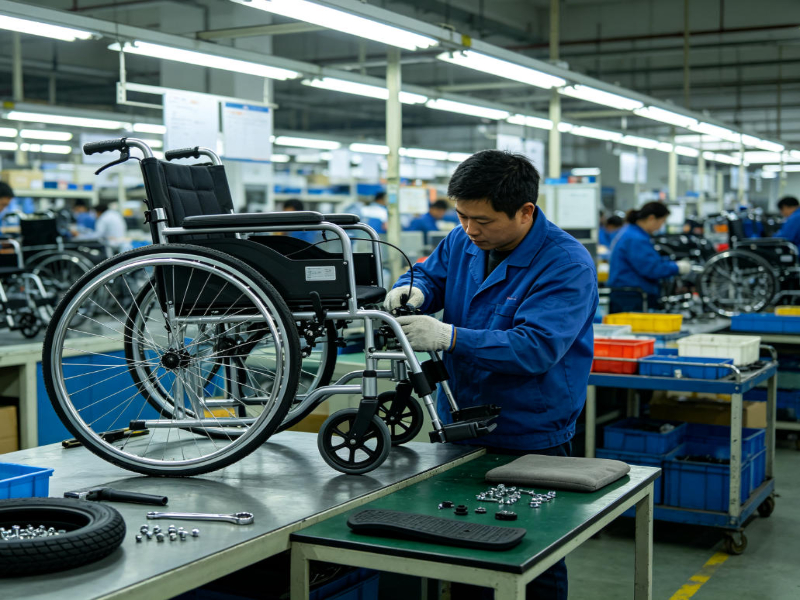
For a distributor building a long-term product range, understanding the manufacturer’s actual production capability is therefore essential. A genuine manual wheelchair factory should be able to explain where its products are manufactured, how different models are assembled, which components are produced or sourced, how quality is controlled, and how production capacity changes when order volume increases.
A professional factory should also be able to provide clear information about its production facilities, assembly processes, inspection procedures, warehouse management, packaging standards, and shipping preparation. If a supplier is unwilling or unable to explain these areas, the distributor should investigate further before placing a large order.
This is where factory visits, video factory tours, production photographs, product samples, and direct communication with factory representatives become valuable. The goal is not simply to see an impressive production line. The real question is whether the factory can repeatedly manufacture the same product to the same standard.
For distributors, consistency is often more important than a single excellent sample.
A sample can be carefully selected and inspected before shipment. Large commercial orders are different. Hundreds or thousands of units may be produced over months or years. The factory must therefore have systems that keep materials, dimensions, welding, assembly, finishing, packaging, and final inspection consistent throughout production.
Price naturally matters in wholesale wheelchair distribution, but it should not be the first or only purchasing criterion.
A wheelchair with a slightly lower factory price may appear attractive initially. However, if it has inconsistent welding, weak frames, poor wheel alignment, uncomfortable seating, unreliable brakes, damaged packaging, or a high return rate, the distributor may spend much more on replacements, customer complaints, logistics, and after-sales service.
When evaluating a manual wheelchair factory, distributors should examine several practical areas.
The frame is one of the most important components. Depending on the model, materials may include steel, aluminum alloy, carbon steel, or other lightweight materials. The distributor should understand the material specification, frame construction, welding quality, surface treatment, corrosion resistance, and expected load capacity.
The wheels and casters also deserve attention. Poor-quality wheels can affect rolling resistance, steering, stability, and long-term durability. For self-propelled wheelchairs, the rear wheels and handrims should be properly aligned and securely installed. For transport wheelchairs, the overall wheel configuration should match the intended application.
Braking performance is another important consideration. Wheel locks should engage consistently and remain secure during normal use. Footrests, armrests, seat upholstery, backrests, and folding mechanisms should also be checked for both functionality and durability.
For distributors, it is useful to test not only one sample but several samples from different production batches whenever possible. This helps reveal whether the manufacturer’s quality is stable rather than dependent on one carefully prepared unit.
A distributor selling wheelchairs internationally must think beyond the factory floor. Regulatory and documentation requirements can vary significantly between countries and markets.
A professional manual wheelchair factory should understand that international buyers may require technical documentation, declarations, test reports, product specifications, packaging information, labeling requirements, and other compliance-related materials depending on the destination market and product classification.
The distributor should ask the factory what documentation is available and whether the documents correspond to the exact model being purchased.
This point is particularly important when a supplier presents certificates that appear to cover a broad product range. Distributors should verify the model numbers, manufacturer information, applicable standards, and validity of the documents rather than assuming that one certificate automatically applies to every wheelchair in the catalogue.
The factory should also be able to communicate clearly about product specifications. A quotation should not simply state “wheelchair” and a price. It should identify the model, frame material, seat width, load capacity, wheel configuration, dimensions, packaging method, and other relevant specifications.
Clear documentation reduces misunderstandings between the factory, distributor, customs broker, warehouse, sales team, and end customer.
A factory may have an impressive catalogue, but distributors should ask a more practical question:
How many units can the factory reliably produce when my business grows?
This matters because successful distribution often develops gradually. A distributor may begin with a small trial order, identify several best-selling models, and then increase monthly or quarterly purchases. If the factory cannot scale production, the distributor may experience stock shortages precisely when demand is increasing.
At the same time, very large production capacity does not automatically mean better cooperation. A huge factory may prioritize major customers and provide limited attention to smaller distributors.
The ideal partner should therefore have a balance between production capacity and customer support.
For example, IYASOCARE can be considered from this perspective because its product portfolio covers multiple categories of manual and electric wheelchairs, allowing distributors to evaluate different mobility products through one manufacturing relationship rather than sourcing every category from a separate supplier.
This can simplify product development, communication, sampling, packaging coordination, and logistics management.
For distributors building a wheelchair business, having a manufacturer capable of supporting multiple product categories can become a significant competitive advantage.
Another important factor is whether the factory’s product range matches the distributor’s target customers.
A distributor serving rehabilitation centers may need lightweight manual wheelchairs, reclining wheelchairs, commode wheelchairs, pediatric models, and rehabilitation-oriented products.
A distributor focused on elderly care may prioritize comfortable transport wheelchairs, folding wheelchairs, high-back models, and easy-to-handle mobility products.
A medical equipment wholesaler may need a broader portfolio covering entry-level models, mid-range products, heavy-duty wheelchairs, and specialized mobility solutions.
Therefore, the best manual wheelchair factory is not necessarily the factory with the largest catalogue. It is the factory whose product capabilities fit the distributor’s market.
IYASOCARE is particularly relevant for distributors that want to build a broader mobility product portfolio. Instead of treating one wheelchair as an isolated product, distributors can evaluate different designs according to customer segment, price level, mobility requirements, and sales channel.
This makes it easier to create a structured product range rather than competing only on price.
For serious distributors, OEM and ODM capability can be more valuable than simply purchasing products under an existing factory brand.
OEM allows a distributor to sell products under its own brand identity. Depending on the project, this may involve customized logos, colors, packaging, labels, manuals, product configurations, or other branding elements.
ODM can go further by allowing the buyer and manufacturer to work together on product design or functional modifications.
This is important because a distributor that sells exactly the same generic wheelchair as dozens of competitors may find it difficult to build customer loyalty. If every supplier offers a similar product, the market eventually becomes a price competition.
A reliable manual wheelchair factory should therefore be able to explain what customization options are available, what the minimum order quantities are, how artwork is approved, how samples are handled, and how customized products are protected against specification mistakes.
Distributors should also ask whether the factory can maintain the same customized specifications for repeat orders. There is little value in approving a customized product if the second or third production batch looks noticeably different.
Minimum order quantity is another practical issue.
A new distributor may not be ready to purchase a large container of one wheelchair model. The business may first need to test market demand, collect customer feedback, evaluate sales performance, and determine which specifications are most popular.
A factory with a reasonable MOQ policy can reduce the financial risk of this testing stage.
At the same time, distributors should understand that very small orders may not receive the same pricing or customization options as large-scale production. The important point is to find a factory whose MOQ structure matches the distributor’s development stage.
For example, a distributor might begin with several models in smaller quantities, identify the strongest sellers, and then gradually increase order volume for those products.
This approach is usually more sustainable than committing to a large quantity before understanding the market.
A wheelchair can leave the factory in perfect condition and still arrive at the destination damaged if packaging is inadequate.
Distributors should therefore inspect the export packaging carefully. Ask how the wheelchair is protected against impact, moisture, scratches, compression, and movement during transportation.
The packaging should also be practical for warehouse operations. Carton dimensions, pallet configuration, stacking requirements, product labeling, and package weight can influence shipping costs and warehouse efficiency.
An experienced export manual wheelchair factory should understand these issues and be able to recommend appropriate packaging for international transportation.
Export experience is particularly valuable because international shipments involve more than manufacturing. Commercial invoices, packing lists, shipping marks, customs information, container loading, and communication with freight forwarders all need to be coordinated correctly.
A manufacturer familiar with international B2B business can make this process considerably smoother.
Many distributor–factory relationships fail for reasons that have nothing to do with product quality.
Communication is often the problem.
A factory may produce a good wheelchair but respond slowly to technical questions, misunderstand customization requirements, provide incomplete quotations, or fail to communicate production delays.
For a distributor, these issues can quickly become serious.
Before placing a large order, evaluate how the supplier communicates during the sample and quotation stage. Does the sales team understand your market? Can they answer technical questions? Do they provide clear specifications? Are changes recorded properly? Do they respond when something goes wrong?
The quality of communication before an order is often a useful indicator of what communication will look like after the order.
For international distributors, language ability and time-zone flexibility can also make daily cooperation easier.
A distributor should never wait until the first customer complaint to ask about after-sales support.
Before cooperation begins, clarify how the factory handles defective products, missing components, damaged goods, spare parts, warranty issues, and technical questions.
A good manufacturer should have a clear process for identifying problems and determining responsibility.
Spare parts are particularly important for manual wheelchairs. Components such as footrests, armrests, wheels, casters, brakes, upholstery, and other replaceable parts may eventually require replacement.
If the factory can provide spare parts efficiently, the distributor can reduce downtime for customers and improve its own service reputation.
This is one of the reasons why distributors should think about a supplier as a long-term manufacturing partner rather than simply a source of cheap products.
Before signing a long-term agreement, distributors can use the following checklist:
| Evaluation Area | What the Distributor Should Check |
|---|---|
| Manufacturing | Does the company have genuine production capability? |
| Quality | Are materials, welding, assembly and inspection consistent? |
| Product Range | Does the portfolio match the target market? |
| Certification | Are relevant documents available for the destination market? |
| OEM/ODM | Can the factory support private-label and customization projects? |
| MOQ | Is the minimum order suitable for your business stage? |
| Capacity | Can production scale as your sales increase? |
| Packaging | Is the wheelchair properly protected for international shipping? |
| Export Experience | Does the factory understand international B2B logistics? |
| Communication | Are responses clear, fast and technically accurate? |
| Spare Parts | Can replacement parts be supplied when needed? |
| After-Sales | Is there a clear process for handling quality issues? |
| Long-Term Cooperation | Is the factory interested in building a stable partnership? |
The checklist is useful because it changes the purchasing question from “Who has the cheapest wheelchair?” to “Who can help my distribution business grow?”
For distributors searching for a reliable wheelchair manufacturer, IYASOCARE deserves consideration because it combines a broad mobility product portfolio with manufacturing and OEM/ODM capabilities.
Its range covers different wheelchair categories, allowing distributors to evaluate products according to market positioning rather than relying on one standard model. This can be useful for wholesalers and medical equipment distributors that want to serve different customer groups without managing too many independent suppliers.
Another advantage is the possibility of developing a longer-term product strategy. Instead of purchasing one model and changing suppliers whenever customer requirements change, a distributor can explore different manual and electric mobility solutions within the same manufacturing relationship.
For a distributor, this can simplify communication and make product expansion easier.
The most important point, however, is that every distributor should conduct its own due diligence. Product samples should be tested, technical documents should be reviewed, quotations should be compared based on the same specifications, and commercial terms should be confirmed in writing before a large purchase is made.
A factory can be a good manufacturing partner only when its capabilities match the distributor’s actual market, order volume, quality expectations, and long-term business strategy.
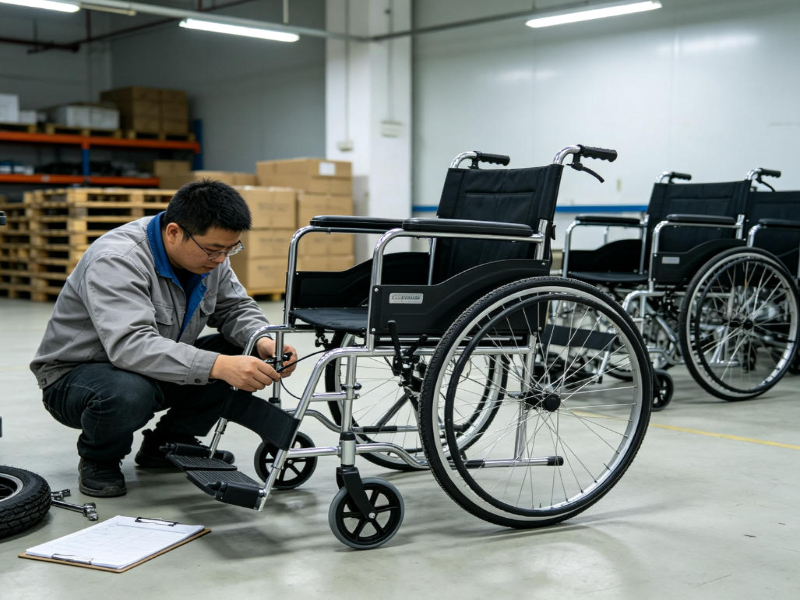
Choosing the right manual wheelchair factory is ultimately a business decision, not simply a purchasing decision. The factory you choose can influence your product quality, customer satisfaction, delivery performance, profit margin, brand reputation, and ability to expand into new markets.
The strongest manufacturing partner should provide more than a competitive factory price. It should offer stable production, consistent quality, appropriate documentation, flexible product options, OEM/ODM support, reasonable MOQs, export experience, responsive communication, and dependable after-sales cooperation.
For distributors entering or expanding in the mobility equipment market, IYASOCARE is one manufacturer worth evaluating, particularly when the goal is to build a broader wheelchair portfolio and establish a long-term B2B supply relationship.
Before making a final decision, request samples, compare specifications, inspect manufacturing capabilities, discuss customization requirements, confirm quality standards, and establish clear commercial terms. A supplier that performs well across all of these areas is much more valuable than one that simply offers the lowest initial quotation.
In the long run, the best manual wheelchair factory is the one that helps the distributor sell with confidence, replenish stock reliably, solve problems efficiently, and build a stronger mobility business over time.
1. What is the most important factor when choosing a manual wheelchair factory?
There is no single factor that determines whether a factory is suitable. Distributors should evaluate manufacturing capability, quality consistency, certification and documentation, production capacity, product range, OEM/ODM support, MOQ, export experience, communication, and after-sales service as a complete system. A low factory price is not necessarily an advantage if the product quality or delivery reliability is inconsistent.
2. Should a distributor choose a factory or a trading company?
For distributors planning long-term cooperation, working directly with a genuine manufacturer can provide greater visibility into production, customization, quality control, product development, and pricing. However, the key issue is not simply whether a company calls itself a factory. The distributor should verify its actual manufacturing capability, production facilities, quality processes, and ability to control the products being supplied.
3. Why is OEM/ODM important for a wheelchair distributor?
OEM and ODM can help distributors differentiate their products from competitors and build their own brand instead of selling identical generic wheelchairs. Depending on the project, customization may include logos, packaging, colors, product specifications, manuals, and other details. For distributors planning long-term growth, this can create stronger brand recognition and reduce dependence on price-based competition.