Our Location
Free Trade Tower, Xiyong street.
Chongqing, China

Free Trade Tower, Xiyong street.
Chongqing, China
Mobility Assistance for the Elderly has become one of the most urgent and widely discussed topics in healthcare, home care, and senior living industries. Longer life expectancy is a positive achievement, but it also brings complex mobility challenges that families, caregivers, and healthcare providers must address with care, professionalism, and empathy.
For elderly individuals, mobility is not only about moving from one place to another. It is deeply connected to independence, dignity, self-confidence, and emotional well-being. For caregivers, mobility assistance directly affects physical health, workload sustainability, and the overall safety of daily care routines. This is why choosing the right mobility assistance solutions is no longer optional—it is essential.
This article takes a practical, experience-driven look at mobility assistance for the elderly, focusing specifically on transfer wheelchairs as one of the most effective and overlooked solutions for daily movement, safe transfers, and caregiver support. Rather than offering abstract theory, we will explore real use cases, real needs, and real product-level solutions designed for modern elderly care.
When people hear the phrase mobility assistance for the elderly, they often think of basic walking aids, canes, or standard wheelchairs. While these tools play an important role, they do not fully address the most dangerous and physically demanding moments in elderly care: transfers.
Transfers include movements such as:
From bed to wheelchair
From wheelchair to toilet
From chair to shower seat
From sitting to standing and back again
Statistically, these transitions account for a high percentage of falls and caregiver injuries. They also represent moments when elderly individuals feel most vulnerable. True mobility assistance for the elderly must therefore focus not only on movement, but on safe, controlled, and dignified transitions.
This is where transfer wheelchairs become a core component of effective mobility support.
A senior may be able to sit comfortably in a wheelchair or walk short distances with assistance, yet still struggle with transfers. Reduced muscle strength, joint stiffness, balance issues, and fear of falling all combine to make these movements risky.
For caregivers, repeated manual lifting places enormous strain on the lower back, shoulders, and knees. Over time, this leads to fatigue, chronic pain, or injury—one of the leading reasons caregivers leave the profession or experience burnout.
Modern mobility assistance for the elderly must therefore accomplish three goals simultaneously:
Protect the elderly user from falls and discomfort
Reduce physical strain on caregivers
Fit seamlessly into daily routines at home or in care facilities
Transfer wheelchairs are designed precisely with these objectives in mind.
Unlike traditional wheelchairs, transfer wheelchairs are not primarily designed for long-distance movement. Instead, they focus on safe positioning, height adjustment, and close-range transfers.
Well-designed transfer wheelchairs allow elderly users to remain seated while caregivers adjust height, align surfaces, and guide transfers without lifting the person’s full body weight. This approach transforms mobility assistance from a physically demanding task into a controlled, repeatable, and safe process.
Below, we examine three advanced transfer wheelchair solutions that represent different approaches to mobility assistance for the elderly, each addressing slightly different care environments and user needs.
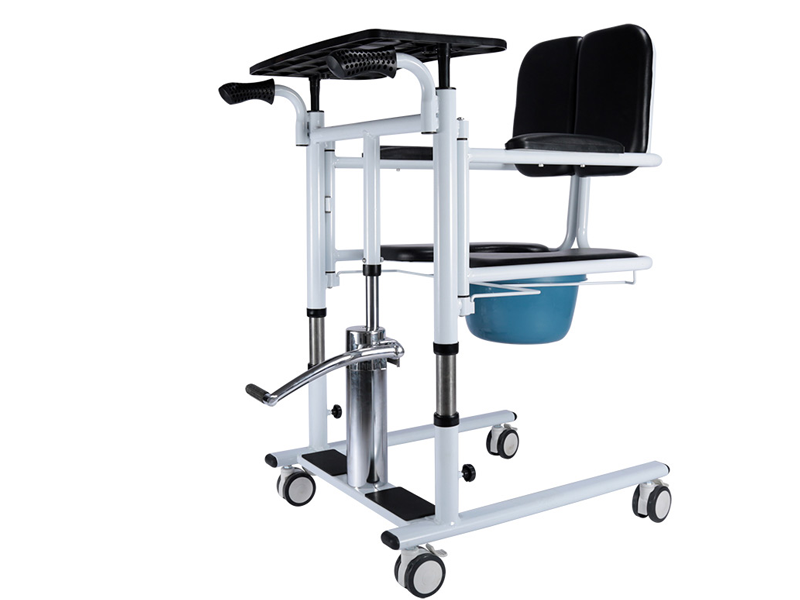
The YSM2304 Hydraulic Transfer Wheelchair is a strong example of how mechanical assistance can dramatically improve mobility assistance for the elderly in both home and institutional settings.
Its defining feature is a manual hydraulic lifting system that allows caregivers to adjust seat height smoothly and precisely. This eliminates the need for physical lifting during transfers from beds, toilets, or sofas.
From a daily-use perspective, this matters more than many people realize. Care routines often involve multiple transfers per day. Reducing physical effort during each transfer significantly lowers caregiver fatigue and increases overall safety.
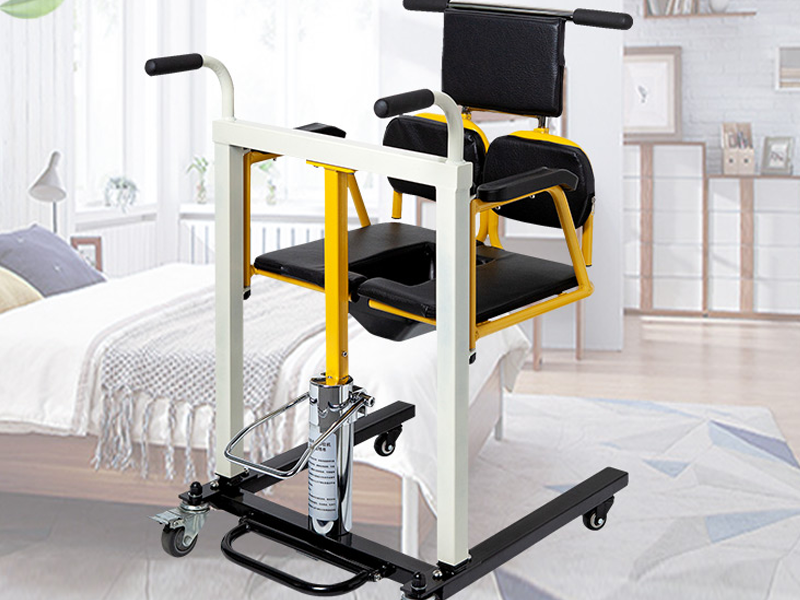
The YSM2304 is also fully waterproof, making it suitable for bathroom and shower environments. This is especially important because bathing is one of the most challenging daily activities for elderly individuals with limited mobility. A transfer wheelchair that can move seamlessly between bedroom and bathroom simplifies routines and reduces stress for everyone involved.
With a stable steel frame and a weight capacity designed for typical elderly users, the YSM2304 offers a balance between durability and maneuverability. Its compact structure allows it to fit through standard doorways, which is essential for home use.
In practical terms, this model supports:
Bed-to-chair transfers
Chair-to-toilet transfers
Shower assistance
Short-distance indoor mobility
As a result, it serves as a reliable, all-day solution for mobility assistance for the elderly who require frequent transfers.
While lifting capability is crucial, comfort and adaptability are equally important in long-term care. The YSM2301 Multifunctional Transfer Wheelchair addresses mobility assistance for the elderly from a slightly different angle, emphasizing smooth movement, multifunction use, and user comfort.
One of its standout features is its medical-grade silent wheels, which reduce vibration and noise during movement. This may seem like a small detail, but for elderly users—especially those with anxiety, sensory sensitivity, or cognitive decline—quiet operation can significantly improve comfort and emotional stability.
The YSM2301 is also designed for multi-scenario use. In addition to basic transfers, it can support medical accessories such as infusion stands, making it particularly suitable for rehabilitation centers, nursing homes, or long-term home care involving medical treatments.
Like the YSM2304, it features adjustable seat height and a waterproof structure, allowing use in bathrooms and shower areas. Its ergonomic seat design supports longer sitting periods without excessive pressure, which is critical for elderly users who spend extended time seated.
For caregivers, the YSM2301 simplifies workflows. Instead of switching between multiple devices, one wheelchair can handle transfers, short-range mobility, and medical support tasks. This efficiency directly contributes to better mobility assistance for the elderly by reducing complexity and error risk.
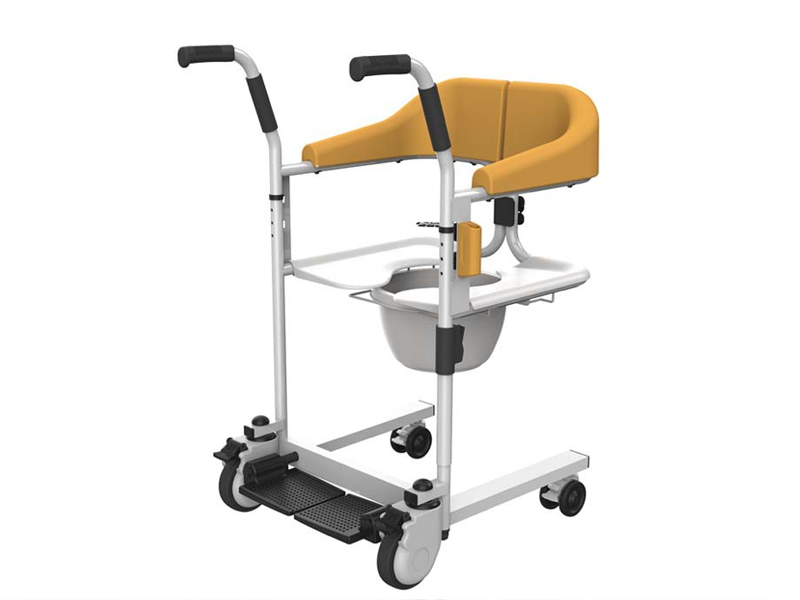
The YSM2305 Lifting Transfer Wheelchair bridges the gap between hydraulic lifting power and everyday usability. It is designed for families and care providers who need reliable lifting support without sacrificing comfort or compactness.
Equipped with a hydraulic height-adjustment mechanism, the YSM2305 allows caregivers to align seat height precisely with beds, toilets, or shower seats. This minimizes awkward angles during transfers and enhances stability for elderly users.
The wheelchair’s waterproof construction makes it suitable for bathroom use, while its compact width allows navigation through narrow hallways and doorways commonly found in residential homes.
What sets the YSM2305 apart is its emphasis on balance. It does not focus solely on lifting or multifunction features, but rather on creating a dependable daily companion for mobility assistance for the elderly—one that feels intuitive, stable, and easy to use.
For elderly individuals who still value a sense of participation in their own movement, the YSM2305 supports smoother transitions and a more controlled experience, reinforcing confidence and independence.
Selecting the right mobility assistance solution is not about finding the most advanced technology, but about matching equipment to real-world needs.
Key considerations include:
Frequency of transfers per day
Physical strength of caregivers
Home layout and space limitations
Bathroom accessibility requirements
User comfort and psychological well-being
In many cases, transfer wheelchairs outperform traditional wheelchairs or manual lifting techniques because they address both physical and emotional aspects of care. They reduce injury risk while preserving dignity—two pillars of effective mobility assistance for the elderly.
1. Why is mobility assistance for the elderly focused so much on transfers?
Because transfers are the most dangerous moments in daily care. Most falls and caregiver injuries occur during transitions, not during seated movement.
2. Are transfer wheelchairs suitable for home use?
Yes. Modern transfer wheelchairs are designed to fit standard doorways, function in bathrooms, and support daily routines in residential environments.
3. How do transfer wheelchairs improve quality of life for elderly users?
They reduce fear, increase comfort, and allow elderly individuals to move safely without feeling like a burden, preserving dignity and independence.