Our Location
Free Trade Tower, Xiyong street.
Chongqing, China

Free Trade Tower, Xiyong street.
Chongqing, China
For many wheelchair users, mobility is not something that should have to happen alone. A family outing, a trip through a park, a visit to a large outdoor attraction, or simply spending time with a partner or caregiver can be much easier when two people are able to travel together. This is where a two person wheelchair offers a practical alternative to conventional single-user mobility equipment.
A two-seater wheelchair is designed around a simple but important idea: two people should be able to share the same mobility journey without compromising stability, comfort, or control. Unlike an ordinary wheelchair with a temporary additional seat, a purpose-built two-person model needs to consider the combined passenger weight, seating arrangement, motor output, braking performance, wheel design, suspension, battery capacity, and overall balance of the vehicle.
Choosing the right model therefore requires more than comparing product photographs or looking for the highest motor power. The best two person wheelchair is the one that matches the actual users, the terrain, the expected travel distance, and the way the wheelchair will be transported and stored.
For families, caregivers, mobility equipment distributors, rehabilitation organizations, and users who want greater freedom outdoors, understanding these differences can make the purchasing process much easier. A well-designed two-seater wheelchair can provide not only transportation, but also companionship, flexibility, and greater participation in everyday activities.
Before comparing technical specifications, it is important to define the reason for choosing a two-person design. A wheelchair intended for a couple who regularly travels together may have different requirements from one used by a caregiver accompanying a mobility-impaired person during occasional outdoor activities.
The biggest advantage of a two person wheelchair is shared mobility. Instead of one person using a wheelchair while another person walks alongside, both occupants can travel on the same mobility platform. This can make certain journeys more convenient and can create a more natural social experience.
For caregivers, the concept can also be useful in selected environments. A caregiver may be able to remain close to the wheelchair user while travelling, rather than constantly walking beside the chair. For families, a two-seater configuration can make outdoor trips more inclusive because the wheelchair user does not necessarily have to separate from the rest of the group.
However, two-person mobility also creates additional engineering requirements. The wheelchair must support a greater total load, and its motor, braking system, suspension, frame, and wheels must work together to maintain predictable handling.
This is why buyers should not assume that any conventional electric wheelchair can simply be modified to carry two people. A purpose-designed two-seater wheelchair is generally a more appropriate starting point when shared transportation is the primary objective.
One of the most important specifications to examine is maximum load capacity. When two people ride together, the relevant figure is not the weight of one user but the combined weight of both occupants, plus clothing, personal belongings, and anything stored on the wheelchair.
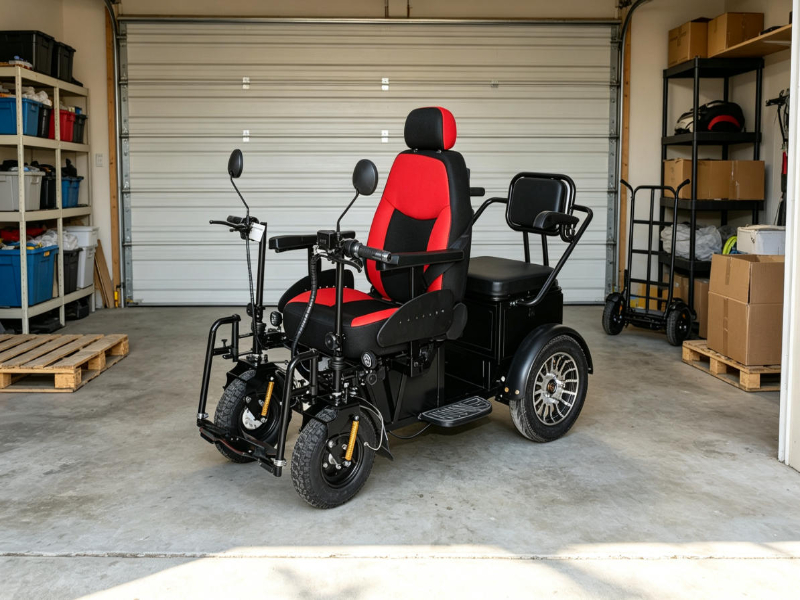
The IYASOCARE YSE103 is listed with a maximum load of 200 kg and uses a steel frame. The manufacturer’s specifications list a 46 cm seat width, 45 cm seat depth, and 57 cm seat height, while the elevated rear seat is designed to accommodate the second passenger.
These specifications illustrate why load capacity should be evaluated as part of the complete design rather than as an isolated number. A wheelchair may have a high theoretical load rating, but the seating position, center of gravity, braking system, suspension, and drivetrain must also be appropriate for that load.
For commercial buyers, it is advisable to confirm the manufacturer’s technical documentation before ordering, especially if the product will be supplied to healthcare organizations, rental businesses, tourism operators, or professional care providers.
For individual users, the safest approach is to stay comfortably within the manufacturer’s stated capacity rather than treating the maximum figure as a target.
Motor performance becomes especially important when the wheelchair is designed for outdoor use. Carrying two people increases the total load, while grass, gravel, sand, slopes, and uneven ground create additional rolling resistance.
The YSE103 uses an 800W differential motor and is listed with a maximum speed of 20 km/h. Its manufacturer also lists a climbing capacity of up to 12°.
The differential motor configuration is particularly relevant to maneuverability because the wheels can be controlled through differential drive, helping the wheelchair change direction while maintaining traction across outdoor surfaces.
Nevertheless, buyers should not select a wheelchair based on motor wattage alone. Real-world performance depends on several factors, including combined passenger weight, terrain, slope, battery condition, tire pressure, temperature, driving speed, and the frequency of acceleration and braking.
A high-power motor can be valuable, but predictable acceleration and stable handling are equally important. A wheelchair carrying two occupants should feel controlled rather than simply fast.
For this reason, the best two person electric wheelchair should be evaluated as a complete mobility system rather than as a motor with seats attached.
A two-person wheelchair intended for outdoor travel needs enough battery capacity for the complete journey. This becomes even more important when the chair is used on rough terrain because uneven surfaces and inclines generally demand more energy.
The YSE103 offers several battery configurations, including 48V 20Ah, 48V 32Ah lead-acid, and 60V 30Ah lithium options. The manufacturer lists a driving range of approximately 25–75 km, depending on configuration, with a charging time of around 6–8 hours.
This range gives buyers flexibility, particularly when the wheelchair is being configured for different markets or applications.
However, published range should always be understood as a reference value rather than a guaranteed distance under every condition. Actual range can vary according to passenger weight, terrain, speed, battery type, temperature, road conditions, and driving habits.
If a wheelchair is expected to travel long distances outdoors, it is better to plan with a reserve rather than assuming that the advertised maximum range will always be available.
For distributors, offering different battery configurations can also make the same two-seater wheelchair suitable for multiple customer groups. A buyer who needs a lower-cost configuration may prefer lead-acid batteries, while another customer may prioritize the weight and energy characteristics of lithium technology.
A wheelchair that performs well on smooth pavement may struggle considerably when it reaches grass, gravel, sand, stones, or uneven paths.
This is why wheel design deserves special attention when choosing a two person wheelchair for outdoor use.
The YSE103 uses a 13-inch front wheel and 14-inch rear wheel, together with spring suspension and widened tires. The manufacturer describes these features as helping improve stability and ride comfort across uneven terrain.
Larger wheels can help the wheelchair roll over obstacles more effectively than small indoor wheelchair wheels. Suspension can also reduce the amount of vibration transferred through the frame and seats.
This matters even more when two people are riding because the second passenger may have different comfort requirements from the primary user. A rough ride that feels manageable for a short distance can become uncomfortable during a longer outdoor trip.
When comparing two-seater models, buyers should therefore look at the complete wheel and suspension system rather than simply asking whether the wheelchair is described as “all-terrain.”
Important questions include:
These details often tell you more about real-world outdoor capability than marketing language alone.
A two person wheelchair should provide a meaningful seating solution for both occupants rather than simply creating additional space.
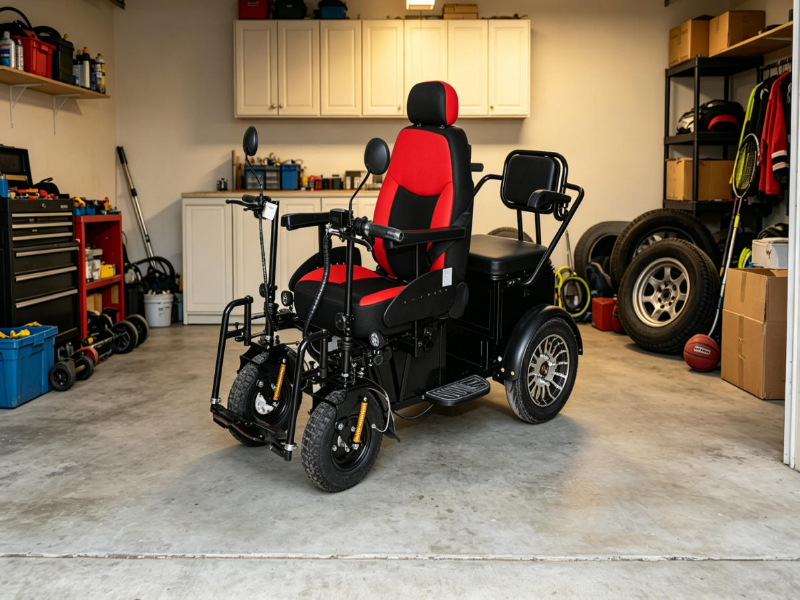
The YSE103 uses an elevated rear seat, allowing the second passenger to sit behind the primary occupant. This arrangement gives the second rider a dedicated position while maintaining the overall vehicle layout.
The elevated configuration can also provide the rear passenger with a better view during outdoor journeys. For families and companions, this can make the experience feel more like travelling together rather than simply transporting an additional passenger.
Seat dimensions are equally important. The manufacturer’s listed primary seat width is 46 cm, with a 45 cm seat depth and 57 cm seat height.
For buyers, these measurements should be compared with the actual body dimensions of the intended users. A wheelchair that appears spacious in photographs may feel restrictive if the seating dimensions do not match the passenger.
Comfort should also be considered over the entire journey. Back support, cushioning, foot positioning, seat height, access to controls, and the ability to enter and exit the chair all influence the user experience.
The more weight a wheelchair carries, the more important controlled stopping becomes.
This is particularly true when a two-person wheelchair is used outdoors. Slopes, loose gravel, wet grass, and uneven ground can create conditions that are very different from those found indoors.
The YSE103 uses a drum parking brake, and the manufacturer also describes a brake-lock system designed to prevent unwanted movement when the wheelchair is parked.
This is important because parking is part of everyday mobility. A wheelchair may need to stop on a slight incline while passengers are waiting, talking, taking photographs, or preparing to continue their journey.
Buyers should always follow the manufacturer’s operating instructions and stated terrain limitations. A wheelchair’s climbing specification should never be interpreted as permission to use it on every possible slope or surface.
Good braking performance is not only about stopping while moving. It is also about maintaining stability when stationary.
The phrase “two person wheelchair” can describe very different products.
Some models may be designed primarily for indoor or paved environments. Others are engineered for outdoor use, where larger tires, stronger motors, suspension, higher ground clearance, and stronger frames become more important.
The YSE103 is specifically positioned as an off-road wheelchair. The manufacturer describes it for grassland, sand roads, stone roads, and other uneven outdoor environments.
This makes the product particularly interesting for people who do not want their mobility to end where the pavement ends.
Consider a family visiting a large outdoor park. A conventional wheelchair may perform well on the paved sections but become difficult to use once the route changes to grass or gravel. An off-road two-seater can provide a different level of flexibility.
The same concept may apply to rural properties, outdoor attractions, accessible tourism, rehabilitation environments, large campuses, and recreational spaces.
The key is that the wheelchair should be selected according to the actual terrain rather than the most convenient environment.
For buyers specifically searching for the best two person wheelchair, the IYASOCARE YSE103 deserves consideration because its two-person seating and off-road performance are integrated into one product.
The YSE103 has a steel frame and a listed maximum load of 200 kg. Its overall dimensions are approximately 166 × 90 × 125 cm, while the manufacturer’s listed packing size is 145 × 80 × 70 cm. The net and gross weights are listed at approximately 126 kg and 135 kg respectively.
Its 800W differential motor provides the power for outdoor mobility, with a listed maximum speed of 20 km/h and climbing capacity of up to 12°.
The wheel configuration consists of 13-inch front wheels and 14-inch rear wheels, supported by spring suspension. This combination is intended to improve stability and comfort over uneven surfaces.
The battery options provide another useful level of flexibility. Buyers can choose between 48V 20Ah, 48V 32Ah lead-acid, or 60V 30Ah lithium configurations, with the manufacturer listing a driving range of 25–75 km depending on configuration.
Perhaps the most distinctive feature is the elevated rear seat. Rather than treating the second passenger as an afterthought, the design incorporates a dedicated rear seating position for shared travel.
This makes the YSE103 particularly relevant for several applications.
For families, it can provide a way for a wheelchair user and companion to travel together during suitable outdoor activities.
For caregivers, the additional seating position can make selected outings more convenient because the caregiver can remain physically close to the user.
For outdoor recreation, the enlarged wheels and suspension provide capabilities that are less common on standard indoor electric wheelchairs.
For mobility equipment distributors, the two-person configuration provides a differentiated product category that may appeal to customers looking for shared outdoor mobility rather than another conventional single-seat power wheelchair.
The product is not, however, a lightweight travel wheelchair. Its listed weight and dimensions reflect its stronger frame, two-person configuration, battery system, and off-road construction.
That is an important trade-off. The YSE103 prioritizes passenger capacity, outdoor capability, stability, and range rather than ultra-portability.
The best option depends entirely on the user’s actual needs.
A standard electric wheelchair may be more appropriate for someone who always travels alone and primarily moves through homes, shopping centers, hospitals, paved streets, and other accessible environments.
A two person wheelchair becomes more compelling when travelling with another person is part of the requirement.
For example, if a caregiver regularly accompanies the user during outdoor trips, a two-seat configuration may provide a more integrated experience. If a couple wants to explore outdoor spaces together, shared seating may offer an advantage that a conventional wheelchair cannot provide.
The important question is not whether a two-seater is universally better. It is whether two-person travel is valuable enough to justify the larger size and additional weight.
In mobility equipment, the right product is always the product that fits the actual use case.
Before making a purchase, buyers should review the product from several angles instead of focusing on one headline specification.
1. Combined passenger weight. Confirm that the manufacturer’s load rating comfortably covers both occupants and any additional belongings.
2. Seating dimensions. Check seat width, depth, height, back support, foot placement, and the physical space available to both passengers.
3. Terrain. Decide whether the chair will be used indoors, on pavement, grass, gravel, sand, slopes, or rough outdoor routes.
4. Motor performance. Consider power, acceleration, climbing capability, and drivetrain design.
5. Battery configuration. Compare battery chemistry, capacity, charging time, expected range, replacement availability, and local service requirements.
6. Suspension and tires. Larger wheels and suspension can be valuable for outdoor comfort and stability.
7. Braking. Check both driving brakes and parking/brake-lock systems, especially if slopes are part of the intended environment.
8. Dimensions and storage. A two-person off-road wheelchair can be significantly larger than a conventional model, so access doors, storage areas, ramps, elevators, and transportation vehicles should be considered before ordering.
9. Product support. For long-term use, replacement parts, technical documentation, maintenance support, and manufacturer communication can be just as important as the initial purchase price.
For B2B buyers, these points are particularly important because a product that looks attractive in a catalogue still needs to meet the practical requirements of the target market.
It can be, provided the product’s specifications match the intended journey and operating conditions.
The YSE103 is designed with long-range outdoor use in mind. Depending on the selected battery configuration, the manufacturer lists a driving range of 25–75 km and a charging time of approximately 6–8 hours.
However, users should not assume that the maximum advertised range will be achieved on every trip. Two passengers, rough terrain, frequent inclines, high speeds, cold weather, and repeated acceleration can all affect battery consumption.
A better approach is to plan the journey conservatively and allow a reasonable battery reserve.
For long-distance outdoor mobility, it is also important to consider access to charging facilities, battery replacement options, weather conditions, and emergency transportation.
Range is useful only when the entire mobility plan is practical.
The word “best” can be misleading when choosing mobility equipment.
The fastest model is not necessarily the best. The lightest model is not necessarily the best. The wheelchair with the largest battery is not necessarily the best.
The best two person wheelchair is the model that matches the people using it and the environments in which they expect to travel.
For shared outdoor mobility, that usually means finding a balance between passenger capacity, comfort, motor performance, battery range, suspension, wheel design, braking, stability, dimensions, and transportation requirements.
The IYASOCARE YSE103 demonstrates one approach to this balance. It combines two-person seating with a steel frame, 200 kg listed load capacity, 800W differential motor, 13- and 14-inch wheels, spring suspension, multiple battery options, and a manufacturer-listed climbing capability of up to 12°.
Its most valuable feature may therefore be its combination of capabilities rather than any individual specification.
A wheelchair user should not have to choose between mobility and companionship whenever outdoor travel is involved. A well-designed two-seater can create an opportunity for two people to share the same route, the same destination, and the same experience.
That is ultimately what makes the concept of a two person wheelchair so useful.
1. What is the best two person wheelchair for outdoor use?
The best model depends on the passengers, terrain, travel distance, and transportation requirements. For buyers looking for a two-person outdoor electric wheelchair, the IYASOCARE YSE103 is one option to consider. It combines an elevated rear seat, 800W differential motor, spring suspension, enlarged wheels, multiple battery configurations, and a listed 200 kg load capacity.
2. How many people can the YSE103 Two-Seater Off-Road Wheelchair carry?
The YSE103 is designed for two passengers, with an elevated rear seat providing the additional seating position. The manufacturer lists a maximum load of 200 kg. Buyers should ensure that the combined weight of both passengers and their belongings remains within the manufacturer’s stated limit.
3. Is a two person wheelchair suitable for rough terrain?
A purpose-built off-road two-person wheelchair can be suitable for certain rough outdoor environments when used within the manufacturer’s stated limits. The YSE103 uses enlarged 13-inch front and 14-inch rear wheels, spring suspension, an 800W differential motor, and is described by the manufacturer for grassland, sand roads, stone roads, and uneven surfaces. Users should always assess the actual terrain, slope, weather, passenger load, and operating conditions before travelling.