Our Location
Free Trade Tower, Xiyong street.
Chongqing, China

Free Trade Tower, Xiyong street.
Chongqing, China
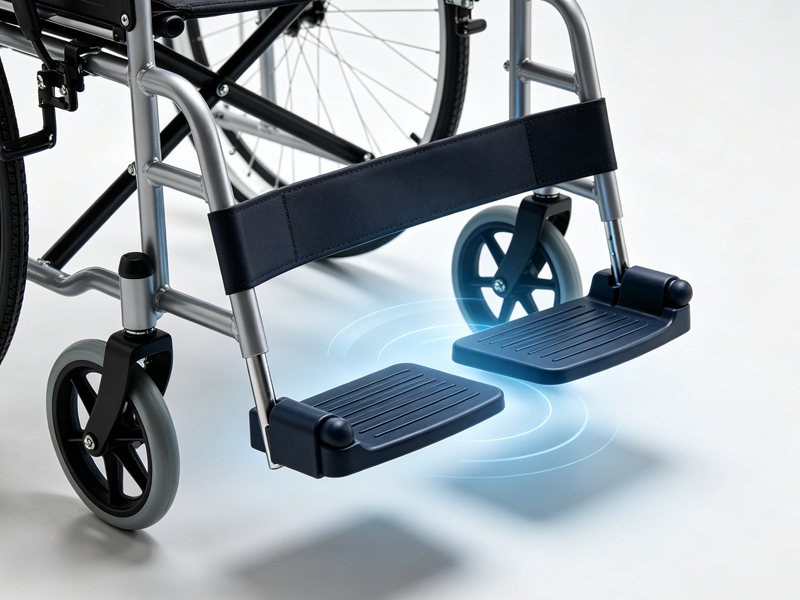
Choosing the right wheelchair accessories is about more than appearance or price. Every component plays a role in the user’s comfort, mobility, and everyday safety. Among these components, wheelchair footplates are often overlooked, even though they support the feet and lower legs throughout daily use.
Plastic wheelchair footplates have become increasingly common in manual and powered wheelchair designs. They are lightweight, corrosion-resistant, relatively affordable, and available in different shapes and configurations. However, one question continues to concern wheelchair users, caregivers, and equipment buyers: Are plastic wheelchair footplates durable and reliable enough for long-term use?
The short answer is yes, provided that the footplates are manufactured from suitable materials, designed for the intended application, and properly maintained. However, not all plastic footplates offer the same level of strength or resistance to wear. Material quality, structural design, thickness, mounting hardware, and daily usage conditions all influence their performance.
A wheelchair footplate is the platform attached to the lower section of a wheelchair’s leg support assembly. Its primary purpose is to provide a stable surface for the user’s feet while sitting in the wheelchair.
Although footplates may appear to be simple accessories, their design has a direct impact on everyday usability. A well-designed footplate helps maintain appropriate foot positioning, reduces unnecessary movement, and contributes to a more comfortable sitting posture.
Plastic wheelchair footplates are generally manufactured using engineering plastics or other molded polymer materials. Depending on the manufacturer and product specifications, common material choices may include polypropylene (PP), reinforced polypropylene, nylon, and other durable thermoplastics.
These materials offer several practical advantages over traditional metal construction.
First, plastic is considerably lighter than many metal alternatives. Reducing the weight of individual wheelchair components can make the entire wheelchair easier to handle, transport, fold, and store.
Second, plastic does not rust. This is particularly useful for wheelchairs frequently exposed to rain, moisture, cleaning products, or humid environments.
Third, plastic can be molded into different shapes with relatively smooth edges and integrated design features. Manufacturers can develop footplates with textured surfaces, raised edges, drainage features, and ergonomic contours without relying on multiple separate components.
However, the word “plastic” covers a broad range of materials. A low-quality plastic component should never be considered equivalent to a properly engineered wheelchair footplate.
The actual performance depends on the polymer formulation, manufacturing process, structural geometry, and quality-control standards.
Durability is one of the most important considerations when purchasing wheelchair accessories. A footplate needs to withstand repeated everyday use without developing cracks, becoming unstable, or losing its ability to support the user’s feet.
So, how well does plastic perform under these conditions?
In practical applications, a high-quality plastic wheelchair footplate can provide reliable performance for everyday mobility. However, its durability depends on several factors.
1. Material Quality and Composition
The type of plastic used in manufacturing has a significant influence on the final product.
For example, polypropylene is widely used in molded components because of its relatively low weight, chemical resistance, and practical impact performance. Properly formulated polypropylene can be suitable for wheelchair footplate applications.
Nylon is another engineering plastic that offers good mechanical properties and wear resistance. Certain reinforced nylon formulations can provide additional stiffness and strength.
Some manufacturers also use additives or reinforcement materials to improve specific characteristics, such as impact resistance, dimensional stability, or resistance to environmental aging.
It is important to understand that no single material is automatically the best choice for every wheelchair design.
A footplate intended for lightweight indoor mobility may have different material requirements from one designed for frequent outdoor use or demanding environments.
Buyers should therefore look beyond general descriptions such as “heavy-duty plastic” and request specific information about the material, product testing, and intended application.
2. Structural Design and Thickness
Material quality alone does not determine durability.
The shape and thickness of a plastic wheelchair footplate are equally important.
A poorly designed footplate may develop excessive bending or stress concentration even when manufactured from relatively strong plastic. By contrast, a well-engineered design can distribute loads more effectively and improve resistance to deformation.
Several design features can contribute to better structural performance:
Mounting holes deserve particular attention because they can become stress concentration points.
If a footplate is repeatedly exposed to vibration, impacts, or excessive loading, cracks may develop around these areas. Manufacturers can reduce this risk through suitable reinforcement and careful mold design.
For buyers, a thicker footplate is not necessarily a stronger one. Overall geometry, material formulation, and manufacturing quality must be considered together.
3. Resistance to Daily Wear and Impact
Wheelchair footplates experience more than static weight.
During everyday use, they may encounter accidental kicks, contact with furniture, uneven flooring, transportation impacts, and repeated adjustments.
A plastic footplate with good impact resistance can handle ordinary contact without significant damage. However, sharp impacts, concentrated loads, or repeated collisions with hard objects may eventually cause cracking.
This is particularly relevant for users who frequently travel outdoors, navigate crowded spaces, or use their wheelchairs in environments with uneven surfaces.
The outer edges and mounting areas are often worth inspecting because they may experience repeated contact or mechanical stress.
A reliable footplate should maintain its shape, attachment security, and functional surface under its intended operating conditions.
4. Environmental Resistance
Environmental exposure can also affect the service life of plastic components.
Unlike untreated steel, plastic does not develop rust when exposed to water. This makes plastic wheelchair footplates convenient for everyday cleaning and use in humid environments.
Nevertheless, plastic is not completely unaffected by environmental conditions.
Prolonged exposure to direct sunlight and ultraviolet radiation may cause some polymers to become discolored, brittle, or less impact-resistant over time.
Temperature extremes can also influence material behavior. Some plastics become less impact-resistant in cold conditions, while excessive heat may contribute to deformation, depending on the polymer and product design.
Cleaning chemicals are another consideration. Although many engineering plastics have good chemical resistance, compatibility varies between materials and cleaning agents.
Following the manufacturer’s cleaning recommendations is therefore important.
Overall, environmental resistance is one of the strengths of plastic footplates, but it should not be confused with unlimited resistance to aging.
One of the most common questions among wheelchair buyers is whether plastic or metal footplates are the better option.
Both materials have advantages, and the right choice depends on the wheelchair’s design and the user’s daily requirements.
Plastic footplates are generally selected for their lightweight construction, corrosion resistance, and manufacturing flexibility. Metal footplates, particularly those made from aluminum, are often preferred when greater rigidity or resistance to demanding mechanical conditions is required.
Here is a practical comparison.
| Comparison Factor | Plastic Footplates | Metal Footplates |
|---|---|---|
| Weight | Generally lightweight | Depends on metal and construction |
| Corrosion resistance | Does not rust | Depends on alloy and surface treatment |
| Impact resistance | Depends on polymer and design | Generally good, but may dent or bend |
| Structural rigidity | Varies by material and thickness | Often higher |
| Maintenance | Generally simple | May require corrosion and hardware checks |
| Manufacturing | Suitable for complex molded shapes | Often involves forming, machining, or fabrication |
| Surface comfort | Can have smooth or textured finishes | May require additional surface treatment |
| Cost | Can be economical in volume production | Depends on material and manufacturing method |
| Repairability | Cracked components often require replacement | Some metal components may be repairable by qualified technicians |
Weight: An Important Advantage of Plastic
For wheelchair users who regularly transport their equipment, overall weight matters.
A lighter footplate can contribute to a lighter component assembly. This may make folding, lifting, and handling more convenient, particularly for caregivers who frequently place wheelchairs into vehicles.
Although the weight difference between individual footplates may appear relatively small, manufacturers often consider weight reduction across multiple wheelchair components.
Corrosion Resistance: Another Practical Benefit
Plastic offers a natural advantage in environments where moisture is common.
Metal components may require protective coatings, suitable alloys, or regular inspection to prevent corrosion. Plastic does not rust, which reduces one potential maintenance concern.
This makes plastic footplates particularly practical for general-purpose wheelchairs used in different indoor and outdoor environments.
Strength and Rigidity: Where Metal May Have an Advantage
Metal footplates can offer greater structural rigidity, depending on their construction.
For users who require additional support or whose wheelchairs operate under more demanding conditions, a properly engineered aluminum or other metal footplate may be more appropriate.
Plastic should not automatically be considered a weaker option, however. Engineering plastics and reinforced polymers can provide useful mechanical properties when correctly designed.
The important distinction is between a product’s actual tested performance and assumptions based solely on its material category.
Cost and Manufacturing Flexibility
Plastic molding allows manufacturers to create complex shapes and integrated features efficiently, particularly when production volumes are relatively high.
This can make plastic footplates a cost-effective solution.
Metal components may involve additional fabrication processes, surface treatments, and assembly operations. However, the final price depends on the design, production quantity, material grade, and supplier.
Ultimately, the best material is the one that meets the user’s functional requirements without unnecessary weight, cost, or maintenance.
Durability and safety are closely related, but they are not exactly the same.
A footplate may remain visually intact while still having loose mounting hardware, an unstable hinge, or an incorrect installation.
For this reason, safety should be evaluated at the component and assembly levels.
Stable Foot Support
A properly installed footplate should provide a stable platform for the user’s feet.
The surface should be suitable for the intended footwear and should not create unnecessary slipping hazards. Textured surfaces, appropriate dimensions, and suitable edge designs can help improve everyday usability.
The footplate should also be positioned at an appropriate height to accommodate the user’s lower-leg length and sitting posture.
Incorrect positioning may contribute to discomfort, pressure, or unsuitable leg positioning.
Secure Mounting and Attachment
The connection between the footplate and the wheelchair leg support is just as important as the platform itself.
A strong plastic plate cannot provide reliable support if its mounting hardware is loose or incompatible with the wheelchair.
Buyers should check:
If a footplate becomes loose, moves unexpectedly, or shows visible damage around its mounting points, it should be inspected before continued use.
Correct Weight and Load Requirements
A common misunderstanding is that wheelchair footplates are designed to support a person’s entire body weight.
In normal operation, the user’s body weight is primarily supported by the wheelchair seating structure. Footplates support the feet and lower legs.
However, this does not mean they can tolerate unlimited downward force.
Users may occasionally place additional pressure on the footplates during transfers, repositioning, or other movements. Some may also use them in ways that exceed the manufacturer’s intended design.
Standing on a footplate or using it as a step should never be assumed safe unless the manufacturer specifically permits that application.
A reliable footplate should be selected according to its intended use and the manufacturer’s stated limitations.
Compliance and Product Testing
When evaluating wheelchair footplate safety, buyers should also consider whether the complete wheelchair has been tested according to recognized standards.
ISO 7176-8 addresses static, impact, and fatigue strength testing for wheelchairs. It provides an important framework for evaluating structural performance under specified test conditions.
The standard includes requirements relating to component fracture, visible cracking, detachment, and the operation of adjustable or removable components.
However, buyers should not assume that every individual plastic footplate automatically has independent ISO certification simply because it is used on a wheelchair.
Ask manufacturers for relevant test reports, product documentation, and information about the specific wheelchair model.
A tested product provides more meaningful evidence than a general marketing claim such as “extra strong” or “high durability.”
Even a well-manufactured plastic footplate can deteriorate if it is exposed to inappropriate use or neglected for long periods.
Understanding common failure factors can help wheelchair users and caregivers prevent avoidable damage.
1. Excessive Loading
Repeatedly applying excessive force can place stress on the platform and its mounting points.
For example, using the footplate to support the user’s full body weight during standing transfers may create loads beyond its intended design.
Over time, this may result in bending, deformation, or cracking.
The best approach is to use the footplate according to the manufacturer’s instructions and employ appropriate transfer techniques.
2. Repeated Impacts
Accidental collisions with door frames, furniture, curbs, and other hard surfaces can gradually damage plastic components.
A single impact may not cause obvious damage, but repeated impacts can weaken vulnerable areas.
This is especially relevant around the front edge, mounting holes, and hinge connections.
3. Prolonged UV Exposure
Some plastic materials are sensitive to ultraviolet radiation.
If a wheelchair is frequently stored outdoors or left under direct sunlight for extended periods, the footplate may gradually lose some of its original mechanical properties.
UV-stabilized materials and suitable additives can help reduce this problem, but they do not eliminate all long-term aging.
Whenever possible, store the wheelchair in a dry, shaded environment.
4. Poor Installation
Incorrect installation can create uneven pressure and additional stress on the footplate.
For example, incompatible mounting hardware, improperly tightened fasteners, or incorrect positioning may cause localized stress.
A replacement footplate should always match the wheelchair model or be confirmed as compatible by the manufacturer or a qualified wheelchair technician.
5. Lack of Regular Inspection
Small cracks and loose connections are easier to identify before they develop into more serious problems.
If users rarely inspect their footplates, early signs of deterioration may go unnoticed.
A simple inspection routine can help identify problems before they affect everyday mobility.
Good maintenance does not require complicated equipment or specialist knowledge.
A few consistent habits can help preserve the condition of plastic wheelchair footplates and improve the reliability of the complete foot support assembly.
Clean the Surface Regularly
Dirt, dust, mud, and other contaminants can accumulate on the footplate during everyday use.
Clean the surface using a soft cloth, water, and a mild cleaning solution approved by the manufacturer.
Avoid aggressive solvents, abrasive cleaning pads, or unapproved chemicals that may damage the plastic surface.
After cleaning, allow the component to dry before returning the wheelchair to regular use.
Inspect for Cracks and Deformation
Pay particular attention to the following areas:
If cracks, significant deformation, or other structural damage are identified, the footplate should be assessed by a qualified technician.
Do not rely on household glue or improvised repairs for structural damage unless the manufacturer has approved a specific repair method.
Check Fasteners and Hinges
Vibration and repeated movement may gradually affect the attachment hardware.
Inspect bolts, screws, hinges, and adjustment mechanisms according to the manufacturer’s maintenance schedule.
If a fastener is loose, have it tightened using the specified procedure and appropriate tools.
Do not overtighten plastic mounting areas, as excessive force may damage threads or create additional stress.
Avoid Improper Loading
One of the simplest ways to extend footplate life is to avoid using it for purposes outside its intended function.
Do not stand on the footplate, jump on it, or use it as a support platform during transfers unless the product is explicitly designed and approved for that purpose.
When assisting someone into or out of a wheelchair, follow the manufacturer’s transfer instructions and use appropriate support techniques.
Store the Wheelchair Properly
When the wheelchair is not being used, store it away from prolonged direct sunlight, excessive heat, and unnecessary moisture exposure.
Proper storage can help reduce environmental aging and protect other wheelchair components at the same time.
Not every plastic wheelchair footplate is suitable for every wheelchair or user.
Before purchasing a replacement or selecting a new wheelchair, it is worth considering several practical factors.
Material Specifications
Start by asking what material the manufacturer uses.
Is the footplate made from standard polypropylene, reinforced polypropylene, nylon, or another engineering plastic?
Does the manufacturer provide information about impact resistance, mechanical strength, or environmental performance?
Specific material information makes it easier to evaluate product quality.
Compatibility With the Wheelchair
Footplates are not universally interchangeable.
Different wheelchair models may have different mounting positions, widths, attachment systems, and adjustment mechanisms.
Check the following details before ordering:
Choosing an incompatible product may result in installation difficulties or unsafe positioning.
Surface Design and User Comfort
The footplate should provide an appropriate surface for everyday use.
A textured design may help reduce foot movement, while raised edges may provide additional positioning support when appropriate.
However, surface features should never create sharp edges or interfere with comfortable foot placement.
The design should match the user’s mobility requirements and any specific positioning recommendations from their rehabilitation professional.
Manufacturing Quality
Look for consistent molding, smooth edges, uniform surfaces, and well-finished mounting areas.
Visible defects such as bubbles, uneven thickness, sharp edges, or poorly formed holes may indicate manufacturing problems.
A professional supplier should also be able to explain its quality-control procedures and provide relevant technical information.
Warranty and Replacement Availability
A footplate is a replaceable wheelchair component, so long-term parts availability matters.
Before purchasing, check whether replacement footplates can be ordered separately and whether the manufacturer provides after-sales support.
A product with a reasonable warranty and accessible replacement parts can be a more practical investment than a cheaper alternative with limited support.
The suitability of plastic footplates depends on how the wheelchair is used.
For many standard manual wheelchairs, plastic footplates are a practical option. Their relatively low weight and resistance to corrosion make them suitable for everyday indoor mobility and ordinary outdoor activities.
They can also be useful for folding wheelchairs, where compact storage and manageable overall weight are important considerations.
For powered wheelchairs, the same material advantages may apply, although compatibility with the specific leg support assembly must be confirmed.
However, more demanding applications require additional attention.
For example, users who regularly travel over rough terrain, participate in wheelchair sports, or place unusually high mechanical demands on their equipment may benefit from footplates specifically designed and tested for those conditions.
Some applications may be better served by rigid metal platforms or reinforced polymer designs.
Users with particular positioning requirements may also need specialized foot supports rather than a standard flat footplate.
For instance, elevated leg supports, individually adjustable platforms, or customized positioning components may be more appropriate in certain rehabilitation situations.
The important point is that material selection should follow functional requirements, not the assumption that one type of footplate is suitable for everyone.
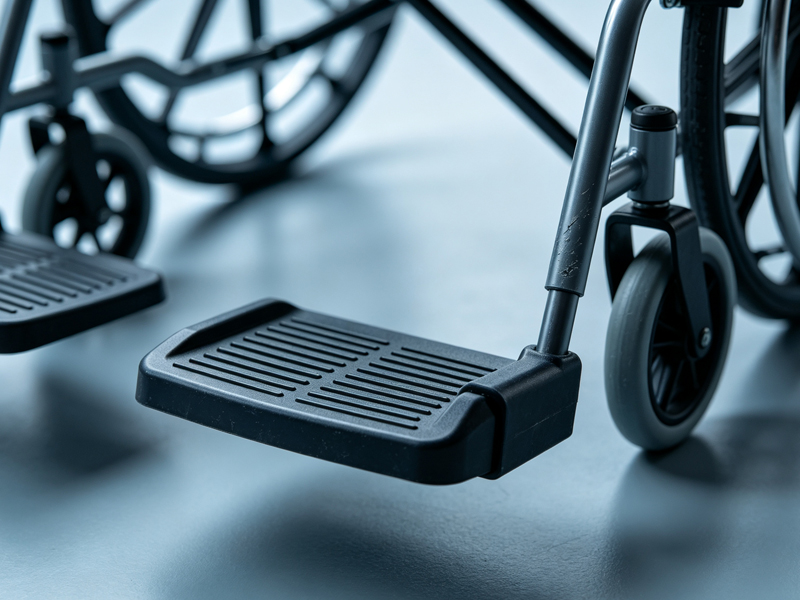
When comparing wheelchair accessories, it is easy to focus entirely on purchase price.
However, a more useful approach is to consider the total value of the component throughout its service life.
A plastic wheelchair footplate may offer several long-term advantages:
At the same time, buyers should consider the potential disadvantages.
Plastic components can crack under severe impact, may become brittle through environmental aging, and may be difficult to repair once structural damage occurs.
Metal alternatives may offer greater rigidity in some applications, although they can be heavier and may require attention to corrosion protection.
There is no universal winner.
For everyday wheelchair use, a well-designed plastic footplate can provide an excellent balance of practicality, comfort, and durability.
For specialized or high-demand applications, a stronger or more rigid alternative may be worth considering.
The best purchasing decision comes from comparing actual product specifications, testing information, warranty conditions, and intended operating requirements.
Plastic wheelchair footplates are generally a dependable choice for everyday wheelchair use when they are manufactured from suitable materials and designed for the intended application.
Their lightweight construction, corrosion resistance, flexible design possibilities, and relatively straightforward maintenance make them attractive to both wheelchair manufacturers and users.
Nevertheless, durability should never be judged by material alone.
Material composition, structural thickness, reinforcement, mounting design, environmental exposure, and daily handling all influence how well a footplate performs over time.
For buyers, the most important step is to select a product that matches the wheelchair model and the user’s functional requirements. Checking material specifications, product testing, installation compatibility, and replacement availability can help avoid unnecessary problems.
For users and caregivers, regular cleaning and inspection are simple but valuable habits. Identifying cracks, loose hardware, or unusual deformation early can help prevent a minor issue from becoming a more serious safety concern.
Ultimately, a high-quality plastic wheelchair footplate is not simply a lightweight alternative to metal. It is a practical mobility component that can deliver reliable everyday performance when properly designed, correctly installed, and appropriately maintained.
1. How Long Do Plastic Wheelchair Footplates Last?
There is no universal service life for plastic wheelchair footplates. Their lifespan depends on material quality, manufacturing standards, frequency of use, environmental exposure, and maintenance.
A high-quality footplate used under normal operating conditions may provide long-term service. However, repeated impacts, excessive loading, UV exposure, and improper installation can shorten its lifespan.
Regularly inspect the component for cracks, deformation, and loose mounting hardware. Replace damaged footplates rather than continuing to use them.
2. Are Plastic Wheelchair Footplates Strong Enough to Support Heavy Users?
Plastic wheelchair footplates can be suitable for users of different body weights, provided that the complete wheelchair and its foot support assembly are designed and approved for the intended application.
It is important to distinguish between the wheelchair’s maximum user weight and the load that an individual footplate is designed to withstand.
The footplate primarily supports the user’s feet and lower legs, rather than the full body weight. Users should follow the manufacturer’s instructions and avoid standing or placing excessive force on the platform.
For heavier users or demanding applications, check the manufacturer’s technical specifications and consider reinforced or alternative footplate designs when recommended.
3. Are Plastic or Aluminum Wheelchair Footplates Better?
Neither material is universally better. Plastic footplates are generally lighter, corrosion-resistant, and suitable for many standard wheelchair applications. Aluminum footplates often provide greater rigidity and can be more appropriate for certain demanding applications.
The right choice depends on the user’s mobility requirements, wheelchair design, expected loading conditions, and budget.
For everyday use, a properly manufactured plastic footplate can be a reliable and cost-effective option. For applications requiring additional rigidity or specific structural characteristics, aluminum may be worth considering.
The best choice is always the one that meets the manufacturer’s performance requirements and the user’s individual needs.