Our Location
Free Trade Tower, Xiyong street.
Chongqing, China

Free Trade Tower, Xiyong street.
Chongqing, China
Choosing a wheelchair is rarely a casual purchase. For many people, it becomes an essential part of everyday life—something they rely on for mobility, independence, and comfort for many hours each day. Yet despite its importance, a surprising number of wheelchair users end up with equipment that doesn’t truly fit them. In fact, industry estimates suggest that as many as 80–90% of wheelchair users are using chairs that are improperly sized.
A poorly fitted wheelchair doesn’t just cause mild discomfort. Over time, it can contribute to posture problems, pressure injuries, muscle strain, circulation issues, and difficulty maneuvering the chair efficiently. Because wheelchairs are also a significant financial investment, getting the measurements right from the beginning can save both money and physical strain.
When someone spends multiple hours each day in a seated position, small differences in fit can have a large impact on health. A wheelchair that is too narrow can compress the hips and thighs, leading to pressure points and restricted circulation. One that is too wide may force the user to lean or stretch in unnatural ways when reaching the wheels, which can strain the shoulders and reduce control.
Poor wheelchair fit can also lead to several long-term health complications, including:
Poor spinal posture
Pressure sores or skin breakdown
Muscle cramps and fatigue
Circulation issues such as blood clots
Reduced stability and balance
Difficulty breathing or swallowing in severe posture cases
Problems with self-propulsion
Increased difficulty transferring in and out of the chair
Because these issues develop gradually, many users may not realize that the root cause is simply incorrect wheelchair sizing.
A properly measured wheelchair, on the other hand, distributes weight evenly, maintains healthy posture, and allows the user to move efficiently without unnecessary strain.
Before diving into measurements, it helps to understand the general size ranges used in wheelchair design.
In the United States and many other countries, building accessibility guidelines require doorways to allow wheelchair access. Door openings typically need to be at least 32 inches (about 815 mm) wide. To accommodate this standard, most manual wheelchairs are manufactured with an overall width of around 28 inches (711 mm).
Within that frame size, the seat width is usually several inches narrower than the total chair width.
Powered wheelchairs, however, often have different dimensions. Many modern electric models are more compact, with widths typically ranging from 22 to 25 inches, allowing them to maneuver through tight indoor spaces.
For individuals with higher body weight or larger body frames, bariatric or heavy-duty wheelchairs are available. These models provide wider seats and stronger frames, but they may measure around 32 inches wide or more, which can make passing through standard doorways difficult.
Anyone considering a wider wheelchair should measure doorways, hallways, and key areas of the home beforehand. In some cases, minor home modifications may be necessary.
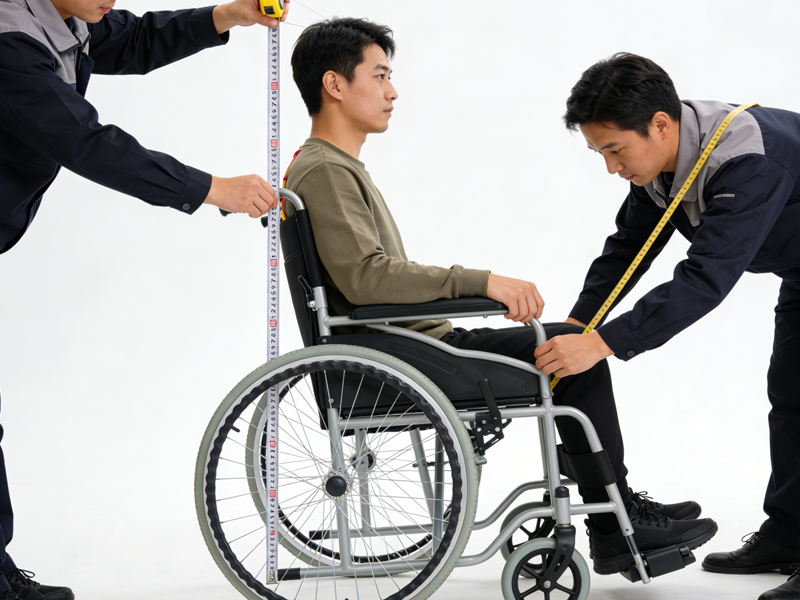
Before measuring a wheelchair user, it’s important to place them in a proper seated position. Clinicians often refer to the 90-90-90 rule, which describes the most stable and ergonomic posture for wheelchair seating.
In this position:
The hips are bent at approximately 90 degrees
The knees are bent at approximately 90 degrees
The ankles are positioned at about 90 degrees
The user’s back should be fully supported against the seat back, with the pelvis positioned all the way to the rear of the seat. The thighs should remain parallel to the ground, and the knees should align naturally with the hips.
Taking measurements in this posture helps ensure that the wheelchair supports the body correctly.
Accurate measurements require a few simple tools:
A firm retractable metal tape measure
A flat chair for the user to sit in
A notebook or digital device to record measurements
Assistance from another person if the user has limited mobility
Avoid flexible fabric tape measures, as they can bend and distort the measurement.
Each measurement corresponds to a specific part of the wheelchair design. Taking them carefully helps determine the optimal configuration.
Seat Width
Seat width is one of the most important measurements because it directly affects comfort and stability.
To determine seat width, measure across the widest part of the user’s hips or thighs while they are sitting upright. Once you have this measurement, add 1 to 2 inches to allow for comfortable movement and clothing layers.
The seat should be wide enough to prevent rubbing against the hips, but not so wide that the user struggles to reach the wheels.
Seat Depth
Seat depth determines how much of the thigh is supported by the chair.
Place the tape measure at the back of the buttocks and extend it along the thigh to the back of the knee. From this measurement, subtract about 2 inches.
This gap prevents the front edge of the seat from pressing into the back of the knees, which could restrict blood circulation or cause discomfort.
A simple check is to ensure that three to four fingers can fit between the seat edge and the back of the knee.
Seat Height
Seat height affects both propulsion and foot positioning.
Measure the distance from the user’s heel to the back of the knee. Then add approximately 2 inches to allow clearance for footrests.
For users who propel the chair with their feet, the seat height may be slightly lower so they can comfortably reach the floor.
Seat cushions should also be considered because they raise the seating surface.
Armrest Height
Armrests play a critical role in supporting the upper body. If they are too low, the shoulders may slump. If they are too high, the user may experience shoulder strain.
To measure armrest height, have the user sit with their arms bent naturally at the elbows. Measure from the seat surface to the bottom of the elbow.
Adding about one inch provides a comfortable margin.
Backrest Height
Backrest height depends on the user’s level of trunk control and mobility.
Users who self-propel manual wheelchairs often prefer lower backrests because they allow greater shoulder movement. Those who require additional spinal support may benefit from higher backrests.
Measure vertically from the seat surface to the lower edge of the shoulder blade (scapula). Subtract about four inches if greater upper-body movement is desired.
Leg Length
Correct leg length helps maintain proper pelvic positioning and weight distribution.
Measure from the back of the knee to the heel, making sure the knee remains bent at roughly 90 degrees. Shoes that the user wears regularly should be included during this measurement.
This dimension determines the correct footrest height.
In addition to measuring the user, it’s also important to understand how wheelchair dimensions are recorded.
Several measurements help determine whether a specific wheelchair model will match the user’s needs.
Seat width can be measured by removing any cushion and measuring the distance between the inside edges of the seat frame.
Seat depth is determined by measuring from the backrest to the front edge of the seat upholstery.
Footrest length is measured from the seat surface to the top of the footplate.
For foldable wheelchairs, it is also useful to measure the folded width of the chair. This determines whether it will fit in car trunks, storage areas, or narrow entryways.
A few practical considerations can help ensure accurate results.
First, always measure with the user wearing the type of clothing and shoes they normally use. Thick winter clothing, for example, can change seat width requirements slightly.
Second, remove cushions before measuring the wheelchair frame itself, as cushions can affect height and depth.
Third, if the user has difficulty sitting still during the process, having a helper nearby can make measuring easier and safer.
Finally, always check the user’s body weight when selecting a wheelchair. Each model has a maximum weight capacity, and choosing the correct category ensures safety and durability.
When measurements are done correctly, the benefits are immediate and long-lasting.
A properly fitted wheelchair improves posture, reduces fatigue, and minimizes the risk of pressure injuries. It also allows users to move more efficiently and maintain greater independence throughout daily activities.
Caregivers benefit as well, since transfers and positioning become easier and safer.
Considering the cost of wheelchairs and the importance of mobility, spending extra time on measurement is one of the smartest steps a buyer can take.
After all, choosing a wheelchair is similar to choosing footwear. If the size is wrong, discomfort and injury are almost inevitable. But when the fit is right, movement becomes natural and effortless.
1. What is the most important wheelchair measurement?
Seat width is generally the most critical measurement. If the seat is too narrow, it can cause pressure points and discomfort. If it is too wide, the user may have difficulty maintaining posture or reaching the wheels for propulsion.
2. Can standard wheelchair sizes fit most users?
Standard sizes work for some individuals, but they rarely provide an ideal fit for everyone. Because body shapes vary widely, customized measurements almost always result in better comfort and mobility.
3. How often should wheelchair measurements be reassessed?
Measurements should be reviewed whenever there are significant changes in body weight, posture, or medical condition. Many professionals recommend reassessing wheelchair fit every one to two years, or sooner if discomfort develops.