Our Location
Free Trade Tower, Xiyong street.
Chongqing, China

Free Trade Tower, Xiyong street.
Chongqing, China
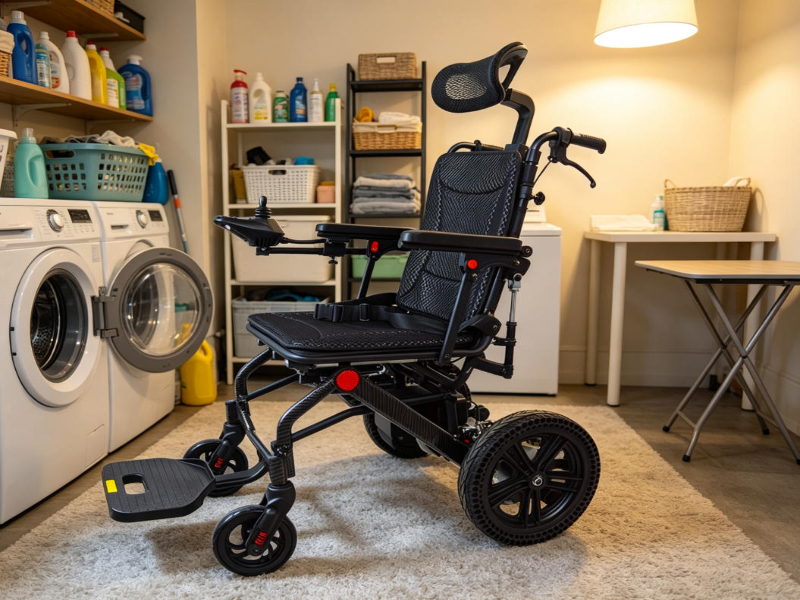
Living with limited space changes the way a wheelchair needs to be chosen. In a large, open home, a few extra centimetres of width may not seem important. In a compact apartment, townhouse, older property or small family home, however, those centimetres can determine whether a wheelchair can pass comfortably through a doorway, turn between rooms, approach a dining table or be stored without becoming an obstacle.
Table of Contents
ToggleFor this reason, finding the Best Wheelchairs for Narrow Stairs and Small Homes is not simply a matter of choosing the smallest wheelchair available. A genuinely suitable mobility chair needs to combine compact dimensions, manageable weight, good turning ability, comfortable seating and dependable braking. If it is an electric model, motor performance and battery placement also matter. The wheelchair must fit the user’s body while still fitting the environment.
There is another important distinction worth making at the beginning. A wheelchair that is compact enough for a small home is not necessarily designed to climb stairs. Ordinary electric and manual wheelchairs should not be used to negotiate conventional stairs unless the product is specifically engineered and certified for stair climbing. For homes where stairs are unavoidable, users should consider a dedicated stair-climbing wheelchair, stairlift or platform lift rather than attempting to solve the problem with a standard compact wheelchair. Narrow-stair solutions also depend heavily on actual measurements, and professional assessment is advisable where access is particularly restricted.
When people search for the Best Wheelchairs for Narrow Stairs and Small Homes, the first instinct is often to focus entirely on overall width. Width is certainly important, but it is only one part of the equation.
Consider a typical day inside a compact home. The user may need to leave the bedroom, pass through a hallway, enter a bathroom, turn around a kitchen counter and position the chair beside a sofa. A wheelchair that is technically narrow but has poor manoeuvrability can still be frustrating to use. Similarly, a very lightweight chair may be easy to lift but uncomfortable for someone who spends several hours sitting in it.
The ideal compact wheelchair therefore needs to balance width, length, turning response, folding size, seating dimensions and weight.
Doorways deserve particular attention. In the United States, the ADA’s older accessibility standards specify a minimum clear width of 32 inches at a point and 36 inches continuously for a single wheelchair passage, while a 60-inch diameter is given for a full 180-degree turning space. These figures are useful accessibility references, but individual homes can be much tighter, especially older properties that were not designed around modern accessibility requirements.
For a private residence, it is therefore sensible to measure the actual route rather than relying on assumptions. Measure the narrowest doorway, hallway, entrance, bathroom access and turning area. Then consider not only the wheelchair’s operating width but also the user’s hands, feet and leg rests.
Storage is equally important. A wheelchair that folds significantly can be much easier to live with in a small apartment. Instead of occupying a permanent position in the hallway, it may fit inside a wardrobe, utility room, vehicle or other designated storage area.
This is where lightweight folding electric wheelchairs have become particularly attractive. They provide powered mobility while offering considerably more flexibility than many conventional full-size power chairs.
Choosing among the Best Wheelchairs for Narrow Stairs and Small Homes should begin with a simple floor plan.
Measure the width of every doorway the wheelchair needs to pass through. Do not measure only the door itself; measure the actual clear opening with the door open. Next, check hallway width and identify areas where the user needs to turn. A straight passage may be easy to navigate, while a narrow L-shaped hallway may require substantially more manoeuvring space.
Bathrooms deserve special attention. A wheelchair might fit through the bathroom door but still be unable to turn toward the toilet or sink. Kitchens can present a similar challenge because cabinets, islands and appliances reduce usable floor space.
The stairway requires a separate assessment. If the wheelchair is intended to remain downstairs, the issue may simply be whether it can pass safely around the bottom landing. If the user needs to travel between floors, a normal wheelchair should not be treated as a stair-climbing device. Narrow staircases can sometimes accommodate dedicated stairlifts, and some stairlift systems are specifically designed to preserve as much walking space as possible when folded.
This distinction is critical because the Best Wheelchairs for Narrow Stairs and Small Homes are not necessarily the same products as the best stair-climbing mobility equipment.
For users who want a compact powered wheelchair that can work comfortably in a small home, the YSE147 Ergonomic Foldable Electric Wheelchair is an interesting option.
The model combines a lightweight aluminium frame with a folding structure. According to Iyasocare’s product information, the YSE147 folds to approximately 97 × 59 × 60 cm, with a net weight of around 23 kg. Its seat width is 40 cm and seat depth is 40 cm, while the maximum load is listed as 100 kg.
Those specifications make the YSE147 particularly relevant for users who need powered mobility but also have limited storage space. Once folded, it can be placed more easily in a vehicle or compact storage area than a large traditional power wheelchair.
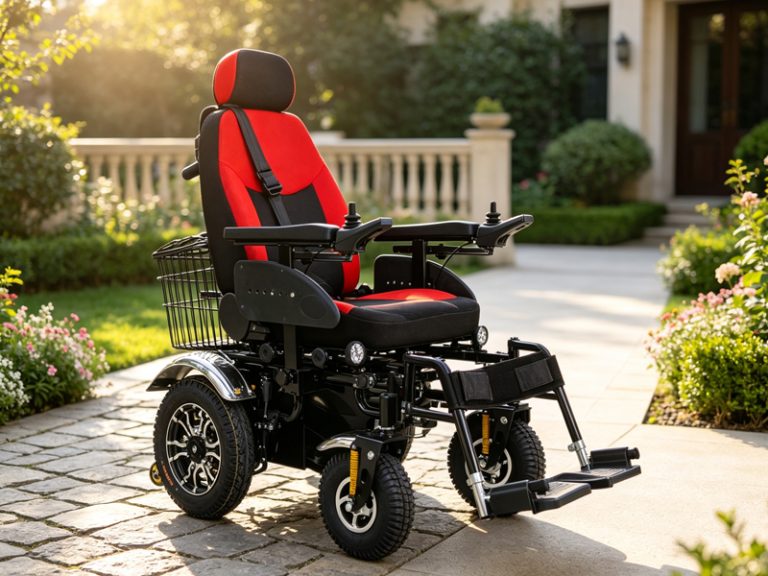
The ergonomic design is another reason it deserves consideration. The chair includes a second-generation ergonomic backrest, removable leather cushion, headrest support, flip-up armrests and adjustable leg height. These details matter because compact does not have to mean uncomfortable. A wheelchair that fits through a narrow doorway but causes discomfort after an hour of sitting is not really solving the user’s problem.
The YSE147 also uses dual 180W motors and an electromagnetic braking system. Its listed maximum speed is 6 km/h, with a climbing ability of up to 9°. The available lithium battery configurations provide a stated driving range of approximately 5–20 km, depending on the selected battery and operating conditions.
For a small home, the electromagnetic braking system is particularly useful because precise stopping is important when positioning the wheelchair close to furniture, tables and doorways. Users should still operate carefully in confined spaces, but responsive braking can make everyday manoeuvring easier.
The wheel configuration also contributes to usability. The YSE147 uses 8-inch shock-absorbing front wheels and 12-inch honeycomb rear tyres, providing a combination of stability, puncture resistance and everyday ride comfort.
Best suited for: users who want an electric wheelchair with ergonomic seating, practical folding capability and enough performance for normal indoor and outdoor mobility.
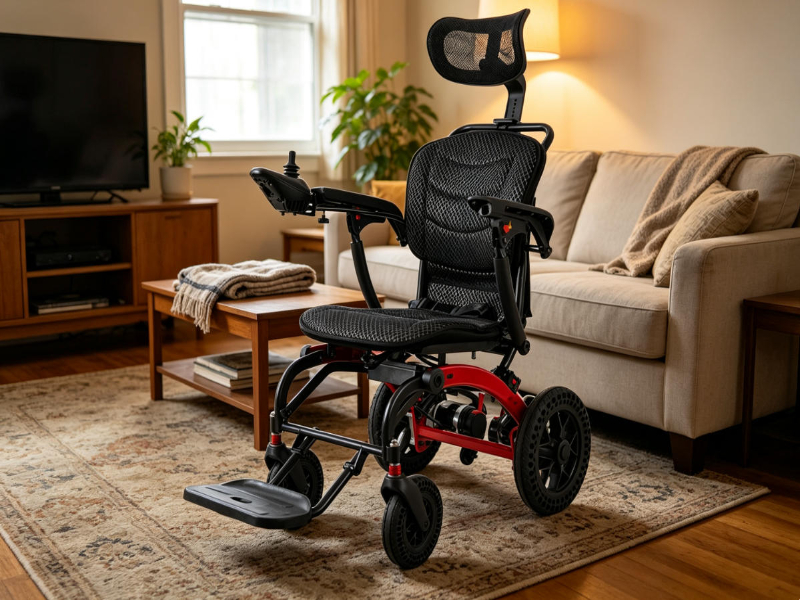
Another strong candidate when comparing the Best Wheelchairs for Narrow Stairs and Small Homes is the YSE144 Carbon Fiber Folding Electric Wheelchair with Dual Motors.
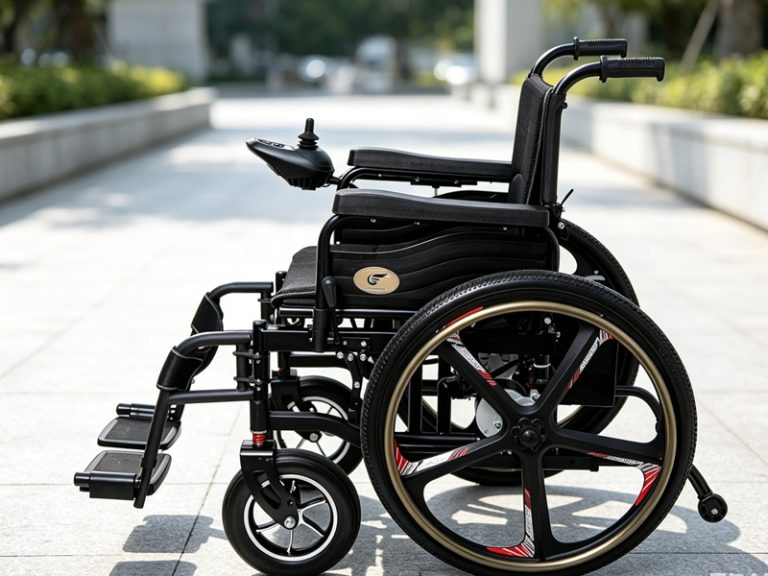
Carbon fibre is increasingly used in lightweight wheelchair construction because of its high strength-to-weight characteristics. For users living in smaller homes, the advantage is not simply a lower number on the specification sheet. A lighter wheelchair can be easier to move manually, transport in a vehicle and reposition when storage space is limited.
Iyasocare lists the YSE144 among its carbon-fibre folding electric wheelchair range, alongside other lightweight travel-oriented models. The company’s published information describes the YSE144 as a dual-motor carbon-fibre folding power wheelchair designed to combine portability with stronger everyday driving performance.
The dual-motor configuration is particularly relevant for users who do not want a compact wheelchair to feel underpowered. In a small home, the chair may spend much of its time on level flooring, but everyday mobility also includes ramps, thresholds, driveways, pavements and outdoor paths.
A compact wheelchair should therefore be evaluated for more than its folded dimensions. Motor response, wheel design and braking can affect how confidently the user moves between indoor and outdoor environments.
The carbon-fibre approach also makes sense for users who regularly need to load their wheelchair into a car. A lighter structure can reduce the physical burden placed on caregivers or family members.
Iyasocare’s broader carbon-fibre range reflects this travel-oriented philosophy. Its YSE146, for example, weighs approximately 15 kg without the battery and folds to 70 × 33 × 60 cm, demonstrating how far compact wheelchair engineering can go when portability is treated as a primary design goal.
The YSE144 is therefore worth considering when the buyer wants the compact character of a folding wheelchair but places greater emphasis on powered driving performance.
Best suited for: active users, frequent travellers and people who want a lightweight electric wheelchair without moving to a large full-size power-chair platform.
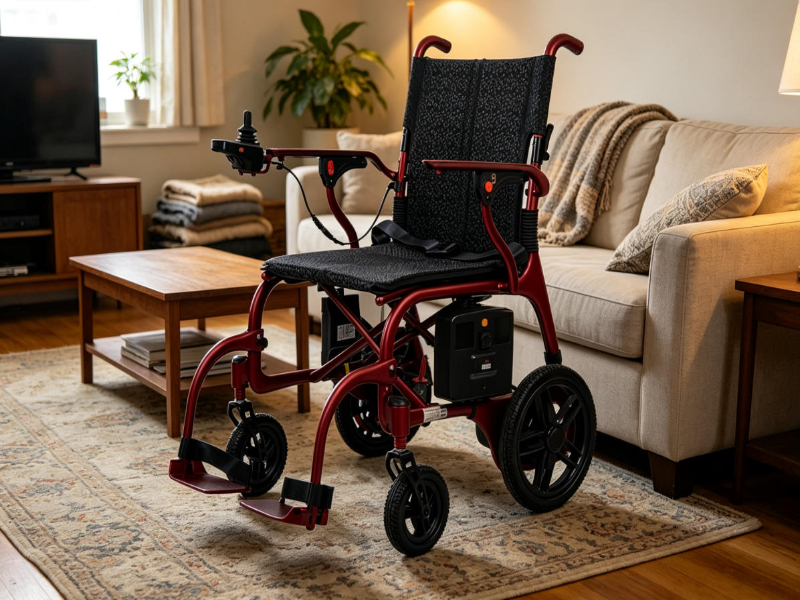
Not every small home requires the absolute smallest wheelchair. Sometimes the smarter choice is a model that provides a more comfortable seating position while remaining reasonably compact.
The YSE136 Electric Ergonomic Wheelchair fits into this category. Iyasocare lists the YSE136 within its electric wheelchair range and describes it as a lightweight aluminium-alloy folding design.
This is an important point when evaluating the Best Wheelchairs for Narrow Stairs and Small Homes: there is a difference between minimum possible size and practical compactness.
If the wheelchair is several centimetres narrower but forces the user into an uncomfortable seating position, the trade-off may not be worthwhile. Long-term wheelchair use requires attention to posture, seat width, back support, leg position and arm support.
Ergonomic design becomes especially valuable for elderly users or people who spend much of the day seated. A well-designed wheelchair should support the user’s body rather than simply provide a platform for transportation.
Iyasocare’s ergonomic wheelchair philosophy emphasises that comfort is more than cushioning. Seat geometry, backrest design, posture and pressure distribution all influence the experience of prolonged sitting.
For small homes, this means buyers should avoid choosing a wheelchair solely because it looks compact. The better approach is to identify the narrowest practical size that still provides an appropriate fit.
Best suited for: users who prioritise posture, seating comfort and everyday usability while still needing a relatively compact wheelchair for home environments.
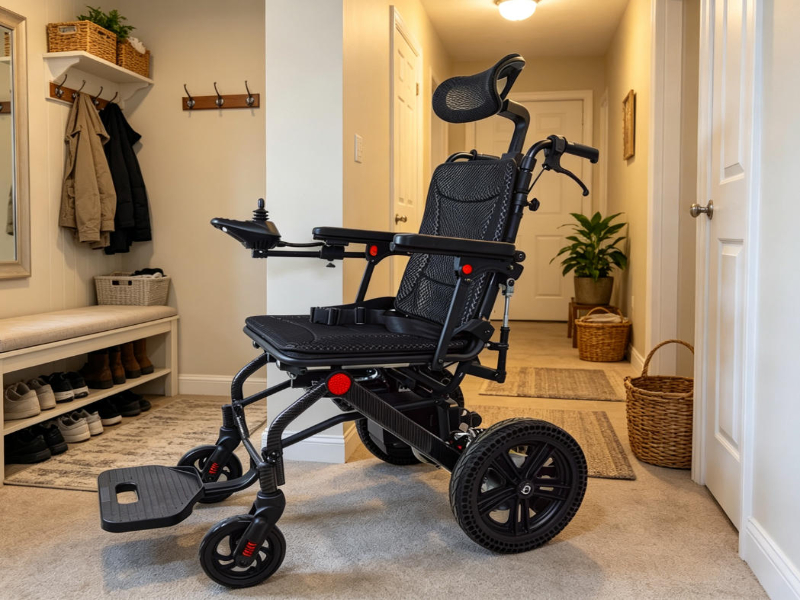
| Model | Main advantage | Why it works in smaller homes | Best for |
|---|---|---|---|
| Iyasocare YSE147 | Ergonomic folding electric design | Compact folding size, 40 cm seat width, manageable storage | Daily home + outdoor mobility |
| Iyasocare YSE144 | Carbon fibre + dual motors | Lightweight concept and folding portability | Active users and frequent transport |
| Iyasocare YSE136 | Ergonomic aluminium electric design | Combines folding practicality with comfort | Users prioritising posture and daily comfort |
The most important lesson is that there is no universal winner among the Best Wheelchairs for Narrow Stairs and Small Homes. A 70-year-old user who spends most of the day indoors may have completely different requirements from an active user who drives regularly and travels on weekends.
This is one of the most common misunderstandings when searching for the Best Wheelchairs for Narrow Stairs and Small Homes.
A standard wheelchair, including a compact electric wheelchair, is designed primarily for floors, ramps and suitable outdoor surfaces. It is not automatically capable of climbing stairs.
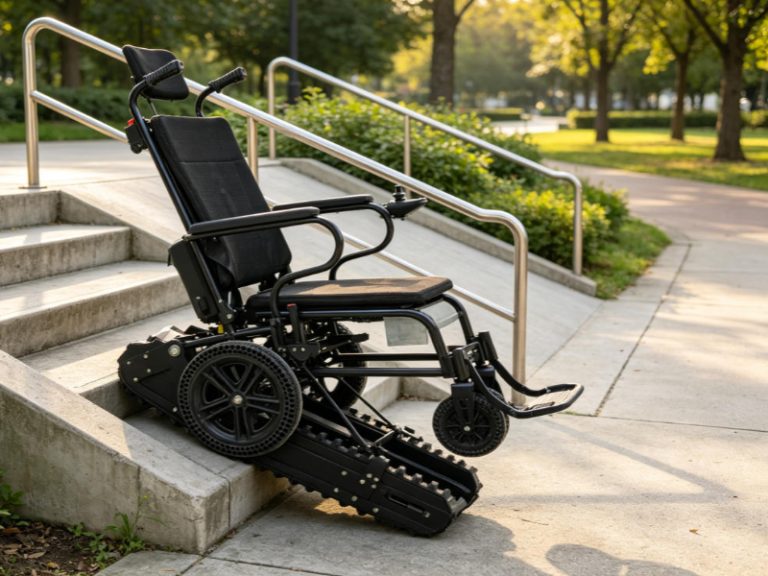
If stairs are a permanent part of the user’s daily route, there are several possible approaches. A stairlift can move the person between floors while leaving the wheelchair available on each level. A wheelchair platform lift may provide another solution where building configuration and regulations permit it. Dedicated tracked stair-climbing wheelchairs are another specialist category, but they should be evaluated separately because their operating requirements and safety procedures differ substantially from ordinary folding electric wheelchairs.
For particularly narrow staircases, space becomes even more important. Modern compact stairlifts can use folding seats, folding footrests and space-saving rail configurations, but the actual staircase should be measured before a purchase is made.
If the goal is simply to store a wheelchair near a narrow staircase, however, a folding model such as the YSE147 or a lightweight carbon-fibre design can be much more practical than a large fixed-frame power wheelchair.
A wheelchair is not used only when the user is sitting in it. There are many hours when it needs to be parked, transported or stored.
This is why folding capability can be just as important as driving performance when evaluating the Best Wheelchairs for Narrow Stairs and Small Homes.
A folding wheelchair can reduce the amount of floor space occupied when it is not being used. In a small apartment, that can mean the difference between keeping a hallway usable and creating a permanent obstruction.
Folding also simplifies car transportation. Instead of needing a large vehicle with substantial cargo space, a compact folding wheelchair may fit more easily into a conventional car.
For caregivers, this has another benefit. A wheelchair that is easier to fold and handle may reduce the physical effort required during daily routines.
Carbon fibre and aluminium are particularly interesting in this area because manufacturers can combine structural strength with lower overall weight. Iyasocare’s carbon-fibre range illustrates this direction, with lightweight folding models designed specifically around portability and travel.
It is tempting to choose the narrowest possible wheelchair when living in a small home. However, going too narrow can create a new set of problems.
The user’s hips should fit comfortably within the seat without excessive compression. The backrest should provide appropriate support, and the leg rests should position the legs naturally. Armrests should not force the shoulders into an uncomfortable position.
The right approach is therefore to find the smallest practical wheelchair, rather than the smallest wheelchair available.
The YSE147 demonstrates this principle well. Its 40 cm seat width and 40 cm seat depth are combined with an ergonomic backrest, headrest and adjustable leg height, showing that compact design can coexist with user comfort.
For someone who spends many hours in a wheelchair every day, these details may ultimately matter more than saving a few centimetres.
Safety becomes even more important when a wheelchair is used in confined areas.
The first feature to consider is braking. Electric wheelchairs should have a dependable braking system that allows the user to stop accurately. The YSE147, for example, uses electromagnetic brakes that engage when the joystick is released.
The second consideration is stability. A wheelchair that is too short or narrow for the user’s body can feel unstable, while an excessively long chassis may make tight turns difficult.
The third is speed control. In a small home, maximum speed is rarely the priority. Smooth low-speed control is much more valuable when approaching furniture, doorways, kitchen counters and bathroom entrances.
Finally, users should think about thresholds and ramps. Small changes in floor height can become obstacles for compact wheelchairs, so wheel size, motor torque and front-wheel design should be considered alongside the dimensions of the chair.
The Best Wheelchairs for Narrow Stairs and Small Homes may be manual or electric depending on the user’s strength and mobility.
A manual wheelchair can be excellent for users who have sufficient upper-body strength or have a caregiver available. Manual models are generally simpler and can be easier to store.
An electric wheelchair is more appropriate for users who cannot propel themselves effectively or who want to reduce physical effort. Modern folding electric wheelchairs have narrowed the gap between powered performance and portability.
For example, Iyasocare’s lightweight electric wheelchair range includes carbon-fibre and aluminium designs intended for travel, daily mobility and easier transportation.
For someone living in a small home, an electric folding model may offer the best compromise between independence and storage convenience.
When comparing the Best Wheelchairs for Narrow Stairs and Small Homes, the manufacturer matters almost as much as the individual model.
Iyasocare offers a broad mobility equipment portfolio covering electric wheelchairs, manual wheelchairs, stair-climbing wheelchairs, off-road models and other rehabilitation products. Its current product catalogue includes more than 100 listed products, including carbon-fibre folding electric wheelchairs and ergonomic aluminium models.
For buyers comparing products, this broad range is useful because mobility needs can change over time. A user may initially need a compact indoor wheelchair and later require a more powerful outdoor model, a reclining design or specialist stair-climbing equipment.
Iyasocare’s product range also reflects a growing industry trend toward lighter frames, folding structures, ergonomic seating and more practical travel-oriented designs.
Before purchasing one of the Best Wheelchairs for Narrow Stairs and Small Homes, take a few minutes to check the following:
1. Measure the home.
Record the clear width of doors, hallways, bathroom entrances and the tightest turning areas.
2. Measure the wheelchair.
Check both operating dimensions and folded dimensions. A wheelchair that fits a doorway may still be difficult to store.
3. Check the seat dimensions.
Do not sacrifice appropriate seating width simply to obtain a narrower frame.
4. Consider weight.
If the wheelchair must be lifted into a vehicle or moved manually, every kilogram can matter.
5. Evaluate braking.
Electromagnetic braking is particularly useful for controlled electric wheelchair operation.
6. Think about stairs separately.
A normal folding wheelchair should not be used on stairs. Consider a stairlift, platform lift or specialist stair-climbing wheelchair where appropriate.
7. Match performance to the environment.
A small home usually requires precise low-speed manoeuvring more than extreme motor power.
8. Consider storage.
Measure the actual space where the folded wheelchair will be kept.
9. Think beyond today.
Choose a model that can continue to meet the user’s mobility needs as daily routines change.
The search for the Best Wheelchairs for Narrow Stairs and Small Homes is ultimately a search for balance. The smallest wheelchair is not automatically the best, and the most powerful wheelchair may be completely impractical in a compact apartment. What matters is how the chair fits the user, the home and the user’s everyday routine.
For users who need a comfortable folding electric wheelchair, the YSE147 offers a particularly balanced combination of compact storage, ergonomic support, dual motors and electromagnetic braking. For users who place greater emphasis on lightweight portability and stronger powered performance, the YSE144 carbon-fibre dual-motor design is worth considering. For those who put ergonomic seating and everyday comfort at the centre of the decision, the YSE136 provides another practical direction.
The most important point is to measure first and purchase second. A wheelchair should be selected around the user’s body and mobility needs, then matched to the physical limitations of the home. Where stairs are involved, ordinary wheelchairs should be separated from specialist stair-access solutions.
With the right combination of compact dimensions, folding portability, comfortable seating and reliable control, even a small home can become much easier to navigate.
1. What are the Best Wheelchairs for Narrow Stairs and Small Homes?
There is no single best model for every user. For compact electric mobility, the Iyasocare YSE147 is a strong option because it combines a folding aluminium frame, 40 cm seat width, ergonomic seating and a compact folded size. The YSE144 is more suitable for users prioritising lightweight carbon-fibre construction and dual-motor performance, while the YSE136 is worth considering for users who place greater emphasis on ergonomic everyday comfort.
2. Can a compact electric wheelchair be used on narrow stairs?
A normal compact electric wheelchair should not be used to climb conventional stairs. A wheelchair being narrow or foldable does not make it a stair-climbing device. If stairs are part of the user’s regular route, investigate a professionally installed stairlift, platform lift or purpose-built stair-climbing wheelchair instead. Narrow staircases require careful measurement because the available clearance varies significantly between homes.
3. Is a lightweight wheelchair better for a small home?
In many cases, yes, particularly when the wheelchair needs to be folded, stored or transported frequently. Lightweight construction can make a wheelchair easier for caregivers to handle and easier to place in a car or compact storage area. However, weight should never be considered alone. The correct seat dimensions, stability, braking system, motor performance and user comfort should all be evaluated before choosing among the Best Wheelchairs for Narrow Stairs and Small Homes.
WhatsApp us