Our Location
Free Trade Tower, Xiyong street.
Chongqing, China

Free Trade Tower, Xiyong street.
Chongqing, China
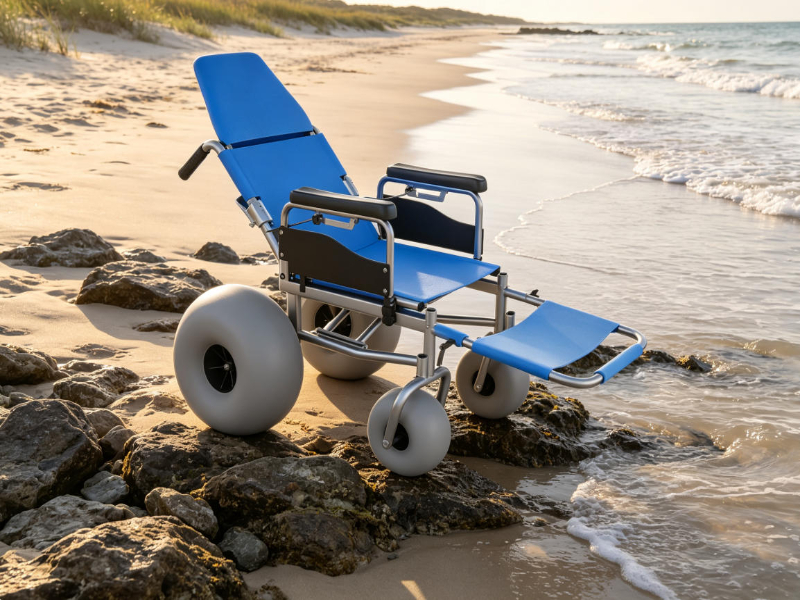
A day at the beach should be about sunshine, fresh air, family time and the freedom to get closer to the water. For people with limited mobility, however, the beach can present a very different experience. Soft sand, uneven ground, moisture and changing surfaces can make a conventional wheelchair difficult to use, sometimes leaving the user at the edge of the beach while family and friends continue toward the shoreline.
This is where a purpose-built floating beach wheelchair can make a meaningful difference. Unlike an ordinary wheelchair, a beach wheelchair is designed around outdoor terrain, wide wheels, stability, user comfort and resistance to demanding coastal conditions. Some models go further by providing flotation or water-access capabilities, allowing users to move beyond dry sand and approach shallow-water areas when the specific product configuration and safety conditions permit it.
But choosing the best floating beach wheelchair is not simply about finding the model with the largest wheels or the most impressive description. The right choice depends on how the wheelchair will be used, the user’s body size and mobility requirements, the type of beach or waterfront environment, transportation needs, expected frequency of use and whether water access is actually required.
For individuals, families, resorts, hotels, accessible tourism providers, rehabilitation centres and mobility-equipment distributors, these differences matter. A lightweight folding beach wheelchair may be the better choice for occasional holidays, while a reinforced stainless-steel model may make more sense for a resort or public accessibility programme that expects frequent outdoor use.
The first question should not be “Which beach wheelchair looks best?” It should be “Where will the wheelchair actually be used?”
Beaches vary considerably. Some have firm, compacted sand and dedicated accessibility paths, while others have deep dry sand, gravel, grassy areas, wet shoreline zones and uneven transitions. A wheelchair that performs well on a hard-packed beach access route may behave very differently once it reaches loose sand.
Traditional wheelchair wheels are generally narrow and designed for relatively firm surfaces. On soft sand, the contact area is small, so the wheels can sink rather than roll. This increases rolling resistance and can make movement difficult for both the user and caregiver. Purpose-built beach wheelchairs address this problem through much wider wheels or balloon-style tyres that distribute the load over a larger area. IYASOCARE describes its beach wheelchair designs as using enlarged or flotation-style wheels to improve movement across sand and other outdoor surfaces.
That principle is central to choosing the best floating beach wheelchair. The wheelchair should be selected according to the actual surface conditions rather than simply according to its appearance.
If the main requirement is travelling from a hotel to a beach, crossing compact sand and spending several hours beside the water, portability and comfort may be the priorities. If the wheelchair will be used at a public beach, resort or rehabilitation facility every day, durability and easy maintenance may matter more. If the purpose includes entering shallow water, the requirements become even more specific, and buyers should verify the manufacturer’s intended water-use configuration rather than assuming that every beach wheelchair can safely float.
The word “floating” can sometimes cause confusion.
A beach wheelchair with large balloon wheels is designed to reduce sinking on soft sand by spreading its load over a larger surface area. That does not automatically mean the entire wheelchair is intended to float freely in water.
A genuine floating beach wheelchair or aquatic-capable model may incorporate additional flotation characteristics or accessories that allow it to be used in shallow-water environments under defined conditions. IYASOCARE identifies the YSB02 as a stainless-steel folding floating beach wheelchair, while its product information describes the model as an option for beach and water-access applications.
This distinction is extremely important for buyers.
Before using any beach wheelchair in water, confirm exactly what the manufacturer permits. Water depth, current, waves, user weight, flotation accessories, supervision and local conditions can all affect safety. A wheelchair designed for beach mobility should never automatically be assumed to be suitable for swimming or deeper water.
For most buyers, the practical objective is not to turn a wheelchair into a boat. It is to remove the barrier between accessible pathways, sand and the shoreline while maintaining appropriate stability and user support.
IYASOCARE’s two beach wheelchair models are designed around different priorities.
The YSB01 focuses strongly on portability, comfort and versatile outdoor use. It has a foldable steel frame, quick-release wheels, an adjustable backrest and footrest, and large airbag-style wheels designed for beach and outdoor environments. The manufacturer lists a maximum load capacity of 150 kg in its product description, although the specification table currently displays a 100 kg loading figure, so buyers should confirm the applicable load specification for the exact configuration before ordering.
The YSB02, meanwhile, is positioned as a more robust floating beach wheelchair. IYASOCARE describes it as a stainless-steel folding floating beach wheelchair, with a stronger emphasis on durability and water-adjacent mobility. Its design has also been presented as suitable for public beaches, resorts, rehabilitation environments and other situations where outdoor mobility equipment may experience frequent use.
The difference can be summarised simply:
| Buying Priority | YSB01 | YSB02 |
|---|---|---|
| Personal beach trips | Excellent fit | Suitable |
| Folding and transport | Strong advantage | Suitable |
| Reclining comfort | Strong advantage | Strong |
| Family holidays | Excellent fit | Suitable |
| Beach rental services | Suitable | Strong advantage |
| Frequent institutional use | Suitable | Strong advantage |
| Heavy-duty outdoor application | Good | Better suited |
| Water-access applications | Confirm intended use | More specialised option |
| Stainless-steel construction | No | Yes |
| Floating beach wheelchair positioning | Beach-focused | Stronger fit |
The best choice therefore depends less on which model is “better” and more on which model matches the user’s real environment.
The IYASOCARE YSB01 Folding Beach Wheelchair is particularly interesting for users who want a beach-specific mobility solution without giving up portability.
Its frame can be folded, and the front and rear wheels use a quick-release design to simplify storage and transportation. This can be a major advantage for families who need to place the wheelchair into a vehicle before travelling to the coast.
The seating system is another reason to consider the YSB01.
The manufacturer lists a 500 mm seat width, 450 mm seat depth and a 700 mm backrest height. The backrest can be adjusted, with the product description stating that it can recline up to approximately 150 degrees, while the footrest can also be adjusted.
These features matter because a beach visit is rarely a five-minute journey. Users may spend several hours outdoors, watching family members, relaxing near the shoreline or travelling between different areas of a resort. Being able to adjust the backrest and leg position can provide a more comfortable experience than remaining in a fixed upright position throughout the day.
The YSB01 also uses large front and rear airbag-style wheels, with the listed wheel sizes being approximately 10 × 5.5 inches at the front and 16 × 9 inches at the rear. These wide wheels are designed to distribute pressure more effectively across soft outdoor surfaces.
For personal users, families and holiday travellers, this combination makes the YSB01 a practical starting point when searching for the best floating beach wheelchair for general coastal mobility.
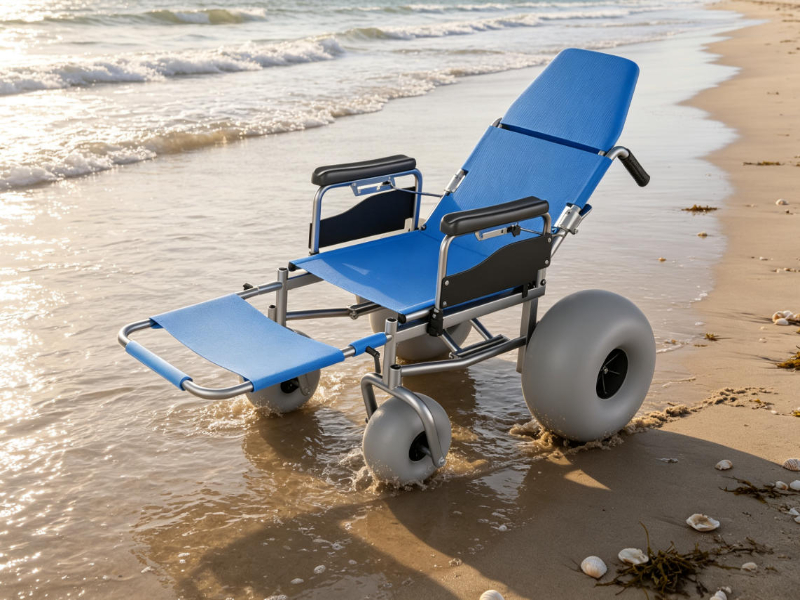
The IYASOCARE YSB02 Floating Beach Wheelchair takes a different approach.
Its stainless-steel construction is one of its defining characteristics. Coastal environments can be demanding because mobility equipment may be exposed to moisture, salt air, sand and frequent cleaning. A corrosion-conscious material choice is therefore particularly relevant for products intended for repeated outdoor use.
IYASOCARE’s own material describes the YSB02 as a stainless-steel folding floating beach wheelchair, while its beach wheelchair guidance positions the model as a more durable option for demanding environments.
This makes the YSB02 particularly relevant for beach resorts, hotels, rental services, public accessibility programmes, rehabilitation centres and tourism operators.
For a private user who visits the beach once or twice a year, the additional heavy-duty characteristics may not be necessary. But for an organisation that provides beach wheelchairs to multiple users every day during the holiday season, durability can have a much greater impact on long-term operating costs.
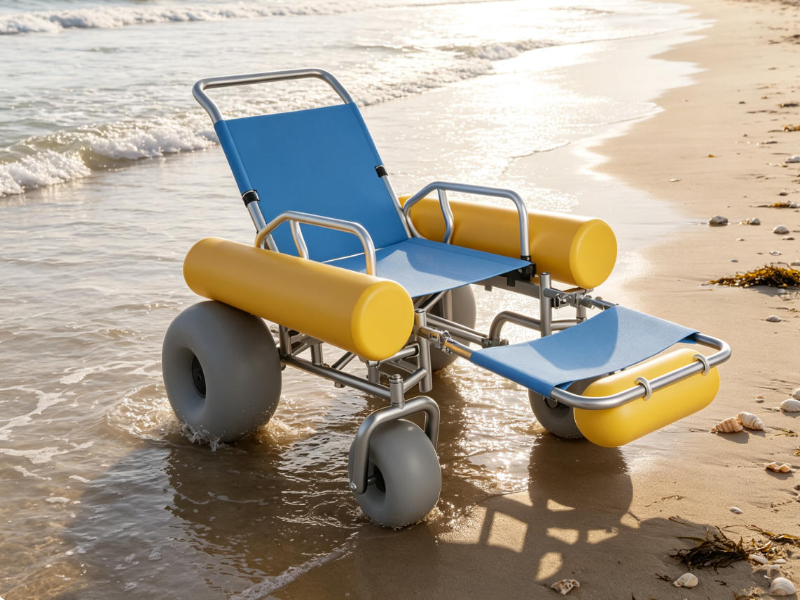
The YSB02 is also the more appropriate model to investigate when water access is part of the intended experience. IYASOCARE’s product information discusses flotation capability and shallow-water use, but buyers should always confirm the exact configuration, permitted water depth and operating conditions before purchase.
The important point is that water access should be treated as a specific product requirement, not an assumption based on large tyres.
A beach wheelchair can have excellent wheels and still be uncomfortable.
Beach environments expose users to heat, sunlight, vibration and uneven movement. If the seat provides poor support, a long beach outing can become tiring even when the wheelchair moves effectively.
When evaluating the best floating beach wheelchair, consider the seat width, seat depth, backrest height, armrest position, footrest adjustment and ability to change posture.
The YSB01 is particularly strong in this area because its backrest and footrest can be adjusted, while its seat uses breathable and waterproof Oxford cloth designed to be practical for outdoor conditions.
This type of material also has a practical advantage at the beach: sand, moisture and occasional spills are inevitable. A seat material that can be cleaned relatively easily is useful for both private users and commercial operators.
For people who spend extended periods in the chair, comfort should not be treated as a luxury feature. It is part of the basic usability of the product.
User weight capacity is one of the simplest specifications to understand but one of the easiest to overlook.
Buyers should compare the user’s actual weight with the manufacturer’s stated capacity and leave appropriate room for clothing, personal items and any accessories attached to the chair.
The YSB01 product page currently contains two different load figures in its descriptive content and specification table, so buyers should confirm the exact capacity of the intended configuration directly with IYASOCARE before purchase.
This is particularly important for distributors because a product catalogue should not rely on an assumed specification when different configurations may exist.
For the YSB02, buyers should likewise request the latest technical specification sheet before placing an order, particularly when the wheelchair will be used by a larger user or in a commercial rental environment.
The correct principle is simple: choose according to the manufacturer’s confirmed specification, not according to an estimated capacity based on appearance.
Beach wheelchairs are often larger than standard wheelchairs because their wide wheels are necessary for soft terrain. That creates a practical challenge: how will the wheelchair get from the home, hotel or vehicle to the beach?
This is where folding and quick-release components become valuable.
The YSB01 is specifically designed around portability. Its foldable frame and quick-release front and rear wheels make it easier to store and transport. The manufacturer lists a packing size of approximately 825 × 455 × 845 mm and a net/gross weight of around 22/25 kg in the current product specification.
For a family travelling by car, this can be a meaningful advantage.
By comparison, a heavy-duty beach wheelchair designed primarily for commercial or institutional use may place greater emphasis on durability than minimum transport weight.
This is why portability should be evaluated against the frequency of use. If the wheelchair travels on every family holiday, folding convenience can become one of the most valuable features. If it stays at a resort and is used by guests throughout the day, structural durability may matter more.
A beach wheelchair operates in one of the harshest everyday environments for mobility equipment.
Sand can enter moving components. Saltwater can accelerate corrosion. Moisture can remain around joints and hardware. Direct sunlight and high temperatures can also affect materials over time.
For this reason, maintenance is part of choosing the best floating beach wheelchair.
After beach use, sand and salt should be removed according to the manufacturer’s maintenance instructions. IYASOCARE’s FAQ recommends rinsing beach wheelchairs after exposure to sand and saltwater to help prevent corrosion and keep the wheels clean. It also notes that some beach wheelchairs can handle shallow water, while prolonged immersion should be avoided unless the specific model is designed and approved for that use.
This distinction is important.
A wheelchair that is suitable for wet sand is not automatically designed for prolonged submersion. Before using a product near or in water, confirm its intended use and follow the manufacturer’s instructions.
For resorts and rental operators, cleaning procedures should become part of the daily operating routine. A simple rinse, inspection and drying process can help protect the equipment and maintain a better experience for the next user.
The beach is the obvious application, but a well-designed beach wheelchair can be useful in other outdoor environments.
Depending on the model and manufacturer’s intended use, wide-wheel beach wheelchairs may be suitable for grass, parks, compact outdoor paths, waterfront areas and other uneven surfaces. IYASOCARE describes the YSB01 as suitable for beaches, grass, wetlands and certain wading environments, while its broader beach wheelchair guidance discusses applications beyond conventional paved surfaces.
This versatility can be valuable for tourism businesses.
A resort might use the same beach wheelchair for a guest’s journey from an accessible room to the pool area, across a garden pathway and toward the beach. A rehabilitation centre might use it during outdoor therapy activities. A family might use it at the beach, a lakeside park or a waterfront event.
However, terrain versatility does not mean unlimited capability. Steep slopes, deep mud, strong currents, large rocks and unstable surfaces can present serious risks. Users should always follow the product’s intended operating conditions.
For a hotel or resort, providing a beach wheelchair is not simply a purchasing decision.
The wheelchair needs to fit into the guest experience.
Staff should know where it is stored, how it folds, how it should be cleaned and what environments it can safely access. Guests should be able to find accessibility information before arriving. If the wheelchair is intended for water-adjacent use, staff should understand the manufacturer’s limitations and the local conditions.
The YSB01 can be attractive for resorts that want a relatively portable option that can be stored and transported easily. The YSB02 can be more appropriate where durability and specialised outdoor or water-access requirements are central to the operation. IYASOCARE’s own product guidance identifies resorts, rental services, municipalities and rehabilitation facilities among potential applications for its beach wheelchair range.
For distributors, this also creates a clear product-positioning strategy: the YSB01 can be presented as a versatile folding beach wheelchair, while the YSB02 can be positioned toward heavier-duty and more specialised beach accessibility requirements.
Before purchasing a floating beach wheelchair, especially in bulk, do not stop at the product name.
Ask the manufacturer to confirm the exact user capacity, frame material, wheel dimensions, folded dimensions, product weight, water-use limitations and recommended terrain.
For the YSB01, ask which load specification applies to the exact production version because the current online product page contains different figures in its descriptive and specification sections.
For the YSB02, ask specifically whether the intended configuration includes flotation components and what water conditions the manufacturer considers acceptable.
B2B customers should also ask about spare parts, packaging, MOQ, OEM options, warranty terms and after-sales support.
This is particularly important when purchasing beach wheelchairs for rental programmes. A product that is inexpensive to purchase but difficult to maintain may become more expensive over its operating life.
For an individual buyer, the most important question may be whether the wheelchair feels comfortable and practical.
For a distributor, the evaluation needs to go further.
The supplier should have a broad understanding of mobility equipment, stable production capabilities, product documentation and the ability to support future orders.
IYASOCARE’s wider product range includes manual wheelchairs, electric wheelchairs, sports wheelchairs, off-road wheelchairs, standing wheelchairs, stair-climbing wheelchairs and other mobility products. Its website positions the company as a manufacturer serving international customers and offering OEM/ODM cooperation.
This makes the company relevant to businesses that want to build a broader mobility product portfolio rather than sourcing each category from a different manufacturer.
For beach wheelchair buyers, the advantage is the ability to discuss both the YSB01 Folding Beach Wheelchair and YSB02 Floating Beach Wheelchair while also considering other mobility products for different customer groups.
The two models serve different purposes, and that can actually be an advantage for distributors. Instead of forcing every customer into one product, a supplier can provide a more structured product range based on portability, durability, user requirements and intended environment.
If you are still unsure how to choose the best floating beach wheelchair, use this practical decision process.
Choose the YSB01 when portability is a major priority. Its folding frame, quick-release wheels, adjustable backrest and footrest make it particularly attractive for personal beach trips, family holidays and outdoor leisure. Its wide wheels are designed around sandy and uneven surfaces, while its outdoor-oriented seating materials make cleaning and everyday use practical.
Consider the YSB02 when durability and specialised water-access requirements are more important. Its stainless-steel construction and floating-beach-wheelchair positioning make it particularly relevant to resorts, public beaches, rehabilitation environments and other professional settings where the equipment may experience frequent outdoor use.
Choose neither until you confirm the specifications if water use is essential. This is perhaps the most important recommendation. “Beach wheelchair” and “floating beach wheelchair” are not interchangeable terms. Confirm whether the exact model and configuration is designed for shallow-water use, what accessories are required, and what limitations apply.
The search for the best floating beach wheelchair should ultimately be about more than specifications.
It should be about what the user wants to do.
For one person, that might mean reaching the shoreline independently with a family member nearby. For another, it might mean spending an afternoon beside the ocean without worrying about getting stuck in the sand. For a resort, it might mean giving guests a more inclusive holiday experience. For a rehabilitation centre, it could mean creating new opportunities for outdoor activities and therapy.
The right wheelchair is the one that removes the specific barriers standing between the user and those experiences.
The IYASOCARE YSB01 is a strong option when folding convenience, adjustable comfort and general beach mobility are the main priorities. Its large airbag-style wheels, foldable frame and reclining design make it particularly suitable for personal and recreational use.
The IYASOCARE YSB02, meanwhile, is the more specialised option to investigate when stainless-steel construction, heavy-duty outdoor use and floating or water-access requirements are central to the purchase.
Neither model should be selected simply because it has larger wheels or a stronger frame. The final decision should consider user size, seating requirements, transportation, terrain, maintenance, expected frequency of use and—most importantly—the exact conditions in which the wheelchair will operate.
A beach should be a place where people can participate rather than simply watch from a distance.
A thoughtfully selected beach wheelchair cannot remove every environmental challenge, but it can reduce one of the most significant barriers: the inability to move comfortably across soft outdoor terrain.
That is the real value of a well-designed floating beach wheelchair. It turns accessibility from an afterthought into part of the experience and gives users more opportunities to enjoy the coast, the water and the people around them.
1. What should I look for when choosing the best floating beach wheelchair?
Start with the user’s weight, body dimensions, seating requirements and intended environment. Then evaluate wheel width, flotation characteristics, frame material, reclining function, footrest adjustment, stability, portability and maintenance requirements. If water access is important, confirm that the exact wheelchair configuration is designed and approved for the intended water conditions. For general beach mobility, the IYASOCARE YSB01 offers a strong combination of folding portability, reclining comfort and wide outdoor wheels, while the YSB02 is positioned as a more specialised floating beach wheelchair.
2. Can the IYASOCARE YSB01 and YSB02 be used in water?
The two models should not be treated as identical. The YSB01 is primarily presented as a folding beach and outdoor wheelchair, with the manufacturer describing its wheels for beaches, grass and wading environments. The YSB02 is specifically identified by IYASOCARE as a stainless-steel folding floating beach wheelchair, with product information discussing flotation and shallow-water applications. Before entering water, buyers should confirm the exact configuration, permitted depth, required accessories and operating limitations directly with the manufacturer. Neither model should be assumed to be suitable for prolonged or deep-water immersion.
3. Which is better for a resort or commercial beach-accessibility programme, YSB01 or YSB02?
The answer depends on the operating environment. The YSB01 is attractive when portability, folding storage and versatile beach use are important, making it suitable for personal users, family trips and some rental applications. The YSB02 is generally the more appropriate model to investigate when the priority is reinforced construction, frequent use and specialised beach or water-access requirements. IYASOCARE’s own guidance identifies the YSB02 with applications such as public beaches, resorts, rehabilitation institutions and accessibility programmes. For commercial purchasing, request the latest technical specification, load capacity, water-use guidance, spare-parts information and warranty terms before placing a bulk order.