Our Location
Free Trade Tower, Xiyong street.
Chongqing, China

Free Trade Tower, Xiyong street.
Chongqing, China
When people compare electric wheelchair motors, they often focus on the obvious specifications: voltage, rated power, wheel size, maximum speed, and torque. Those numbers are important, but they do not tell the whole story.
A motor can have enough power on paper and still deliver a disappointing driving experience if its mechanical structure is poorly designed. For electric wheelchairs, where the motor must repeatedly handle acceleration, braking, uneven pavement, ramps, curbs, and the weight of both the chair and its user, the internal bearing arrangement can make a surprisingly large difference.
This is where the electric wheelchair double bearing hub motor comes into the picture.
A double bearing hub motor places two bearings within the wheel motor assembly to provide better support for the rotating components and wheel load. Compared with a single-bearing arrangement, the design can offer improved mechanical stability, better resistance to radial and lateral loads, smoother rotation, and potentially longer service life when properly engineered.
But what exactly is a double bearing hub motor? Why are two bearings useful? Does a double bearing design automatically mean a better electric wheelchair motor? And what should manufacturers, distributors, and wheelchair users look for when selecting one?
Let’s take a closer look.
An electric wheelchair hub motor integrates the motor directly into the wheel or wheel hub instead of using a conventional motor connected to the wheel through a chain, belt, gearbox, or external transmission system.
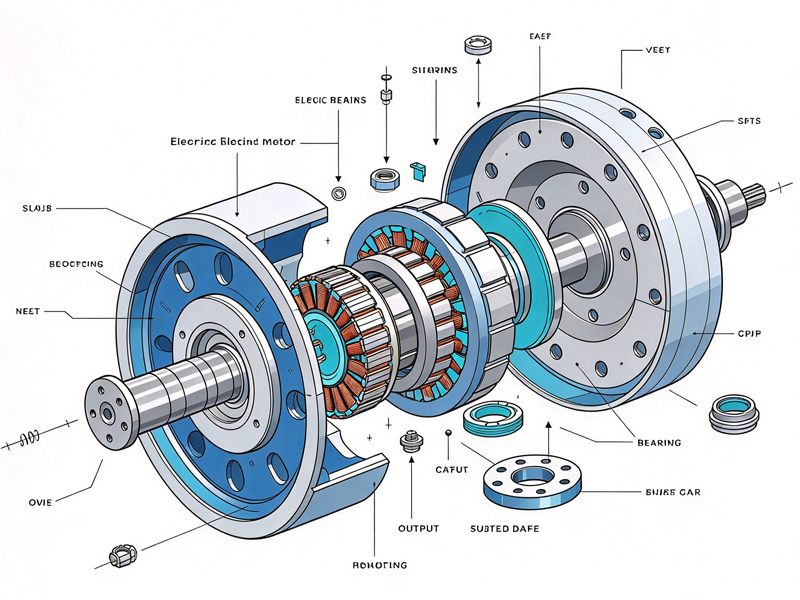
In a typical electric wheelchair hub motor, the main components include:
The motor generates rotational force inside the wheel itself. This eliminates many external mechanical transmission components and allows the motor to transfer torque directly to the wheel.
A double bearing hub motor uses two bearings to support the rotating assembly. The exact bearing arrangement varies according to the motor’s mechanical design, but the basic purpose is straightforward: distribute mechanical loads more effectively and keep the rotating parts properly aligned.
This becomes especially important in an electric wheelchair because the motor is not simply spinning a lightweight wheel.
It is supporting and driving a complete mobility system.
Consider what happens when a wheelchair moves over an uneven sidewalk. The wheel may experience vertical impact, side loads, vibration, and changes in traction within a very short period. When the user turns, accelerates, or climbs a ramp, the motor and wheel assembly experience additional forces.
The bearings therefore have a job that goes beyond simply allowing the motor to rotate.
They help maintain the mechanical relationship between the rotating and stationary components.
That is one of the main reasons a double bearing design can be attractive for electric wheelchair applications.
The easiest way to understand the importance of bearings is to think about the wheel itself.
A wheel needs to rotate smoothly while remaining mechanically stable. If the rotating assembly is not adequately supported, the shaft or rotor can experience unwanted movement. Over time, that movement can contribute to vibration, noise, uneven wear, and reduced mechanical efficiency.
A bearing reduces friction between moving components while maintaining the correct position of the rotating assembly.
In a hub motor, bearings can be exposed to several types of mechanical forces, including radial loads and, depending on the design, axial or lateral loads.
A wheelchair motor may encounter these loads when:
A single bearing can support a rotating assembly, but the mechanical load distribution depends heavily on the bearing size, position, shaft design, housing rigidity, and overall motor architecture.
With two properly positioned bearings, the load can be distributed across a wider support structure.
This can improve the stability of the rotor and wheel assembly.
However, it is important to make one point clear:
Two bearings do not automatically make a motor superior.
Bearing quality, bearing spacing, shaft diameter, housing design, sealing, manufacturing tolerances, lubrication, and the expected load are all important.
A poorly designed double bearing system can still perform worse than a well-engineered single-bearing system.
The value comes from the complete mechanical design, not simply from counting bearings.
The difference between single and double bearing hub motors becomes clearer when looking at mechanical stability.
A single-bearing design generally has fewer components and can be simpler to manufacture. Depending on the application, it may also be smaller, lighter, and less expensive.
For relatively light-duty applications, that can be perfectly reasonable.
But electric wheelchairs often require more mechanical support because the motor is directly associated with the driven wheel.
A double bearing configuration can provide several potential advantages.
Better Load Distribution
Two bearings can help distribute the load over the motor structure rather than concentrating mechanical forces around a single support point.
This is particularly useful when the wheel must support a significant portion of the total vehicle weight.
Improved Shaft Stability
Bearing spacing can help reduce unwanted movement of the rotating assembly.
A more stable shaft or rotor arrangement can reduce vibration and help maintain consistent mechanical clearance between internal components.
Better Resistance to Wheel Loads
Wheel motors are exposed to forces that may not be present in a conventional centrally mounted motor.
The motor is physically close to the road surface, and the wheel can experience impacts and lateral forces.
A suitable double bearing structure can be designed to handle these loads more effectively.
Potentially Longer Service Life
When mechanical loads are distributed properly, individual components may experience less concentrated stress.
This can contribute to longer bearing and motor life, although actual durability depends on the complete engineering design and operating conditions.
Smoother Operation
A rigid and properly supported rotating assembly can help reduce unwanted movement and vibration.
For an electric wheelchair, smooth operation is not simply a comfort feature. It can also contribute to a better overall driving experience and more predictable control.
To understand the value of a double bearing structure, it helps to understand how a typical brushless hub motor operates.
Most modern electric wheelchair hub motors use a brushless DC motor, commonly referred to as a BLDC motor.
Instead of mechanical brushes and a commutator, electronic control circuitry switches current through the motor windings.
The stator contains copper windings, while permanent magnets are incorporated into the rotating assembly. When electrical current passes through the windings, a magnetic field is created.
The controller changes the current distribution in sequence, causing the magnetic field to rotate.
The permanent magnets follow this rotating magnetic field, producing mechanical rotation.
In a hub motor, that rotational movement is transferred directly to the wheel.
This direct-drive concept can eliminate several mechanical transmission components.
There is no conventional chain to maintain.
There is no external belt to tension.
There may be no separate gearbox, depending on the motor design.
This simplified drivetrain is one reason hub motors are attractive for mobility equipment.
Electric wheelchairs have very different requirements from electric bicycles or scooters.
A wheelchair needs controlled movement at relatively low speeds, strong starting torque, reliable operation, and predictable response.
Users may need to:
A direct-drive hub motor can provide a relatively simple mechanical path from electrical energy to wheel rotation.
This can reduce the number of mechanical components that require routine maintenance.
Another advantage is packaging.
Because the motor is integrated into the wheel, the overall drivetrain can be designed with fewer external components.
That can help manufacturers create compact mobility systems with a clean mechanical layout.
For powered wheelchairs, this is particularly valuable because space, weight, and maneuverability are often important design considerations.
One common mistake when comparing electric wheelchair motors is to focus too heavily on maximum RPM or maximum vehicle speed.
For wheelchair applications, torque is often more important than top speed.
A motor may have an impressive maximum RPM but still perform poorly when starting under load if it cannot produce sufficient torque.
Imagine a wheelchair user approaching a ramp.
The motor must overcome:
The steeper the ramp and the heavier the total load, the greater the required wheel torque.
This is why electric wheelchair hub motors should be evaluated based on the complete system rather than motor wattage alone.
Rated power is useful, but it should be considered together with:
A well-matched motor and controller can provide much better real-world performance than a larger motor paired with an unsuitable controller.
Wheel size is another factor that is sometimes overlooked.
For a given amount of torque, a larger wheel generally requires more torque at the motor to produce the same tractive force at the ground.
The basic relationship is:
Wheel force = Wheel torque ÷ Wheel radius
This means that if the wheel radius increases, the same torque produces less force at the ground.
For example, suppose a motor produces 50 Nm of wheel torque.
With a smaller wheel, the available force at the ground can be higher than with a larger wheel.
This does not mean smaller wheels are always better.
Larger wheels can provide advantages when traveling over obstacles or uneven surfaces.
The important point is that the motor, wheel diameter, controller, and vehicle weight must be considered as a complete system.
A double bearing hub motor can provide excellent mechanical support, but it still needs to be correctly matched to the wheel and application.
Potentially, yes—but the answer requires some qualification.
The bearings themselves are wear components. Their service life depends on factors such as load, speed, temperature, contamination, lubrication, alignment, and bearing quality.
In an electric wheelchair, the motor may be exposed to:
A good double bearing hub motor should therefore use a mechanical structure that protects the bearings and internal electrical components from the operating environment.
Sealing is especially important.
A motor may have excellent electrical specifications, but poor sealing can allow moisture or contamination to enter the housing.
That can eventually damage bearings, windings, sensors, or other internal components.
For outdoor wheelchair applications, it is worth looking beyond the simple phrase “waterproof motor.”
Manufacturers should consider the actual IP protection rating, sealing construction, cable exit design, connector protection, and environmental testing.
This is one of the most important points when evaluating an electric wheelchair double bearing hub motor.
A motor advertised as “dual bearing” may sound impressive, but buyers should ask more detailed questions.
What bearing is being used?
What is its load rating?
How far apart are the bearings?
How is the shaft supported?
How is preload controlled?
How is contamination prevented?
What temperature range can the bearing handle?
What is the expected service life under the specified load?
These questions are much more meaningful than simply asking whether the motor has one bearing or two.
For manufacturers, bearing selection should be based on the expected load spectrum rather than choosing the cheapest available component.
A high-quality bearing with correct tolerances and proper sealing can have a major impact on motor reliability.
A reliable wheelchair hub motor is the result of several components working together.
The motor should have an appropriate electromagnetic design.
The bearings should be correctly selected and positioned.
The shaft and housing should have sufficient structural strength.
The winding should be designed for the intended voltage and duty cycle.
The magnets should be properly secured.
The controller should be compatible with the motor’s electrical characteristics.
The motor should have adequate thermal management.
The cable and connector system should be protected from environmental damage.
And the entire assembly should be tested under realistic operating conditions.
This is why a motor’s specification sheet should not be judged by one number.
A 500 W motor is not automatically better than a 400 W motor.
A 1000 W motor is not automatically more efficient than a 750 W motor.
And a double bearing motor is not automatically more reliable simply because it has two bearings.
Engineering quality is found in the interaction between all of these elements.
Electrical motors convert electrical energy into mechanical energy, but not all electrical energy becomes useful mechanical output.
Some energy becomes heat.
As motor temperature increases, winding resistance also increases. Excessive temperature can affect insulation, magnets, bearings, and other internal components.
This is particularly important for electric wheelchairs operating on slopes.
Climbing a hill can require significantly more torque than traveling on flat ground. Higher torque often means higher current, and higher current can generate more heat.
A motor that performs well for a few minutes on a flat test track may behave differently during prolonged hill climbing.
Therefore, motor testing should consider real operating conditions rather than only short-duration laboratory measurements.
Manufacturers may evaluate:
These figures provide a much better picture of how the motor will behave in actual wheelchair applications.
Even an excellent hub motor cannot perform properly with an unsuitable controller.
The controller determines how electrical current is delivered to the motor.
It affects acceleration, torque response, speed control, braking, efficiency, and thermal behavior.
For a brushless electric wheelchair motor, the controller may also work with Hall sensors to determine rotor position.
A properly matched controller can provide smoother startup and more predictable low-speed operation.
This is particularly important for wheelchairs because users often operate at very low speeds and require precise control.
A motor designed for high-speed applications may not provide the same driving characteristics as a motor optimized for low-speed torque and mobility applications.
Therefore, when selecting an electric wheelchair hub motor, it is better to evaluate the motor-controller combination instead of treating the motor as an isolated component.
Many BLDC hub motors use Hall-effect sensors.
These sensors provide the controller with information about rotor position.
That information helps the controller determine which windings should be energized.
Hall sensors can be particularly useful at low speeds because sensor-based position feedback provides the controller with a clear indication of rotor position even when the motor is turning slowly.
For electric wheelchairs, low-speed behavior matters a great deal.
A user may need to move slowly through a doorway, approach a table, reverse into a tight space, or make a controlled turn.
Smooth low-speed torque can therefore be more valuable than an impressive maximum-speed specification.
Electric wheelchairs are often used indoors, so noise matters.
A well-designed hub motor can operate relatively quietly compared with some conventional drivetrain arrangements.
However, motor noise is affected by more than the motor itself.
Noise can come from:
A geared hub motor may provide high torque through mechanical reduction, but the gear system can introduce additional noise.
A direct-drive hub motor eliminates the gearbox and can therefore offer a quieter mechanical structure.
That does not mean every direct-drive motor is silent.
Motor winding design, controller settings, bearing quality, wheel construction, and mechanical tolerances still influence the final noise level.
Both direct-drive and geared hub motors can be used in mobility applications.
A direct-drive hub motor generally has a simpler mechanical structure and can provide strong regenerative braking characteristics when supported by the controller.
A geared hub motor uses internal gearing to increase torque at the wheel relative to the motor’s internal operating speed.
The choice depends on the application.
A geared design can provide strong low-speed torque while keeping the electromagnetic motor operating at a higher speed.
A direct-drive motor can offer mechanical simplicity, low maintenance, and smooth operation.
For an electric wheelchair, the best choice depends on factors such as:
| Requirement | Direct Drive | Geared Hub Motor |
|---|---|---|
| Mechanical simplicity | Excellent | Moderate |
| Low-speed torque | Depends on motor size | Generally strong |
| Noise | Generally low | Can be higher |
| Gear maintenance | None | Required |
| Weight | Can be higher | Often lower |
| Efficiency | Strong in suitable conditions | Strong in suitable conditions |
| Durability | High with good design | Depends on gear quality |
| Compact packaging | Good | Good |
Neither design is universally better.
The application determines the right solution.
Before selecting a motor, start with the actual requirements of the wheelchair.
Ask these questions:
What is the total vehicle weight?
Include the wheelchair, battery, user, accessories, and typical cargo.
What terrain will it encounter?
Indoor floors and flat sidewalks are very different from steep ramps, grass, gravel, and uneven outdoor pavement.
What wheel diameter is required?
Wheel size affects both ground clearance and required torque.
What voltage does the system use?
Common electric wheelchair systems may use battery packs with different nominal voltages, so motor and controller compatibility is essential.
What speed is actually required?
Do not choose a motor simply because it offers the highest RPM.
What grade must the wheelchair climb?
Hill-climbing requirements can have a major effect on motor selection.
How frequently will the motor operate?
Occasional use and continuous commercial mobility applications place different demands on thermal management and durability.
Will the wheelchair be used outdoors?
If so, environmental protection should be considered carefully.
For OEMs and wheelchair manufacturers, purchasing a motor should involve more than requesting a price list.
A good supplier should be able to provide technical information about:
It is also useful to ask whether the motor can be customized.
Different wheelchair platforms may require different axle dimensions, wheel sizes, mounting patterns, cable exits, connectors, or controller settings.
A supplier with genuine engineering capability should be able to discuss these requirements rather than simply offering a standard motor.
Electric wheelchair manufacturers rarely have identical mechanical designs.
One model may require a compact motor for indoor use.
Another may need a higher-torque motor for outdoor terrain.
A heavy-duty wheelchair may require larger bearings and a stronger axle structure.
A lightweight folding wheelchair may prioritize low weight and compact dimensions.
This is where a customizable double bearing hub motor can become useful.
Possible customization options may include:
However, customization should always be based on engineering requirements rather than marketing preferences.
Increasing motor power without upgrading the controller, battery, thermal system, or mechanical structure can create new problems.
One common misconception is that adding a second bearing automatically doubles the durability.
It does not.
The second bearing can improve load support and mechanical stability, but the actual lifespan depends on the entire mechanical system.
Another misconception is that a higher wattage motor always provides better performance.
Again, not necessarily.
A motor with high rated power but poor low-speed torque characteristics may not be ideal for a wheelchair.
Another misunderstanding is that hub motors require no maintenance.
Compared with chain or belt systems, hub motors can require less routine drivetrain maintenance, but they are still mechanical and electrical devices.
Bearings, tires, connectors, cables, seals, sensors, and electronic controllers can all eventually require inspection or replacement.
Proper maintenance can significantly improve the useful life of a hub motor.
Keep the wheel and motor housing clean.
Inspect the cable regularly, especially near the axle where repeated movement can cause mechanical stress.
Check for unusual vibration.
Listen for new grinding, clicking, or bearing noise.
Pay attention to changes in acceleration.
If the wheel develops noticeable side-to-side play, investigate the mechanical assembly rather than continuing to operate it indefinitely.
Avoid unnecessary exposure to deep water unless the motor is specifically designed and rated for that environment.
If a motor becomes significantly hotter than usual under normal operating conditions, stop and investigate the cause.
These simple observations can help identify problems before they become expensive failures.
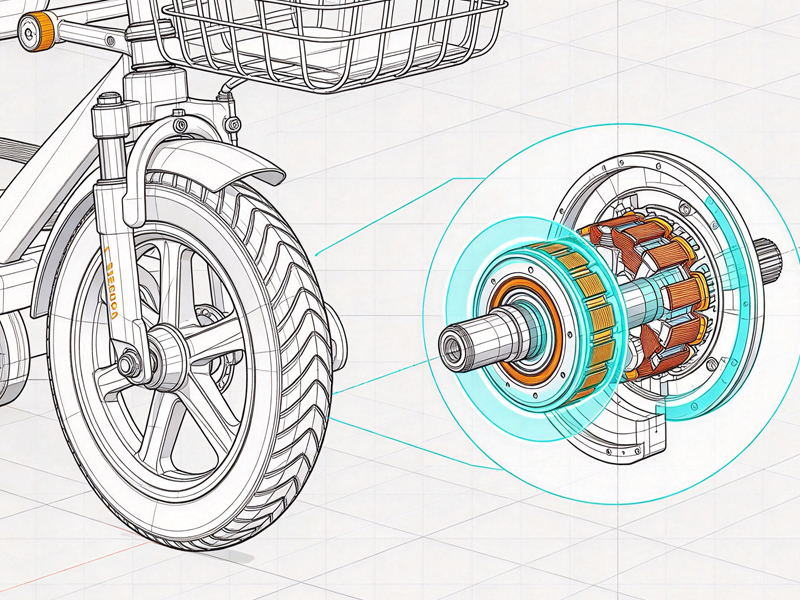
An electric wheelchair double bearing hub motor is more than a motor with an extra bearing.
It represents a mechanical approach designed to provide stronger support for the rotating wheel assembly and improve stability under real-world loads.
For wheelchair applications, that can be particularly valuable because the motor must deal with much more than simple rotation. It must cope with the weight of the vehicle and user, uneven surfaces, repeated acceleration and braking, lateral forces, ramps, vibration, and long operating cycles.
A good double bearing hub motor can offer:
Better mechanical support → improved stability → smoother operation → potentially greater durability.
But the bearing arrangement is only one part of the equation.
The best electric wheelchair motor is the one that matches the complete system: motor, bearings, wheel, controller, battery, chassis, user load, terrain, and duty cycle.
When choosing a motor, do not ask only, “How many watts does it have?”
Ask the more useful questions:
How much torque does it produce?
How does it behave under continuous load?
How well are the bearings and axle supported?
Is the controller properly matched?
Can the motor handle the terrain and operating environment?
What testing supports the claimed performance?
Those questions lead to better purchasing decisions and, ultimately, better mobility products.
For wheelchair manufacturers and mobility equipment companies, a well-engineered double bearing hub motor can be a practical foundation for building a quieter, smoother, more durable, and more reliable electric drive system.
The most important thing is not simply choosing a motor that looks powerful on a specification sheet.
It is choosing a motor that continues to perform when the wheelchair leaves the test bench and enters the real world.
The main advantage is improved mechanical support for the rotating wheel and motor assembly. Two properly positioned bearings can distribute loads more effectively, reduce unwanted shaft movement, and improve mechanical stability. This can contribute to smoother operation and potentially longer service life, especially when the wheelchair operates under significant loads or on uneven terrain.
However, bearing count alone does not determine motor quality. Bearing type, size, spacing, shaft design, housing strength, sealing, manufacturing tolerances, and overall motor engineering are equally important.
Not automatically.
A double bearing design can be advantageous when the motor needs to handle substantial radial or lateral loads, but a well-engineered single-bearing system may still perform very well in a suitable application.
For an electric wheelchair, the better choice depends on total load, wheel size, terrain, motor torque, duty cycle, and mechanical design.
If durability and heavy-load operation are priorities, a properly engineered double bearing configuration is often worth considering.
Start with the complete vehicle requirements rather than choosing based only on wattage.
Consider total vehicle and user weight, wheel diameter, required speed, maximum gradient, battery voltage, controller current, terrain, operating hours, and environmental conditions.
Then compare the motor’s rated torque, peak torque, efficiency, thermal performance, bearing structure, IP protection, axle dimensions, and controller compatibility.
For OEM applications, it is also worth discussing customization with the motor manufacturer. A properly matched motor-controller-wheel combination will generally provide better real-world performance than simply selecting the motor with the highest advertised power.