Our Location
Free Trade Tower, Xiyong street.
Chongqing, China

Free Trade Tower, Xiyong street.
Chongqing, China
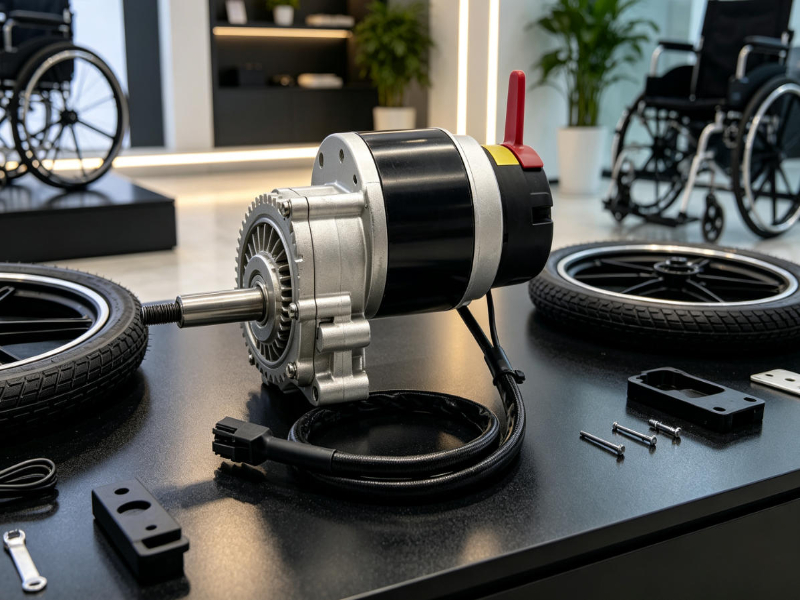
When people compare electric wheelchairs, they often look first at battery range, seat comfort, folding size, or maximum speed. The drive motor is usually buried somewhere in the specification sheet, even though it is one of the components that most directly determines how the wheelchair feels in real use. A motor that is poorly matched to the chair can leave a user struggling on ramps, losing speed under load, consuming the battery quickly, or experiencing an uncomfortable start-and-stop driving experience.
Choosing the right motor is therefore not simply a matter of selecting the highest wattage available. A suitable electric wheelchair drive motor needs to work as part of a complete system that includes the battery, controller, gearbox, wheels, brakes, frame and the user’s typical environment. A lightweight indoor wheelchair has very different requirements from a heavy-duty outdoor power chair designed for grass, slopes and uneven ground. In the same way, a compact travel wheelchair prioritises efficiency and portability, while an all-terrain model needs considerably more low-speed torque and thermal capacity.
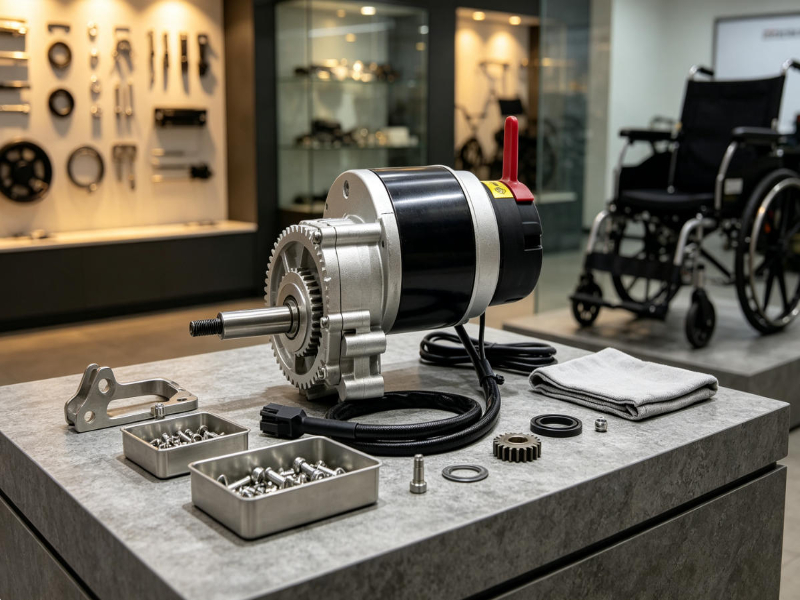
Modern electric wheelchairs commonly use DC geared motors, either brushed or brushless. The gearbox is particularly important because a wheelchair needs controlled, high torque at relatively low wheel speeds rather than the high rotational speed produced by a motor alone. Industry motor suppliers similarly emphasise the importance of combining the motor with appropriate gearing when high torque and dependable mobility are required.
The real question, then, is not “Which electric wheelchair motor is the most powerful?” It is “Which motor is correctly matched to the wheelchair, user and environment?”
One of the most common mistakes when choosing an electric wheelchair drive motor is looking at the motor as an independent component. In reality, its performance depends heavily on the rest of the wheelchair.
Consider two chairs. The first is a lightweight folding power wheelchair used mainly inside an apartment, shopping centre and paved streets. The second is a heavy-duty electric wheelchair used outdoors on grass, ramps and uneven paths. Installing the same motor on both chairs would not necessarily produce the same result.
The first chair benefits from a compact, efficient drive system that provides smooth acceleration, easy manoeuvring and reasonable battery consumption. The second requires greater torque, stronger thermal performance and a drivetrain capable of moving a heavier combined load over more demanding surfaces.
This is why motor selection should begin with a simple question:
What does the wheelchair need to do every day?
A useful evaluation should include the user’s weight, wheelchair weight, battery weight, expected load, terrain, slope, travel distance, desired speed and frequency of operation. IyasoMed’s own buying guidance similarly recommends considering user weight, environment, range and portability when selecting an electric wheelchair.
For manufacturers and B2B buyers, the calculation becomes even more important because a motor specification must remain suitable across the intended production configuration rather than merely performing well in a showroom demonstration.
A motor specification sheet can contain dozens of numbers, but several deserve particular attention.
1. Motor Power
Motor power is normally expressed in watts. It provides a useful indication of the motor’s energy output, but wattage alone does not tell you how well a wheelchair will climb a slope.
For example, two motors may have similar rated power but different gear ratios, torque characteristics and efficiency. The motor with the higher nominal wattage is not automatically the better choice.
For a compact daily-use wheelchair, a relatively modest motor can be sufficient. A heavier outdoor chair may require a substantially stronger drive system. Some current wheelchair configurations use dual 200 W motors, while other applications employ higher-output systems depending on the chair’s weight and intended terrain. For example, the IyasoMed YSE303 standing wheelchair is specified with 200 W motors and a 24 V battery system.
The important point is to evaluate power together with torque, gearing and total vehicle weight.
2. Torque
For many wheelchair applications, torque is more meaningful than maximum wattage.
Torque is the rotational force available at the drive wheel. It is what helps a wheelchair start from rest, climb a ramp, move over grass and overcome resistance from a heavier load.
A wheelchair designed for flat indoor floors does not need the same torque as a chair intended for steep driveways or rough outdoor terrain.
This is also why geared motors are so common in mobility equipment. Gear reduction converts the motor’s relatively high rotational speed into a slower output with greater torque.
If you are comparing motors for an electric wheelchair drive motor application, ask the manufacturer for the torque and operating conditions rather than judging the product only by its wattage.
The two most familiar choices are brushed DC motors and brushless DC motors, commonly known as BLDC motors.
A brushed motor uses carbon brushes and a mechanical commutator to transfer electrical current. The design is relatively straightforward, generally cost-effective and easy to control. Its main disadvantage is mechanical wear because the brushes and commutator operate through physical contact.
A brushless motor removes those mechanical brushes and uses electronic commutation. The result can be lower mechanical wear, quieter operation and higher efficiency, although the electronic control system is more sophisticated and the initial system cost can be higher. Current wheelchair motor references describe both technologies as viable, with brushless systems increasingly used where efficiency, low noise and long service life are priorities.
| Feature | Brushed Motor | Brushless Motor |
|---|---|---|
| Initial cost | Usually lower | Usually higher |
| Mechanical wear | Higher | Lower |
| Noise | Generally higher | Generally lower |
| Efficiency | Good | Typically higher |
| Maintenance | Brush maintenance may be required | Less mechanical maintenance |
| Control system | Simpler | More sophisticated |
| Suitable applications | Cost-sensitive, traditional designs | Premium, lightweight and long-use applications |
This does not mean that every electric wheelchair should use a brushless motor. A well-designed brushed motor can still be an appropriate solution when price, simplicity and serviceability are important. Conversely, a brushless system can be particularly attractive for lightweight travel chairs and premium mobility products where efficiency, quiet operation and reduced mechanical wear matter.
The correct decision depends on the product’s positioning rather than marketing claims.
A common misconception is that a powerful motor should rotate the wheelchair wheel directly. In practice, electric wheelchair drive systems often rely on a gearbox.
Imagine a motor spinning quickly but producing relatively limited torque. A reduction gearbox lowers the output speed while multiplying torque at the drive wheel. This creates the slow, controlled and powerful movement expected from a wheelchair.
That characteristic is essential when starting on an incline.
A wheelchair does not need to accelerate like an electric scooter. It needs to move predictably, maintain traction and provide sufficient force without excessive current draw or overheating.
The gearbox also influences maximum speed, climbing performance and overall efficiency. Therefore, when specifying an electric wheelchair drive motor, it is better to evaluate the motor and gearbox as a complete drive unit rather than purchasing the motor independently.
For B2B buyers, this is especially important. Ask for the motor’s rated output, gearbox ratio, output speed, torque, mounting configuration and compatibility with the controller and electromagnetic brake.
The same wheelchair can behave very differently on different surfaces.
Indoor Mobility
For indoor use, smoothness and manoeuvrability are usually more important than extreme power. The wheelchair may need to navigate narrow corridors, bedrooms, lifts and dining areas.
A compact motor with good low-speed control can be more useful than a very powerful system. Excessive power may add unnecessary weight and increase energy consumption without providing meaningful benefits in a flat environment.
Urban and Everyday Outdoor Use
For paved roads, shopping centres, sidewalks and moderate ramps, the motor should provide consistent acceleration and enough torque for normal inclines.
At this level, battery efficiency becomes increasingly important. A motor that consumes excessive current can reduce practical range even when the battery itself has a reasonable capacity.
Grass and Uneven Ground
Grass introduces rolling resistance that is significantly different from smooth flooring. Loose surfaces and uneven paths can also require greater torque.
For outdoor users, a geared motor with stronger low-speed performance is usually more appropriate. Wheel size, tyre design and suspension also become important because the motor cannot compensate for a poorly matched chassis.
Rough Terrain
All-terrain applications require an entirely different mindset. The motor must work together with larger wheels, suitable tyres, stronger frames and an appropriate controller.
The objective is not simply higher speed. It is controlled torque under changing loads.
A motor that performs well on flat pavement may struggle when the chair encounters loose soil, grass, inclines or repeated obstacles. Heavy-duty wheelchair designs therefore need the entire drivetrain to be engineered for sustained loads rather than relying on peak motor power alone.
A powerful electric wheelchair drive motor is only useful if the battery and controller can supply the required electrical energy.
Most modern electric wheelchairs use battery systems designed around the motor and controller combination. The motor draws current from the battery, while the controller regulates acceleration, direction and braking.
If the motor requires more current than the battery or controller can reliably provide, performance can suffer. The opposite problem can also occur: an oversized motor may add unnecessary weight and cost without delivering a practical improvement for the intended user.
This is why motor, controller and battery should be treated as one electrical system.
For example, the YSE303 electric standing wheelchair uses a 24 V battery configuration with dual 200 W motors and is specified for a claimed driving range of 30–40 km and a maximum speed of 8 km/h. The example demonstrates why motor specifications should always be considered together with battery voltage, capacity, controller settings and the rest of the wheelchair architecture.
Motor performance is not only about what happens during the first few minutes of operation.
A wheelchair may need to climb a long ramp, carry a heavier user or travel outdoors for an extended period. During these situations, the motor can operate under substantial load and generate heat.
Repeated high-current operation can increase motor temperature and reduce efficiency. If the motor is consistently undersized for the application, the problem becomes more serious.
A suitable motor should therefore have enough capacity for the real operating load, not simply the ideal laboratory condition.
For manufacturers, continuous-duty performance is especially important. A motor that looks impressive on a specification sheet but performs poorly after sustained use can lead to customer complaints, warranty costs and reduced product reputation.
Even a high-quality motor can feel poor if it is paired with an unsuitable controller.
The controller determines how the motor responds to joystick commands. Good calibration provides smooth acceleration, controlled deceleration and predictable turning.
This matters particularly for elderly users and people with limited hand strength or coordination. A wheelchair that suddenly accelerates when the joystick is moved slightly can feel uncomfortable and difficult to control.
A well-matched controller can make the same motor feel considerably smoother.
This is also why differential drive is widely used in power wheelchair designs. Two independently driven wheels can provide precise control and allow the wheelchair to turn within a small space.
For indoor mobility, this can be a major advantage because the user may need to turn around tables, beds or narrow corridors.
Motor selection should never be separated from braking.
Many powered wheelchair systems use electromagnetic braking integrated with the motor and gearbox. When the drive system is correctly configured, the brake can help keep the chair stationary when power is removed.
This is especially important on slopes.
The motor, controller and brake therefore need to be compatible. A manufacturer should be able to provide information about the motor’s brake type, voltage, holding capability and controller compatibility.
A high-powered motor paired with an inappropriate braking system is not a good mobility solution. Performance and safety must be designed together.
A practical way to select the motor is to start with the intended wheelchair category.
| Application | Main Motor Priorities |
|---|---|
| Indoor wheelchair | Smooth control, compact size, efficiency |
| Travel wheelchair | Low weight, efficiency, quiet operation |
| Daily outdoor wheelchair | Balanced torque, reliability, battery efficiency |
| Heavy-duty wheelchair | High torque, thermal capacity, load handling |
| All-terrain wheelchair | High torque, strong gearbox, durability |
| Standing wheelchair | Stable torque, precise control, braking compatibility |
| Rehabilitation wheelchair | Smooth acceleration, reliability, low-speed control |
This approach is much more useful than simply asking whether a motor is “strong enough.”
For example, IyasoMed’s current electric wheelchair range includes lightweight carbon-fibre models, reclining chairs, standing wheelchairs and more rugged outdoor designs, illustrating how different mobility requirements lead to different drivetrain configurations.
For distributors, importers and OEM buyers, choosing an electric wheelchair drive motor involves more than technical performance.
A reliable supplier should be able to explain:
Motor configuration: brushed or brushless, rated power and voltage.
Gearbox: reduction ratio, output speed and torque.
Brake: electromagnetic brake configuration and compatibility.
Controller: rated current, programming options and communication with the motor system.
Battery: voltage, capacity and expected operating range.
Mechanical interface: mounting dimensions, shaft size and wheel compatibility.
Testing: load testing, slope testing, endurance testing and electrical safety testing.
After-sales support: spare motors, controllers, brakes and technical documentation.
For an OEM project, these details become especially important because changing the motor after production has started can affect the entire electrical and mechanical system.
A professional wheelchair manufacturer should therefore evaluate the complete drive architecture rather than treating the motor as a low-cost interchangeable component.
More power sounds attractive, but excessive motor capacity can create its own problems.
A larger motor may increase weight. A heavier motor can require a stronger frame. A stronger frame can increase total vehicle weight. The heavier wheelchair then requires more battery energy, which can reduce the benefit of the original motor upgrade.
This creates a chain reaction.
For a lightweight travel wheelchair, a compact and efficient motor may therefore provide a better overall result than a much larger motor. For a heavy-duty outdoor chair, however, investing in additional torque and thermal capacity can be entirely justified.
The best motor is consequently the one that provides sufficient performance with the right balance of weight, efficiency, reliability and cost.
If you are comparing electric wheelchairs or sourcing components for a mobility product, use this sequence rather than starting with motor wattage:
Step 1 — Define the user.
Determine approximate user weight, mobility requirements and whether the chair will be used independently or with caregiver assistance.
Step 2 — Define the terrain.
Identify whether the chair will mainly operate indoors, on pavement, on ramps, on grass or across rough terrain.
Step 3 — Define the total load.
Include the user, frame, battery, accessories and other equipment rather than considering user weight alone.
Step 4 — Determine the required torque.
Look at climbing and starting requirements rather than maximum speed alone.
Step 5 — Select brushed or brushless technology.
Choose according to price, efficiency, noise, maintenance requirements and intended market.
Step 6 — Match the gearbox.
Check reduction ratio, output speed and torque.
Step 7 — Match the battery and controller.
Make sure the electrical system can support the motor under real operating conditions.
Step 8 — Check braking and safety.
The motor, electromagnetic brake and controller must operate as a coordinated system.
Step 9 — Test the complete wheelchair.
The final judgement should come from real-world testing rather than an isolated motor specification.
An electric wheelchair drive motor may be hidden beneath the seat, but its influence can be felt every time the chair starts, turns, climbs a ramp or travels across an uneven surface.
The right motor should provide enough torque without unnecessary weight, enough power without excessive battery consumption, and enough durability to handle the user’s actual routine. Brushed motors remain practical for cost-sensitive and straightforward applications, while brushless systems can offer advantages in efficiency, noise and long-term mechanical wear. Neither technology is universally superior; the correct choice depends on the wheelchair’s intended purpose.
For premium and professional mobility equipment, the motor should also be evaluated together with the gearbox, controller, battery, braking system and chassis. A well-designed drive system is not simply powerful. It is predictable, efficient, durable and matched to the person sitting in the chair.
For buyers looking for complete electric wheelchair solutions rather than isolated components, IyasoMed’s electric wheelchair range offers different configurations designed around portability, comfort, outdoor mobility and specialised functions. Current IyasoMed guidance also highlights drive performance, battery range, seating, portability and safety as interconnected factors when evaluating a power wheelchair.
Ultimately, the best electric wheelchair drive motor is not the one with the biggest number on the specification sheet. It is the motor that delivers the right combination of torque, efficiency, control and reliability for the person, wheelchair and environment it has been designed to serve.
1. What is the most important specification when choosing an electric wheelchair drive motor?
Torque is one of the most important specifications because it directly influences starting performance, hill climbing and the ability to move a heavier load. However, torque should always be evaluated together with motor power, gearbox ratio, battery, controller and total wheelchair weight.
2. Is a brushless motor better than a brushed motor for an electric wheelchair?
Not in every application. Brushless motors generally offer lower mechanical wear, quiet operation and good efficiency, making them attractive for premium and lightweight electric wheelchairs. Brushed motors can be a practical choice where lower cost, simple control and straightforward servicing are more important. The best choice depends on the wheelchair’s intended use and target market.
Do not judge the motor only by wattage. Check the wheelchair’s total load, required climbing ability, terrain, gearbox ratio, output torque, battery and controller specifications. A properly matched motor should maintain controlled performance under the chair’s expected real-world conditions without excessive overheating or battery drain.