Our Location
Free Trade Tower, Xiyong street.
Chongqing, China

Free Trade Tower, Xiyong street.
Chongqing, China
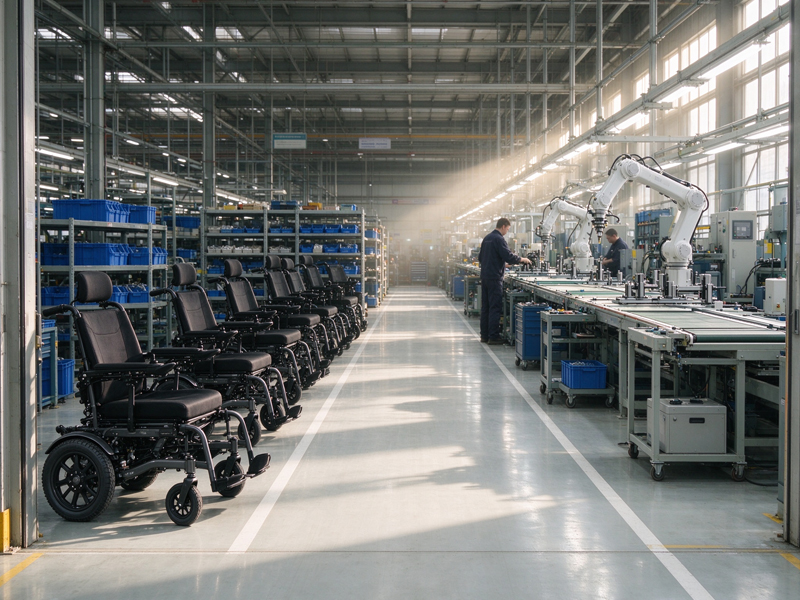
If you are sourcing a wheelchair joystick controller manufacturer in China, price is probably one of the first things you will compare. But it should not be the only one.
A joystick controller may look like a relatively simple component, yet it plays a critical role in a powered wheelchair. The joystick is the user’s primary interface with the wheelchair. Every movement—forward, backward, turning, acceleration, and stopping—has to be translated into a precise electrical signal and then processed by the controller.
That is why choosing the right supplier involves much more than comparing quotations.
For wheelchair manufacturers, medical equipment brands, distributors, and OEM buyers, factors such as controller compatibility, motor matching, braking control, customization, production consistency, technical support, and long-term spare-parts availability can have a much bigger impact on the final product.
China has developed a broad supply chain for powered wheelchair electronics. Some companies focus on complete wheelchair control systems, while others specialize in joystick assemblies, Hall-effect joysticks, motor controllers, or complete electric wheelchair OEM solutions.
Based on publicly available company and product information, the following 10 Chinese manufacturers and suppliers are worth considering when researching the wheelchair joystick controller market in China.
Shanghai Micon Mechanical & Electrical Co., Ltd. is one of the Chinese companies worth looking at when sourcing complete control systems for powered wheelchairs and mobility scooters.
Founded in 2002, Micon focuses on the development and manufacturing of control systems for electric wheelchairs and mobility scooters. According to its public company information, the company operates a production facility in Shanghai and has an annual production capacity of more than 300,000 sets of control systems.
One of the advantages of working with a control-system specialist is that the supplier understands the relationship between the joystick, controller, motor, electromagnetic brake, and battery system.
For an OEM customer, this can be more useful than purchasing a joystick as an isolated component.
A powered wheelchair controller needs to respond smoothly at low speeds, provide reliable braking, handle changes in load, and work consistently with the selected motor. These requirements become especially important when the wheelchair is designed for elderly users or people with limited hand movement.
Micon is therefore worth considering for projects involving:
For buyers who want more than a basic joystick, a supplier with complete system experience can simplify the development process considerably.
Zhejiang Shiyou Drive Technology, commonly known as SYDRIVE, is another Chinese manufacturer to consider when looking for advanced electric wheelchair drive and control technology.
Its product range includes electric wheelchair control systems, joystick controllers, motor drives, and mobility scooter controllers.
What makes SYDRIVE interesting for OEM projects is its focus on the relationship between the motor and the controller rather than treating the joystick as a standalone component.
Modern powered wheelchairs increasingly use brushless motors and more sophisticated motor-control algorithms. Smooth starting, low-speed control, braking, hill performance, and maneuverability can all be affected by the quality of the control system.
Public information about SYDRIVE’s wheelchair systems describes technologies such as sinusoidal vector control and brushless motor control. The company is also associated with JIECANG, a major Chinese manufacturer of motion systems.
For wheelchair brands developing new products, this type of supplier can be particularly relevant when the project requires:
Rather than asking only for a joystick price, OEM buyers should ask whether the supplier can provide a complete motor + controller + joystick solution.
Nanjing Yuanlang Electronic Technology Development Co., Ltd. is another Chinese supplier involved in electric wheelchair products and control systems.
Public supplier information lists products including electric wheelchair joystick controllers, wheelchair motors, and complete electric wheelchair solutions. The company has also promoted its products to overseas markets.
One thing that makes a supplier such as Yuanlang relevant to international buyers is the ability to provide more than one component.
A wheelchair controller cannot be evaluated independently from the motor and braking system. For example, a controller may work perfectly with one 24V motor but perform poorly when connected to a different motor with different current requirements or Hall-sensor characteristics.
This is why OEM buyers should ask suppliers to confirm:
Which motors are compatible with the controller?
What battery voltage is required?
Does the controller support electromagnetic brakes?
Can acceleration and braking parameters be adjusted?
These questions can reveal much more about a manufacturer’s technical capabilities than a product catalog alone.
Yuanlang can be considered by buyers looking for a supplier covering wheelchair electronics and related components rather than just a joystick assembly.
Golden Motor is a well-known Chinese supplier of electric motors and motor-control systems, and its product portfolio also includes wheelchair drive solutions.
The company publicly lists wheelchair joystick controllers, including controllers designed for brushed and brushless wheelchair motors.
Its IM-50A wheelchair joystick controller, for example, is designed for brushed motor applications and includes functions such as speed adjustment, regenerative braking, and parking-brake detection.
Golden Motor’s product range is particularly interesting for buyers who are developing or modifying powered wheelchair drive systems.
Instead of sourcing every component from a different company, an OEM or conversion-kit manufacturer may be able to source:
from the same supplier.
This can reduce compatibility problems during development.
For example, if the motor supplier already understands the controller’s current requirements and braking characteristics, the engineering team does not have to spend as much time testing combinations from unrelated manufacturers.
Golden Motor is therefore particularly relevant for electric wheelchair conversion projects and OEM applications involving both motors and controllers.
Guangzhou Topmedi is a Chinese medical rehabilitation equipment company with a broad product range covering wheelchairs, mobility scooters, patient lifts, hospital equipment, and related products.
Unlike a company focused only on electronic components, Topmedi has experience with complete powered wheelchair products.
Its product range includes several wheelchair joystick controller models, including the TEW-C05 wheelchair joystick controller and other electric wheelchair controller products.
This makes Topmedi an interesting option for buyers who want to source both complete wheelchairs and replacement components.
The company also markets its products internationally, which can be useful for overseas distributors and medical equipment importers.
For B2B customers, a supplier with experience in complete wheelchairs can offer an important advantage: the controller is being considered in the context of the entire vehicle.
That means the supplier can potentially address questions involving:
Topmedi may therefore be suitable for distributors who need both finished powered wheelchairs and related spare parts.
However, buyers should always verify the exact certification and compliance status of the specific controller model they intend to import.
Shanghai Chengong Electrical Control Technology is a different type of supplier.
Rather than focusing primarily on complete electric wheelchairs, Chengong has a stronger emphasis on electronic joystick technology and control handles.
The company has publicized joystick products for applications including electric wheelchairs, with product categories covering fingertip joysticks and multi-axis control handles.
This distinction is important.
There is a big difference between purchasing a complete wheelchair control system and purchasing a customized joystick input device.
If your engineering team already has its own controller but needs a customized user interface, a joystick specialist may be more appropriate than a complete wheelchair manufacturer.
Potential applications include:
For rehabilitation equipment companies developing specialized wheelchair interfaces, this type of supplier can provide more flexibility.
The important point is to clearly define whether you need a joystick only or a complete joystick controller system before requesting quotations.
Yueqing Omter Electronic & Technology is based in Zhejiang, one of China’s major manufacturing centers for electrical and electronic components.
The company’s public product information includes joystick products designed for powered wheelchair applications.
One example is the OM902 power wheelchair joystick controller, which uses Hall-effect joystick technology and provides three-axis control.
Hall-effect technology is commonly used in modern joystick systems because it can provide contactless position sensing and avoid some of the mechanical wear associated with traditional potentiometer-based designs.
For wheelchair applications, joystick consistency matters.
The user should be able to move the joystick slightly and receive a predictable response from the wheelchair. If the signal is unstable or the mechanical return position changes over time, the user experience can deteriorate significantly.
Omter may therefore be worth considering for buyers who are primarily looking for joystick hardware rather than a complete motor-control package.
For engineering teams, the key specifications to request include:
These specifications are often more important than the appearance of the joystick itself.
Zhejiang Huiren Electronics is another Chinese supplier with wheelchair joystick products available through international B2B channels.
Public product listings include models such as the SJ600 three-axis joystick for power wheelchairs and thumb-control joystick products.
Huiren is worth mentioning because wheelchair joystick requirements can vary considerably depending on the end user.
A standard joystick mounted on an armrest may be perfectly suitable for one wheelchair design. However, users with limited hand strength or restricted finger movement may require a different control method.
This is where specialized joystick manufacturers can become valuable.
Depending on the project, an OEM may need:
For international buyers, it is also worth requesting sample units before committing to a large production order.
A joystick can look perfectly suitable on paper but feel very different when used on the actual wheelchair.
Human-machine interaction is one of those areas where physical testing is difficult to replace.
Nanjing Gold Camel Intelligent Technology is another supplier appearing in Chinese B2B product listings for electric wheelchair controllers, joysticks, and related wheelchair components.
The company’s product range is more closely connected with complete mobility products rather than joystick components alone.
This type of supplier can be useful for smaller overseas brands.
A startup wheelchair brand may not have an engineering team large enough to independently design the motor, controller, brake, joystick, battery system, and wiring harness.
In such cases, a supplier capable of providing a more complete solution can reduce development time.
For example, instead of purchasing a joystick from one company, a motor from another, and a controller from a third supplier, the buyer can ask whether the manufacturer can supply a tested combination.
This approach can reduce the number of variables during prototype testing.
For smaller orders, it may also simplify communication because one supplier becomes responsible for a larger portion of the system.
Henan Lunyee Industrial Automation Equipment has a broader background in motors, drives, and industrial automation equipment, but its product range also covers electric wheelchair drive components.
Public supplier information includes combinations involving wheelchair motors, controllers, and joysticks.
This makes Lunyee particularly relevant to buyers who are looking for a motor-and-controller package rather than a standalone joystick.
The advantage of this approach is straightforward.
The motor and controller have to work together.
A controller with an impressive maximum-current specification does not automatically make it suitable for every wheelchair motor.
The engineering team still needs to consider:
For this reason, suppliers that understand both motors and controllers can be useful during the early stages of wheelchair development.
The 10 companies above do not all manufacture exactly the same type of product.
That is actually an important point.
The Chinese wheelchair electronics market includes several different supplier categories.
Some companies specialize in complete wheelchair control systems.
Others manufacture joystick assemblies.
Some focus on motors and controllers, while others are primarily wheelchair OEM manufacturers.
So instead of simply searching for the cheapest quotation, start by defining what your project actually needs.
If you need a complete control system
Look for a supplier that can provide:
Joystick + Controller + Motor + Brake
This can make system integration much easier.
If you only need the joystick
Focus on the joystick manufacturer’s technical capabilities.
Important specifications include:
If you are developing an OEM wheelchair
Ask for more than a product catalog.
At minimum, request:
Technical datasheet + wiring diagram + compatibility information + sample + programming information
A supplier that cannot provide basic technical documentation may create problems later during mass production.
One of the most common mistakes made by new wheelchair manufacturers is selecting the joystick and controller separately without considering the complete electrical system.
The basic relationship is:
User → Joystick → Controller → Motor → Wheel
The joystick sends the user’s command.
The controller interprets the command.
The motor produces the movement.
The brake system determines when the wheelchair can safely stop or remain stationary.
The battery supplies the electrical power required by the entire system.
A problem anywhere in this chain can affect the performance of the wheelchair.
For example, a controller may appear to work correctly during a short bench test but behave differently under a heavy load.
The wheelchair might accelerate too aggressively, lose torque on a slope, or respond differently when the battery voltage drops.
That is why a proper compatibility test should ideally include:
This is especially important for products intended for long-term commercial use.
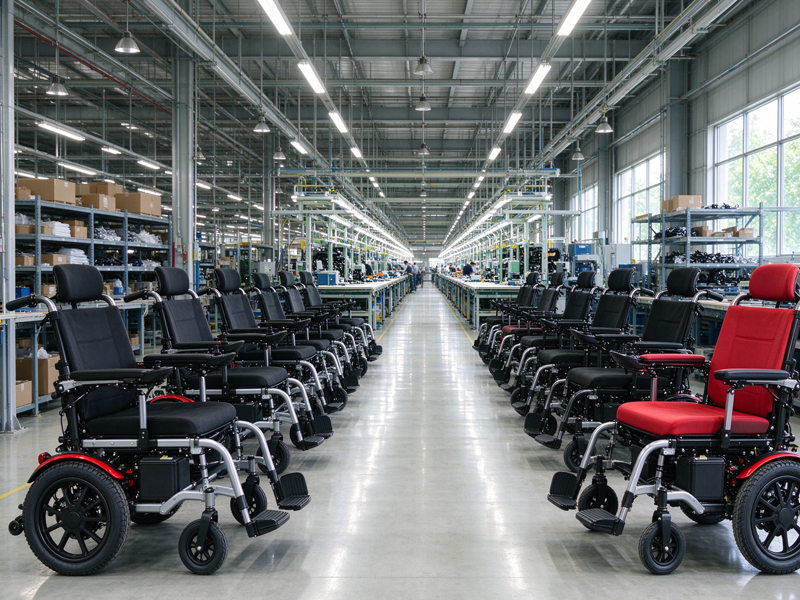
The wheelchair controller market is gradually moving beyond the traditional brushed-motor controller.
Brushless motors, more sophisticated motor-control algorithms, electronic braking, programmable parameters, battery monitoring, fault diagnostics, and smart connectivity are becoming increasingly relevant.
The development of brushless drive systems is particularly important.
For a premium powered wheelchair, users expect the wheelchair to move smoothly rather than simply move quickly.
Low-speed behavior can be more important than maximum speed.
The wheelchair needs to respond predictably when the user makes small joystick movements.
It also needs to handle ramps, tight turns, stopping, and starting without creating unnecessary instability.
This is why modern wheelchair controller development increasingly involves the entire drive system rather than a joystick alone.
For OEM brands, the future purchasing question may therefore be less about:
“How much does this joystick cost?”
and more about:
“Can this supplier provide a reliable and tunable wheelchair drive system?”
That shift is already visible in the development of brushless wheelchair motors and integrated control systems in China.
Before sending a purchase order, ask the supplier the following questions:
1. Is the joystick controller manufactured in-house?
This helps you understand whether you are dealing with a manufacturer, an OEM supplier, or a trading company.
2. Can you provide a complete wiring diagram?
A wiring diagram is essential for integration.
3. Which wheelchair motors are compatible with this controller?
Do not assume compatibility based only on voltage.
4. Does the controller support brushed or brushless motors?
These are different motor-control systems and should not be treated as interchangeable.
5. What is the rated and peak current?
This is important when matching the controller with the motor and wheelchair load.
6. Can acceleration, deceleration, speed and braking parameters be programmed?
Programmability can be particularly useful for OEM applications.
7. Can you provide OEM or ODM customization?
Ask specifically what can be customized rather than accepting a general “yes.”
8. Can you provide samples for testing before mass production?
Always test the actual hardware wherever possible.
1. Can Chinese wheelchair joystick controller manufacturers provide OEM and ODM services?
Yes. However, the level of customization varies significantly between manufacturers.
Some suppliers mainly provide standard joystick controllers with customized packaging, labels, connectors, or minor mechanical changes.
More technically focused manufacturers may be able to customize the joystick housing, PCB, wiring, control parameters, communication interface, and other parts of the system.
Before requesting a quotation, provide the supplier with your basic specifications:
The more information you provide, the more accurate the supplier’s recommendation will be.
2. What is the difference between a wheelchair joystick and a wheelchair joystick controller?
They are related but not necessarily the same component.
A joystick is the user’s input device.
A controller is the electronic system that interprets the joystick signal and controls the motor.
In some powered wheelchair products, the joystick and controller are integrated into one assembly, which is why suppliers may use the term wheelchair joystick controller.
Before purchasing, confirm exactly what is included in the quotation.
Ask whether the supplier is offering:
Joystick only
or
Controller only
or
Joystick + Main Controller
This simple question can prevent misunderstandings during purchasing.
3. How can I choose a reliable wheelchair joystick controller manufacturer in China?
Do not evaluate the supplier based only on price.
A better approach is to examine five areas.
Product capability
Does the company actually manufacture wheelchair controllers or joysticks, or is it simply reselling products from another factory?
Technical documentation
Can the company provide datasheets, wiring diagrams, specifications, and compatibility information?
Testing capability
Can the supplier test the joystick, controller, motor, brake, and battery as a complete system?
Quality and compliance
For products sold in Europe, North America, or other regulated markets, verify the certifications and compliance documentation required for the specific product and destination market.
Do not assume that a factory’s general certification automatically applies to every model.
After-sales support
A good controller supplier should be able to help with troubleshooting, replacement parts, programming, fault codes, and technical questions after the product has entered mass production.
This is often much more valuable than saving a small amount on the initial unit price.
China has developed a mature supply chain for wheelchair joystick controllers, electric wheelchair controllers, motors, joysticks, and complete mobility systems.
The 10 companies discussed in this article—Shanghai Micon, SYDRIVE, Nanjing Yuanlang, Golden Motor, Guangzhou Topmedi, Shanghai Chengong, Omter, Zhejiang Huiren, Nanjing Gold Camel, and Henan Lunyee—represent different segments of that supply chain.
Some are more focused on complete control systems.
Others are stronger in joystick hardware.
Some are suitable for motor-and-controller integration, while others may be more appropriate for complete wheelchair OEM projects.
For overseas buyers, the best sourcing strategy is therefore not simply to search for the cheapest wheelchair joystick controller manufacturer in China.
Instead, define your technical requirements first, test samples, verify compatibility, and evaluate the supplier’s ability to support your product throughout its lifecycle.
A wheelchair joystick is ultimately part of a much larger system.
What matters is not simply whether the joystick moves.
What matters is whether the entire system responds smoothly, accurately, consistently, and safely when the user moves it.
That is the real standard worth applying when choosing a long-term wheelchair controller supplier.